
Calculator
Noise Exposure Calculator
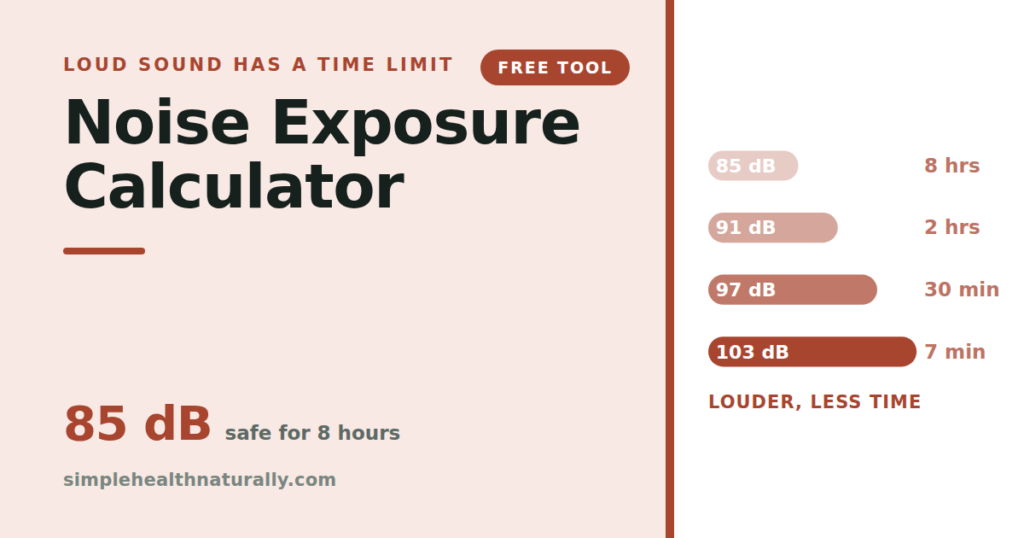
This noise exposure calculator shows the time limit on loud sound, and that limit shortens far faster than most people expect. Every 3 decibels louder halves how long you can safely listen.
A typical day
Applied to your loudest exposure only. Real world protection usually falls well below the number printed on the packet.
The limits behind this
NIOSH sets 85 dB for 8 hours as the recommended ceiling. Safe time halves for every 3 dB above that, so 100 dB allows about 15 minutes and 115 dB allows under 30 seconds.
Which exposure spends it
Safe listening time at each level
- 85 dB8 hours
- 91 dB2 hours
- 94 dB1 hour
- 100 dB15 minutes
- 106 dBunder 4 minutes
- 112 dBunder 1 minute
Estimates only, based on typical decibel levels for each activity. Actual levels vary widely and a sound meter app gives a far better reading. Noise induced hearing loss is permanent and nothing reverses it. Ringing in the ears, muffled hearing after loud sound, or any sudden change in hearing needs prompt medical attention.
Volume has a clock attached to it and almost nobody knows the numbers. At 85 decibels you have eight hours. At 100 decibels, which is roughly where phone headphones sit at maximum, you have fifteen minutes. Noise exposure works on an exponential scale that human intuition handles badly, and this calculator turns your day into a percentage of the daily limit.
Below the tool you get why the scale behaves this way, how loud everyday things actually are, and what protects hearing that never repairs itself.
Why 3 Decibels Matters So Much
Decibels are logarithmic. That single fact explains everything that follows.
An increase of 3 dB doubles the sound energy reaching your ear. Not a small step up. Twice as much.
Because the energy doubles, the safe exposure time halves. NIOSH builds its recommended limits on exactly that relationship, starting from 85 dB for 8 hours.
| Level | Safe time per day |
|---|---|
| 85 dB | 8 hours |
| 88 dB | 4 hours |
| 91 dB | 2 hours |
| 94 dB | 1 hour |
| 97 dB | 30 minutes |
| 100 dB | 15 minutes |
| 103 dB | 8 minutes |
| 106 dB | 4 minutes |
| 112 dB | Under 1 minute |
| 115 dB | About 28 seconds |
Look at the jump from 85 to 100. Fifteen decibels sounds like a modest increase and it cuts your allowance from eight hours to a quarter of an hour.
This is why loudness feels misleading. Something that sounds twice as loud is nowhere near twice the energy, and the damage tracks energy rather than perception.
How Loud Things Actually Are
Approximate levels for common situations.
| Sound | Level |
|---|---|
| Quiet library | 40 dB |
| Normal conversation | 60 dB |
| Vacuum cleaner, busy street | 70 dB |
| Heavy traffic, hair dryer | 80 dB |
| Loud restaurant, city commute | 85 dB |
| Lawnmower, subway platform | 90 dB |
| Motorcycle | 95 dB |
| Headphones near maximum, power tools | 100 dB |
| Nightclub, loud fitness class | 105 dB |
| Concert front section | 110 dB |
| Chainsaw, siren up close | 115 dB |
| Firework at close range, gunshot | 140 dB and above |
Two entries deserve attention.
Headphones near maximum. Most smartphones can output somewhere around 100 to 110 dB. At 100 dB the daily allowance is fifteen minutes, which makes a two hour commute at high volume roughly eight times a full day of exposure.
Anything at 120 dB and above can cause immediate damage rather than cumulative damage. Fireworks, gunshots and sirens at close range fall here, and a single unprotected exposure can permanently change your hearing.
The Comparison That Explains Everything
Run a typical day through the calculator and the result is counterintuitive.
One hour of loud commuting at 85 dB uses about 12 percent of the daily budget.
Forty five minutes of headphones at 100 dB uses about 300 percent.
Same person, same day. The exposure that feels loud contributes almost nothing. The exposure that feels normal, because it is in your ears and under your control, spends twenty five times more.
That inversion is the whole reason this tool is worth using.
Ear Protection Changes the Maths
Protection works better than almost any other intervention, and the numbers are dramatic.
A two hour concert at 105 dB comes to roughly 2,500 percent of a daily dose.
The same concert with 20 dB earplugs drops to about 25 percent.
One accessory, a hundredfold difference.
What the ratings mean. Earplugs and defenders carry a Noise Reduction Rating in dB. Real world protection almost always falls short of the printed figure, because fit is rarely perfect.
Foam plugs need proper insertion. Rolled thin, inserted deep, held while they expand. Loosely placed foam plugs deliver a fraction of their rating.
Musician plugs reduce evenly across frequencies. Standard foam plugs muffle high frequencies more than low ones, which is why music sounds dull through them. Filtered plugs cost more and preserve the sound.
Two layers work. Plugs plus over ear defenders adds roughly 5 dB beyond the better of the two, not the sum of both.
The 60 60 Rule for Headphones
A simple guideline that maps onto the numbers above.
No more than 60 percent volume, for no more than 60 minutes at a time. Then take a break.
Most phones sit around 100 to 110 dB at maximum, so 60 percent lands roughly in the mid 80s where the allowance runs to hours rather than minutes.
Three additions help.
Noise cancelling headphones lower your volume without you deciding to. People turn music up to overcome background noise. Take away the background and the reason goes with it.
Check your phone’s built in warnings. iOS reports headphone audio levels under Health, and Android has similar tracking. Both will tell you where you actually sit.
Over ear beats in ear at the same perceived volume, since in ear designs deliver sound directly to the ear canal.
What Damage Actually Looks Like
Understanding the mechanism explains why it does not heal.
Sound moves tiny hair cells in your inner ear, which convert movement into nerve signals. Loud sound bends them too hard. Repeated or extreme exposure kills them.
Human hair cells do not regenerate. Birds and fish can regrow theirs. Mammals cannot. Whatever is lost is lost permanently.
Early loss is invisible. Damage typically begins in the higher frequencies, around 4 kHz, before affecting speech frequencies. People notice nothing for years while the loss accumulates quietly.
Signs of trouble after loud exposure.
- Ringing, buzzing or hissing in the ears, called tinnitus
- Muffled or dulled hearing
- A feeling of fullness in the ears
- Difficulty following conversation in a noisy room
Temporary muffling and ringing usually resolve within a day or two. That recovery is not harmless. It signals stress in the hair cells, and repeated episodes accumulate into permanent loss.
See a doctor promptly for sudden hearing loss in one or both ears, tinnitus lasting more than a day or two, ear pain after loud sound, or dizziness alongside hearing changes. Sudden sensorineural hearing loss is treatable when caught within the first two weeks and often not afterwards.
Beyond Hearing
Noise affects more than ears, and the research here is more solid than most people expect.
Sleep. Night time noise fragments sleep even when it does not wake you fully. Traffic noise is the most studied source.
Cardiovascular effects. Long term exposure to environmental noise associates with raised blood pressure and higher cardiovascular risk in large population studies. The proposed mechanism runs through chronic stress activation.
Concentration. Background noise degrades performance on tasks requiring sustained attention, particularly speech that you can almost make out.
Our sleep calculator covers bedtime windows and our attention fragmentation tracker covers the interruption side.
Frequently Asked Questions
How loud is too loud?
Above 85 dB with prolonged exposure. Safe time halves for every 3 dB increase, so 100 dB allows about 15 minutes and 115 dB allows under 30 seconds.
How long can I listen to headphones safely?
At around 100 dB, which is near maximum on most phones, about 15 minutes a day. At 60 percent volume most people fall into the mid 80s where hours are fine.
What is the 60 60 rule?
No more than 60 percent volume for no more than 60 minutes at a time, then a break. It is a simple way to stay under the exposure limits.
Do earplugs really help at concerts?
Enormously. A two hour concert at 105 dB is roughly 2,500 percent of a daily dose. With 20 dB plugs it falls to about 25 percent.
Is hearing loss from noise reversible?
No. Human inner ear hair cells do not regenerate. Temporary muffling recovers, and the underlying stress still accumulates toward permanent loss.
Why do my ears ring after a loud night?
Tinnitus after noise exposure signals overstressed hair cells. It usually settles within a day or two, and repeated episodes cause permanent damage.
Does noise cancelling protect hearing?
Indirectly and effectively. It removes the background noise people compete with by turning volume up, so listening levels drop without any conscious decision.
Are apps accurate for measuring noise?
Reasonably for a rough reading. NIOSH published a sound level meter app tested against professional equipment. Phone microphones vary, so treat readings as approximate.
At what level does damage happen instantly?
Around 120 dB and above. Fireworks at close range, gunshots and sirens can cause immediate permanent damage from a single exposure.
Final Thoughts on Noise Exposure
Hearing damage is one of the few common health problems that is entirely preventable and completely irreversible. That combination makes the numbers worth knowing.
Two things matter most. Headphone volume is the exposure most people underestimate, because it feels controlled and comfortable while sitting far above the level that has an eight hour limit. And earplugs at concerts change the arithmetic by a factor of a hundred for the price of a coffee.
Any ringing that lasts more than a day or two, sudden hearing loss, or muffled hearing after loud sound all need a doctor promptly rather than waiting to see whether they settle.
References
- National Institute for Occupational Safety and Health. Occupational Noise Exposure Recommended Exposure Limit. cdc.gov
- National Institute on Deafness and Other Communication Disorders. Noise-Induced Hearing Loss. nidcd.nih.gov
This calculator provides estimates using typical decibel levels for each activity. Actual levels vary widely and a sound level meter gives a far more accurate reading. Noise induced hearing loss is permanent and nothing reverses it. See a doctor promptly for sudden hearing loss, tinnitus lasting more than a day or two, ear pain after loud sound, or dizziness alongside hearing changes. Read our full medical disclaimer and fact checking policy.