
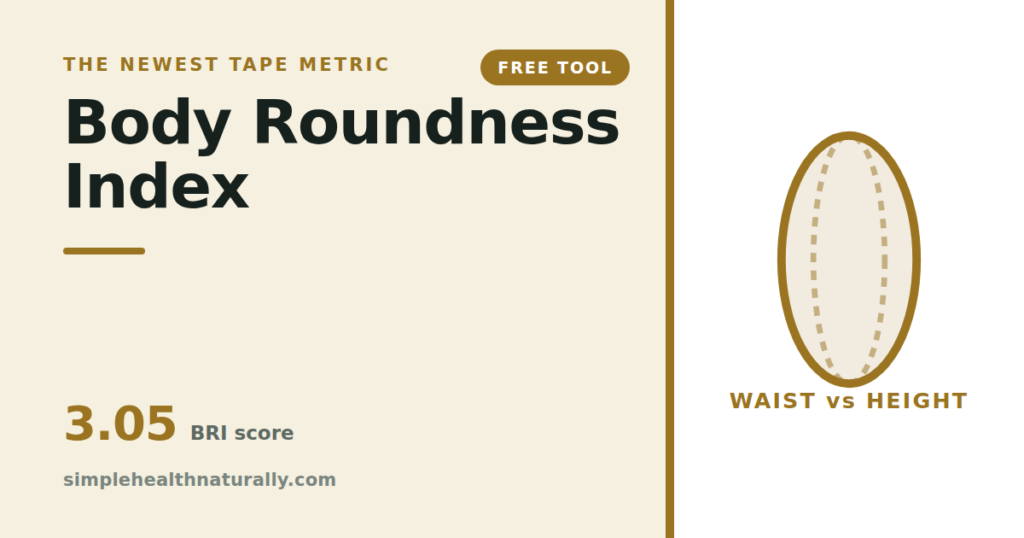
The body roundness index takes your waist and your height and works out how round your body actually is. Not how heavy you are, and not how tall. How close your shape sits to a circle rather than a long thin ellipse.
That sounds like geometry rather than medicine, and it started as exactly that. The calculator below gives you your BRI score, shows where it falls against the US adult population, draws the ellipse your measurements describe, and cross checks the result against the simpler waist to height ratio.
Solid shape is yours. Dashed shape is a body whose waist is just under half its height.
What the Body Roundness Index Measures
Picture your body as an ellipse standing on end. Your height sets how tall that ellipse is. Your waist sets how wide it is. A tall narrow ellipse belongs to someone carrying little around the middle. A shape closer to a circle belongs to someone carrying a lot.
Mathematicians already have a word for how far an ellipse sits from a circle. That word is eccentricity, and the body roundness index rests directly on it. The index runs from about 1 for the narrowest bodies to well past 10 for the roundest.
The point of the exercise is visceral fat. Fat packed around the liver, pancreas and intestines pushes the abdominal wall outward and makes the ellipse rounder, and that deep fat is the kind that drives insulin resistance, fatty liver and heart disease. A tape and a geometric model pick it up without a scan.
The Formula, and Why It Looks So Strange
Diana Thomas and colleagues published the index in 2013 in a paper on the relationships between body roundness, body fat and visceral adipose tissue. The equation looks intimidating and the logic behind it is simple.
BRI = 364.2 minus 365.5 times the square root of one minus the squared ratio of your waist radius to half your height
Two steps hide inside it. First your waist circumference becomes a radius by dividing by two pi, because a circumference wrapped into a circle has a radius. The calculator then compares that radius against half your height, which is the long axis of the ellipse. The rest of the equation is scaling, chosen so the numbers land in a range people can read.
Worked through with real figures it becomes ordinary. A man of 178 centimetres with an 86 centimetre waist scores 3.05. Add 16 centimetres to that waist and the score climbs to 4.83. Height alone never moves it, which is exactly the point.
What Your BRI Score Means
Most interpretation of BRI comes from a large study of US adults that split the population into fifths. The table below shows those fifths.
| BRI score | Population fifth | What it describes |
|---|---|---|
| Under 3.4 | Lowest | The narrowest fifth of US adults |
| 3.4 to 4.4 | Second | Below average roundness |
| 4.5 to 5.4 | Middle | The typical US adult |
| 5.5 to 6.8 | Fourth | Above average roundness |
| 6.9 and above | Highest | The roundest fifth of US adults |
Read those rows as a description of a population rather than as a set of targets. The middle fifth is simply where the average American sits, and average is not the same thing as healthy in a country where most adults carry excess weight.
The U Shape, and Why a Low Score Is Not a Problem by Itself
A 2024 study in JAMA Network Open followed nearly 33,000 US adults and found a U shaped relationship between body roundness index and all cause mortality. People in the highest fifth carried about 49 percent higher risk than the middle, and people in the lowest fifth carried about 25 percent higher risk.
That second figure gets misread constantly, and it deserves care. A very low BRI in a general population survey often belongs to someone who is frail, underweight or unwell rather than someone who is fit. Illness causes weight loss, and weight loss narrows the waist. The statistics pick up the illness, not a danger in being slim.
The practical reading is straightforward. Do not try to raise a low BRI. If your waist sits under half your height and you feel well, your low score reflects a healthy shape. If your waist narrowed without you trying, that is worth a conversation with your doctor for reasons that have nothing to do with this index.
BRI Against BMI and Waist to Height Ratio
Three tools compete for the same job, and they differ in what they can see.
| Measure | Needs | Sees central fat | Has a clear target |
|---|---|---|---|
| BMI | Height and weight | No | Yes, 18.5 to 24.9 |
| Waist to height ratio | Waist and height | Yes | Yes, under 0.5 |
| Body roundness index | Waist and height | Yes | Not yet |
BRI and waist to height ratio use exactly the same two measurements, so they always move together. Anyone whose waist passes half their height sees both numbers rise, and neither can tell you anything the other misses.
The difference lies in guidance. Waist to height ratio has a threshold that health bodies endorse and that anyone can remember. BRI has population fifths and a growing research base, and no health authority has yet set a target score. That makes BRI the more interesting research measure and the less useful bathroom measure, at least for now. Our waist to height ratio calculator gives you the version with a target attached.
Where BRI earns its place is in tracking. The scale spreads changes out more than a ratio running between 0.4 and 0.6 does, so a modest drop in waist size shows up as a satisfying move in the score.
How to Measure Your Waist Correctly
Everything here rests on one tape reading, so a careless measurement makes the score meaningless.
Find the midpoint. Feel for your lowest rib, then the top of your hip bone. Measure halfway between the two, which usually sits slightly above the navel.
Bare skin or one thin layer. A jumper adds well over an inch.
Keep the tape level. Check in a mirror that it runs parallel to the floor all the way round.
Breathe out normally. Take the reading at the end of a relaxed breath, without sucking in.
Measure twice and average. Two readings more than half an inch apart mean one of them went wrong.
Morning works best, before food or drink. A full gut adds an inch by evening, which moves BRI by more than a month of real progress.
How to Lower a High BRI
Only one thing moves this score, and that is waist size. Height stays put, so every strategy here targets central fat.
Run a modest calorie deficit. Visceral fat responds faster than fat anywhere else, so the waist often narrows before the scale moves much. Our calorie deficit calculator sets a pace you can hold.
Put protein at the centre of every meal. Protein preserves muscle during a deficit and keeps hunger manageable. Our protein intake calculator sets your daily range.
Cut liquid sugar before anything else. Sweet drinks raise liver fat more than the same calories eaten as food. Our added sugar calculator shows what an ordinary day costs.
Raise soluble fiber. Oats, beans, lentils and apples slow digestion and track with lower visceral fat. Our fiber intake calculator shows your gap.
Sleep seven hours or more and keep alcohol low. Both push fat storage toward the middle when they slip.
Sit ups do not appear on that list because spot reduction is not real. Abdominal work builds muscle underneath the fat rather than removing what sits on top.
What BRI Cannot Tell You
The model treats a human body as a single smooth ellipse, and a body is not that. Four limits follow.
It cannot separate visceral fat from fat sitting under the skin of the abdomen. Two people with matching waists can carry very different amounts of the dangerous kind.
It ignores everything below the waist. Fat on the hips and thighs never enters the equation, even though where fat sits changes what it does.
It has no sex specific thresholds, unlike waist circumference, even though men and women store fat differently.
And its evidence base, while growing fast, is far younger than the decades behind BMI and waist circumference. Most of it comes from one national survey.
Use BRI as one reading among several. A high score is a prompt to check blood pressure, blood sugar and cholesterol rather than a diagnosis on its own. Our body fat calculator adds a second view from the same tape measure.
Who Should Not Use This Calculator
Several groups get a score that means nothing useful.
Pregnant women. Waist measurement carries no meaning during pregnancy.
Children and teenagers under 18. The population data behind the fifths came from adults.
People with fluid retention or abdominal swelling. Heart failure, liver disease and some medications inflate the waist reading and the score with it.
People recovering from abdominal surgery. Wait until swelling settles.
Anyone with a history of disordered eating. Body measurement can cause real harm here. Talk to your clinician first.
Frequently Asked Questions
What is a good body roundness index score?
No health authority has set a target yet. The most useful guide is the waist to height ratio behind the score. Keep your waist under half your height and your BRI usually lands somewhere between 2 and 3.5.
How is BRI calculated?
The formula divides your waist circumference by two pi to give a radius, then compared against half your height to give the eccentricity of an ellipse. The formula scales that result into a number that usually runs from about 1 to 10.
Is body roundness index better than BMI?
For central fat, yes. BMI cannot tell muscle from fat or see where fat sits, while BRI rests entirely on waist size relative to height. BMI still has decades more research behind it and clear published thresholds.
Why is a low BRI linked to higher mortality?
Very low scores in population surveys often belong to people who are frail or unwell rather than fit, since illness causes weight loss and a narrower waist. A low score on a healthy body is not a risk.
Does BRI differ for men and women?
The formula treats both the same, unlike waist circumference cutoffs, which are sex specific. That is one of the open criticisms of the index, since men and women store fat differently.
How often should I check my BRI?
Once a month is enough. Waist size moves slowly, and daily changes reflect food and fluid rather than fat.
Should I use BRI or waist to height ratio?
Use waist to height ratio for a target, because it has one that health bodies endorse. Use BRI for tracking, because its wider scale makes small changes easier to see. They use the same two measurements.
Is this body roundness index calculator free?
Yes. No sign up, no email and no limits. Everything runs in your browser and nothing leaves your device.
Final Thoughts on Your Body Roundness Index
The body roundness index is the newest of the tape measure tools and one of the more interesting. It turns two ordinary measurements into a picture of your shape, and it picks up the fat that BMI has always missed.
Treat the population fifths as context rather than a target, keep your waist under half your height, and check the score once a month with the same tape at the same time of day. Browse the rest of our free health calculators to fill in the numbers around it.
This calculator provides a general estimate for healthy adults and does not replace advice from your doctor or a registered dietitian. Read our full medical disclaimer and fact checking policy.