
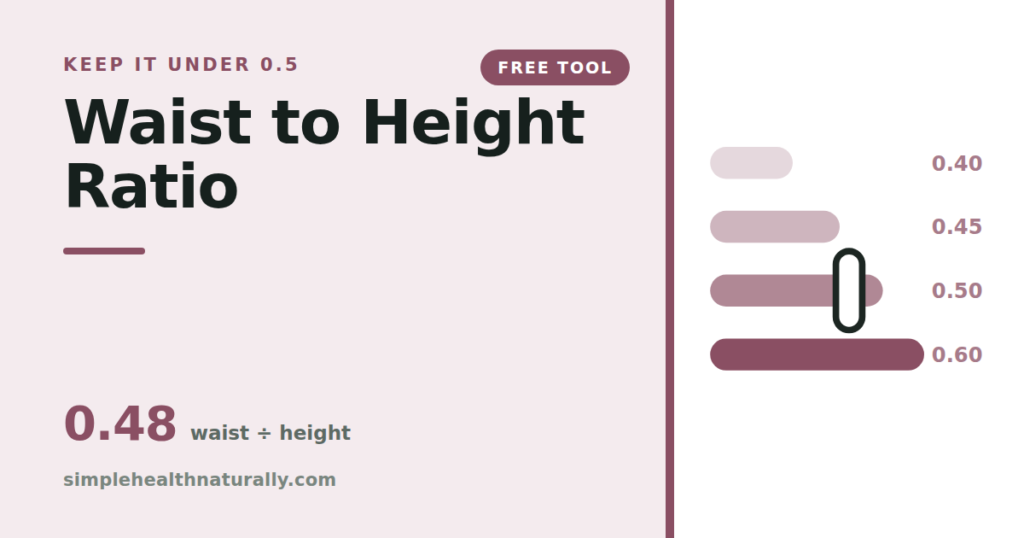
Your waist to height ratio tells you more about your health in ten seconds than the scale manages all year. Divide your waist by your height. Keep the answer under 0.5 and you have cleared the single most useful screening test you can run at home.
The calculator below runs that number for you, sorts it into the categories the UK National Institute for Health and Care Excellence uses, and gives you a target waist to aim at. A second tab handles waist to hip ratio, which answers a different question about where your fat sits.
What the Waist to Height Ratio Actually Measures
Fat behaves differently depending on where your body puts it. Fat under the skin on your thighs and hips sits there quietly. Fat packed around your liver, pancreas and intestines does not.
That deeper fat carries the name visceral fat, and it acts almost like an organ of its own. It releases free fatty acids straight into the vein that feeds your liver. It pumps out inflammatory signals. It interferes with the way insulin works. None of that shows up on a bathroom scale.
A tape around your middle picks it up because visceral fat pushes the abdominal wall outward. Your waist divided by your height corrects for body size, so a person of 5 feet and a person of 6 feet land on the same scale. That single correction is what makes the ratio work across sexes, ages and ethnic groups.
The Four Categories and What Each One Means
The UK National Institute for Health and Care Excellence sets four bands for adults with a BMI under 35, and they are simple enough to remember without a chart.
| Ratio | Category | What it means |
|---|---|---|
| Under 0.40 | Below the healthy band | Possibly too little, worth a conversation if unplanned |
| 0.40 to 0.49 | Healthy central adiposity | No increased health risk from waist size |
| 0.50 to 0.59 | Increased central adiposity | Increased risk, worth acting on |
| 0.60 or more | High central adiposity | Further increased risk, see a clinician |
NICE distilled the whole thing into one sentence that anyone can act on. Keep your waist to less than half your height. For someone of 5 feet 10 inches that means a waist under 35 inches. For someone of 5 feet 4 inches it means under 32.
The guidance applies to adults with a BMI below 35. Above that point, waist measurement adds little because central fat is already a given, and clinical assessment takes over.
How to Measure Your Waist Correctly
The whole method rests on one measurement, so a sloppy tape ruins the result. Five steps get it right.
Find the right spot. Feel for your lowest rib on one side, then the top of your hip bone below it. The measuring point sits halfway between the two. For most people that lands slightly above the navel rather than on it.
Bare skin or one thin layer. A jumper adds an inch and a half without you noticing.
Keep the tape level. Check in a mirror that it runs parallel to the floor all the way round. A tape that dips at the back reads high.
Breathe out normally, then measure. Do not suck in and do not push out. Take the reading at the end of a relaxed breath.
Measure twice. Take two readings and average them. Anything more than half an inch apart means one of them was wrong.
Morning works best, before you eat or drink. Food and fluid in your gut can add an inch by evening, and that swing is bigger than several months of real progress.
Why Waist to Height Ratio Beats BMI
BMI takes your weight and divides it by your height squared. That is the entire method. It cannot see what the weight consists of and it cannot see where the weight sits.
Three failures follow from that. A muscular person reads as overweight while carrying very little fat. An adult with a perfectly normal BMI can carry a large amount of visceral fat, a pattern researchers call normal weight obesity, and BMI calls that person healthy. And BMI cutoffs behave differently across ethnic groups, which is why some countries lower the thresholds for their populations.
The waist to height ratio sidesteps all three. Muscle does not sit on your waistline. Visceral fat does. And because the ratio scales with height rather than using fixed cutoffs, the same 0.5 boundary holds up across populations.
None of that makes BMI useless. It works well for tracking populations and for flagging the extremes. For one person standing in a bathroom with a tape measure, the ratio simply tells you more. Our body fat calculator uses the same tape and adds a percentage figure to the picture.
Waist to Hip Ratio and What It Adds
The second tab in the calculator divides your waist by your hips instead of your height. That answers a related but different question. Not how much central fat you carry, but how your body distributes fat overall.
The World Health Organization published cutoffs for it after an expert consultation on waist circumference and waist hip ratio, and the thresholds differ by sex because fat distribution does.
| Measure | Men | Women |
|---|---|---|
| Waist to hip ratio, substantially raised risk | 0.90 or more | 0.85 or more |
| Waist circumference, raised risk | 94 cm or 37 in | 80 cm or 31.5 in |
| Waist circumference, substantially raised risk | 102 cm or 40 in | 88 cm or 34.5 in |
People often describe the two patterns as apple and pear. Apple shaped bodies carry fat around the middle and run the higher metabolic risk. Pear shaped bodies carry it on the hips and thighs, where it sits under the skin and causes far less trouble.
The ratio has one real weakness. Waist and hips often shrink together during weight loss, so the number can barely move while your health improves a great deal. Waist to height ratio does not have that problem, because your height stays where it is.
What Visceral Fat Does Inside the Body
Understanding why the number matters makes it far easier to act on. Three chains of events run from central fat.
Fat reaches your liver first. Visceral fat drains into the portal vein, which runs straight to the liver. A steady flow of fatty acids there drives fat storage inside liver cells, and that is the starting point of fatty liver disease.
Insulin stops working properly. Fat inside the liver and muscle blunts the signal insulin sends, so your pancreas produces more of it. Years of that pattern lead to type 2 diabetes.
Low grade inflammation runs constantly. Visceral fat releases inflammatory messengers around the clock, and chronic inflammation damages blood vessel walls over time.
The reverse also holds, and that is the encouraging part. Visceral fat responds faster to diet and exercise than fat anywhere else on the body. It comes off first.
How to Shrink Your Waist
Sit ups do not do this job. Spot reduction is not a real thing, and abdominal exercise builds muscle under the fat rather than removing what sits on top. Six things do work.
Run a modest calorie deficit. Overall fat loss takes visceral fat with it, and takes it early. Our calorie deficit calculator sets a target you can actually hold.
Eat protein at every meal. Protein preserves muscle during a deficit and keeps hunger down between meals. Our protein intake calculator gives you a daily range.
Raise soluble fiber in particular. Oats, beans, lentils, apples and psyllium slow digestion and feed gut bacteria, and higher soluble fiber intake tracks with lower visceral fat. Our fiber intake calculator shows your gap.
Cut liquid sugar first. Sweet drinks raise liver fat more than the same calories eaten as food, because fructose arrives in a rush the liver cannot spread out. Our added sugar calculator shows what a normal day costs.
Sleep seven hours or more. Short sleep raises cortisol and appetite hormones, and both push fat storage toward the middle. Our sleep calculator helps you set a bedtime that fits whole cycles.
Keep alcohol low. Alcohol delivers empty calories and sends fat storage toward the abdomen, which is where the phrase beer belly comes from.
How Fast Can the Ratio Change
Waist size moves at a steady and fairly predictable pace. Most adults lose about one inch from the waist for every 8 to 10 pounds of body weight lost, though people who start with more central fat often see it come off faster than that.
Work an example through. A man of 5 feet 10 inches with a 40 inch waist sits at 0.57. He needs to reach 34.5 inches to clear the 0.5 line, so about 5.5 inches, which works out near 45 to 55 pounds. At one pound a week that is a year of steady effort.
The health returns arrive far sooner than the target does. Visceral fat starts falling within weeks of a deficit, and blood pressure, triglycerides and blood sugar improve after a 5 percent loss.
Measure once a month, not once a week. Day to day changes are food and fluid rather than fat.
Where the Ratio Falls Short
No single measurement covers everything, and this one has known blind spots.
It cannot separate visceral fat from fat under the skin on your abdomen. Two people with identical waists can carry very different amounts of the dangerous kind, and only a scan settles that.
Conditions that cause fluid buildup or bloating push the number up without any change in fat. Very tall and very short adults sit at the edges of the data behind the bands. And a person with a well developed core can measure slightly larger without carrying extra fat.
Use the ratio as the first screen rather than the last word. A result in the increased or high band is a reason to book blood pressure, blood sugar and cholesterol checks, not a diagnosis on its own.
Who Should Not Use This Calculator
Several groups get results that mean nothing useful.
Pregnant women. Waist measurement carries no meaning during pregnancy.
Children and teenagers under 18. Age specific charts handle this properly, and the adult bands do not transfer.
Adults with a BMI of 35 or above. NICE stops recommending the ratio here, because central fat is already established and clinical assessment matters more.
People with fluid retention or abdominal swelling. Heart failure, liver disease and some medications inflate the reading.
People recovering from abdominal surgery. Wait until swelling settles fully.
Anyone with a history of disordered eating. Body measurement can do real harm here. Talk to your clinician first.
Frequently Asked Questions
What is a good waist to height ratio?
Anything from 0.40 to 0.49 sits in the healthy band. The simple version is to keep your waist to less than half your height, which works the same way for men and women.
Where exactly should I measure my waist?
Halfway between your lowest rib and the top of your hip bone, with the tape level all the way round. For most people that lands just above the navel rather than on it.
Is waist to height ratio better than BMI?
For one person assessing their own risk, yes. BMI cannot tell muscle from fat or see where fat sits, while the ratio picks up central fat directly and holds across sexes and ethnic groups.
Does the same 0.5 threshold apply to women?
Yes. Unlike waist circumference cutoffs, which differ by sex, the 0.5 boundary applies to both men and women because dividing by height already corrects for body size.
How much weight do I need to lose to drop an inch from my waist?
Most adults lose roughly one inch of waist per 8 to 10 pounds of body weight. People carrying more central fat at the start often see it come off faster.
What is the difference between waist to height and waist to hip ratio?
Waist to height measures how much central fat you carry relative to your size. Waist to hip measures how your body distributes fat overall. Waist to height tracks change better, because your height never moves.
Can exercises target belly fat directly?
No. Spot reduction does not work. Abdominal exercises build muscle underneath, while the fat on top comes off through an overall calorie deficit, better sleep and less liquid sugar.
Is this waist to height ratio calculator free?
Yes. No sign up, no email and no limits. Everything runs in your browser and nothing leaves your device.
Final Thoughts on Your Waist to Height Ratio
One tape measure and one division give you a better read on your metabolic health than a year of weighing yourself. Your waist to height ratio picks up the fat that actually causes trouble, and it does that without a clinic, a scan or a subscription.
Keep the number under 0.5 and check it every three months. A result above that line is not a verdict, it is a prompt to change something small and measure again. Browse the rest of our free health calculators to fill in the numbers around it.
This calculator provides a general estimate for healthy adults and does not replace advice from your doctor or a registered dietitian. Read our full medical disclaimer and fact checking policy.