
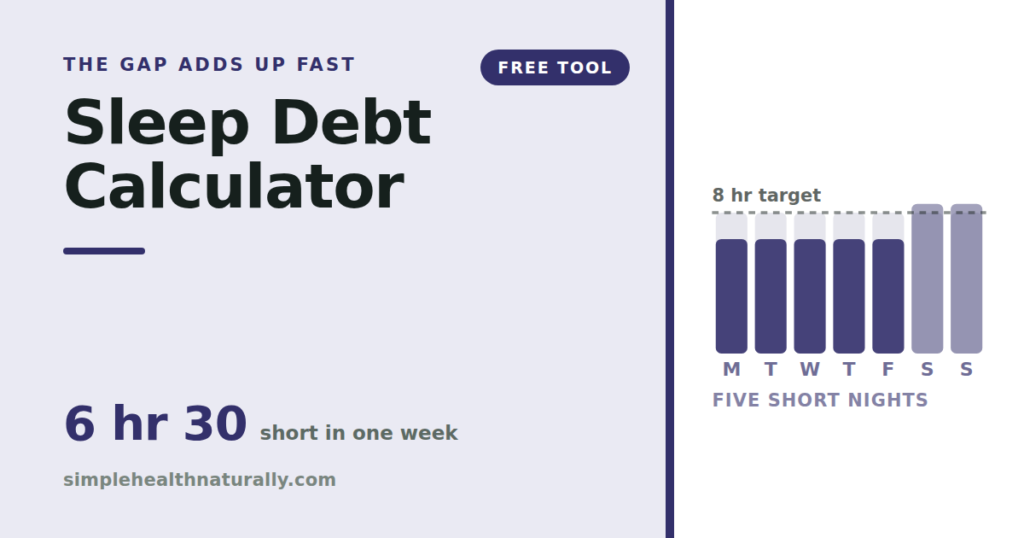
This sleep debt calculator adds up the gap between the sleep you need and the sleep you actually get across a week. Enter your weeknights and your weekend nights separately, because those two rarely match and the difference is where most of the debt hides.
Thirty minutes short on a weeknight feels like nothing at the time. Five of those nights come to two and a half hours, and the total keeps running until the weeknights themselves change.
Adults aged 18 to 60 need 7 or more hours a night according to the CDC.
| Weekly gap | What it means |
|---|
How Sleep Debt Builds Up
Sleep debt is the gap between the sleep you need and the sleep you get, added up night after night. Thirty minutes short looks like nothing. Five nights of it comes to two and a half hours, and a month of that pattern reaches ten.
The starting point is the amount you need. The CDC sets 7 or more hours for adults aged 18 to 60, 7 to 9 hours for ages 61 to 64, and 7 to 8 hours from 65. Individual need sits somewhere inside those bands, and the honest way to find yours is a stretch of days with no alarm.
| Weeknight sleep | Weekend sleep | Weekly debt against 8 hours |
|---|---|---|
| 7 hr 30 | 8 hr 30 | 1 hr 30 |
| 7 hr | 9 hr | 3 hr |
| 6 hr 30 | 8 hr 30 | 6 hr 30 |
| 6 hr | 9 hr | 8 hr |
| 5 hr 30 | 8 hr | 12 hr 30 |
The fourth row is worth sitting with. Six hours on weeknights with a full nine at the weekend still leaves a whole night of sleep missing every week, and that pattern describes a lot of working adults.
Why the Weekend Lie In Does Not Settle the Bill
Catching up feels like repayment. A controlled trial tested exactly that idea and found something less comfortable.
Researchers put healthy young adults through nine nights in three groups: nine hours of sleep every night, five hours every night, or five hours on weekdays with unlimited weekend sleep. The results appeared in Current Biology, and the weekend group did not come out ahead.
- Both short sleep groups snacked more after dinner and gained weight.
- Insulin sensitivity dropped by around 13 percent in the group that stayed short all week.
- The weekend recovery group ended up worse on some measures, with muscle and liver insulin sensitivity falling by 9 to 27 percent once the short nights resumed.
One study does not settle a question, and the sample was small and young. The practical read is modest rather than dramatic: an extra three hours on Sunday morning does not undo five short weeknights, so the weeknights are where the fix belongs.
How Long Recovery Actually Takes
Sleep debt does not work like a bank balance where every missing hour needs paying back one for one. Your body handles part of it by making the next nights deeper rather than longer, which is why one solid night after a short one helps more than the clock suggests.
That mechanism has limits. A short backlog from one rough week clears over a few consistent nights at your full length. A pattern that has run for months behaves differently, because the body treats the shortened night as the new normal and the daytime sleepiness stops feeling unusual.
Two practical points follow. Consistency beats volume, so seven nights at your target does more than five short nights and two long ones. And the tiredness you feel is a poor gauge of the debt, because people adapt to feeling below par and stop noticing it.
What the Sleep Debt Calculator Cannot See
Three things sit outside any arithmetic on hours.
Time in bed is not time asleep. Most people fall asleep in 10 to 20 minutes and wake briefly through the night, so eight hours in bed usually means seven and a half asleep. Enter the sleep rather than the bedtime if you can.
Quality changes what the hours are worth. Broken sleep with apnoea, alcohol or a new baby delivers less than the clock suggests. Seven fragmented hours can leave you worse off than six solid ones.
Need varies between people. The 7 to 9 hour band covers most adults, and a small number sit outside it in both directions. Your own number shows itself on holiday, once the backlog clears and your sleep settles at a natural length.
How to Use Your Sleep Debt Calculator Result
Move bedtime rather than wake time. Wake time is usually fixed by work or school. The card showing an earlier bedtime is the number to act on, and 15 minutes at a time works better than an hour at once.
Keep the weekend within an hour of the weekday. A three hour shift on Saturday moves your body clock the same way a flight does, which makes Monday harder. Our sleep calculator gives bedtime windows that fit whole cycles.
Check what is stealing the hours. Late caffeine costs more than people think, and our caffeine calculator shows how much is still in your system at bedtime.
Rerun it in two weeks. The figure only means something as a trend. One bad week is a bad week, and the same result three times running is a pattern.
When to See a Doctor Instead
- Eight hours in bed and still exhausted. That points at quality rather than quantity, and sleep apnoea is the most common cause.
- Loud snoring with pauses in breathing. A partner usually notices this before you do, and it needs assessment.
- A month of trouble falling asleep or staying asleep. That meets the usual threshold for chronic insomnia, which has effective treatment.
- Sleepiness that hits while driving. Treat this as urgent rather than routine.
- Shift work that never settles. Night rotations need a different plan, and the standard advice about fixed bedtimes does not apply.
Frequently Asked Questions
Can you catch up on lost sleep?
Partly. Your body makes the following nights deeper rather than longer, which clears a short backlog over a few consistent nights. A pattern that has run for months does not clear with one weekend.
How many hours of sleep debt is too much?
Above about seven hours a week you are missing more than a full night every week, which is where daytime sleepiness and poor concentration usually show up. Under three hours is a small gap that one or two earlier nights fixes.
Does sleeping in on Saturday help?
It helps you feel better that morning and it does not undo the week. A trial that gave people unlimited weekend sleep after short weeknights found the metabolic changes came back once the short nights resumed.
How do I find out how much sleep I actually need?
Take a stretch of days with no alarm, such as a holiday. The first few nights run long while the backlog clears, then the length settles. That settled figure is your need.
Do naps count toward sleep debt?
A nap reduces sleepiness and counts toward your total, though it does not replace night sleep hour for hour. Keep naps under 30 minutes and before mid afternoon so they do not push bedtime later.
Why am I still tired after eight hours?
Quality rather than quantity is the usual answer. Sleep apnoea, alcohol, an irregular schedule and some medications all break sleep into pieces that add up to less than the clock shows. Persistent tiredness despite enough time in bed is worth a doctor visit.
Is sleep debt the same as insomnia?
No. Sleep debt means not enough time available for sleep. Insomnia means the time is there and sleep does not come. The second one has its own treatment and needs a clinician rather than an earlier bedtime.
Final Thoughts on Your Sleep Debt Calculator Result
The sleep debt calculator turns a vague feeling of tiredness into a number, and the number is usually larger than people expect. Thirty minutes a night disappears without notice and still adds up to a lost night every fortnight.
Fix the weeknights rather than the weekend. Move bedtime 15 minutes at a time, keep Saturday within an hour of a workday, and run the numbers again in two weeks to see whether the pattern actually shifted.
This calculator provides general estimates for healthy adults and does not replace advice from your doctor. Persistent tiredness despite enough time in bed deserves medical assessment. Read our full medical disclaimer and fact checking policy.