
Calculator
Caffeine Calculator
This caffeine calculator takes what you drank and when. It shows your daily total and how much caffeine is still in your system at bedtime.
These change how fast your body clears caffeine. Half life sits near 5 hours for most adults.
190 mg of the 400 mg daily guideline for healthy adults
Estimates only. Caffeine content varies widely between brands and brewing methods, and clearance speed differs a lot between people. Talk to your doctor about caffeine if you are pregnant, take medication, or have a heart condition or anxiety disorder.
An afternoon coffee feels harmless because you cannot feel it by evening. That does not mean it has gone. This caffeine calculator models how much is still circulating when you go to bed, using a decay curve rather than a simple daily total.
Below the tool you get how quickly caffeine actually clears, why the answer differs so much between people, and what the research says about the last cup of the day.
Why Your Total Is Not the Point
Most caffeine calculators add up milligrams and stop there. Two people can drink the identical 200 milligrams and end up in completely different positions at bedtime.
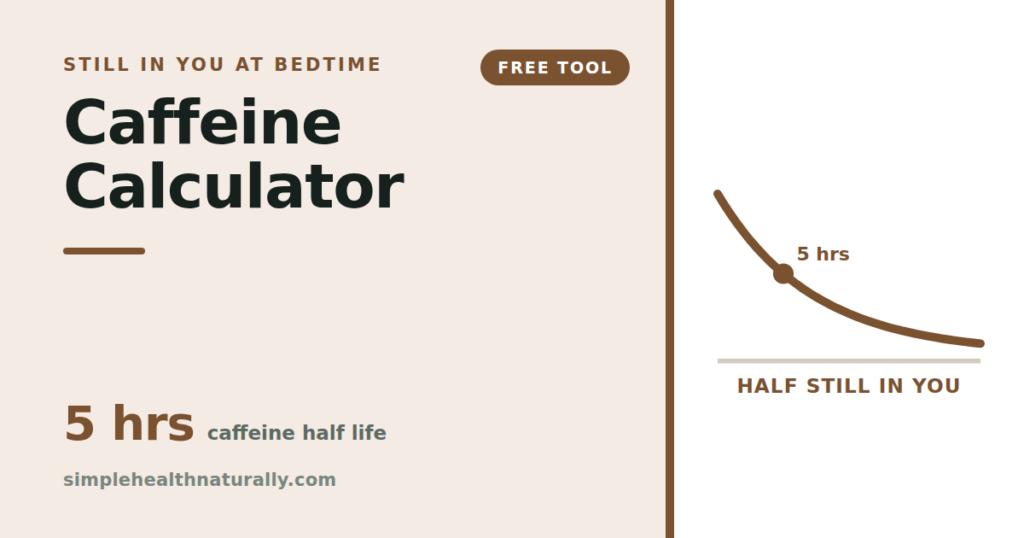
The timing is what matters. Caffeine leaves your body through exponential decay, which means a fixed proportion clears in each period rather than a fixed amount.
The average half life for a healthy adult sits around five hours. Drink 200 milligrams at 2 pm and you still have about 100 milligrams at 7 pm, 50 milligrams at midnight and 25 milligrams at 5 am.
That last figure surprises people. A single afternoon coffee is still measurably present when your alarm goes off.
What the Sleep Research Found
The most quoted study on this is small and its result is striking.
Researchers gave 12 healthy adults 400 milligrams of caffeine, roughly two to three cups of coffee, at bedtime, three hours before bed and six hours before bed. All three timings disrupted sleep compared with placebo.
The six hour condition is the interesting one. Objectively measured total sleep time fell by more than an hour compared with placebo, dropping from 7.68 hours to 6.50 hours.
The part that matters most. At six hours the participants did not notice. Their sleep diaries showed nothing unusual while the monitor recorded over an hour of lost sleep. Only the objective measurement caught it.
That awareness gap explains why so many people insist afternoon coffee does not affect them. The disruption is real and the perception of it is not.
The researchers recommended stopping caffeine at least six hours before bed, and keeping afternoon caffeine to before 5 pm.
How Fast You Clear It
Half life varies enormously between people, which is why the calculator asks.
| What applies | Rough half life |
|---|---|
| Typical healthy adult | 5 hours |
| Regular smoker | 3 hours |
| Combined oral contraceptive | 8 hours or more |
| Pregnancy, later stages | 10 to 15 hours |
| Some liver conditions | Considerably longer |
Tobacco speeds clearance. Compounds in tobacco smoke induce the liver enzyme that breaks caffeine down. Smokers often clear it roughly twice as fast, which is part of why quitting can make your usual coffee feel like too much.
Oral contraceptives slow it. Estrogen inhibits the same enzyme. Many women on combined pills clear caffeine at half their usual rate without ever being told.
Pregnancy slows it dramatically. Clearance drops through the pregnancy, and by the third trimester the half life can stretch to 15 hours. That is why pregnancy guidance caps intake at 200 milligrams daily rather than 400.
Genetics play a part too. Variants in the CYP1A2 gene divide people into fast and slow metabolisers. Slow metabolisers are the ones who genuinely cannot drink coffee after lunch.
How Much Is in Your Drink
Figures below are typical rather than exact, since brewing method and brand change things considerably.
| Drink | Caffeine |
|---|---|
| Brewed coffee, 8 oz | 95 mg |
| Large coffee shop coffee, 16 oz | 150 to 300 mg |
| Espresso, single shot | 63 mg |
| Instant coffee, 8 oz | 62 mg |
| Matcha, 8 oz | 70 mg |
| Black tea, 8 oz | 47 mg |
| Green tea, 8 oz | 28 mg |
| Cola, 12 oz | 34 mg |
| Energy drink, 8 oz | 80 mg |
| Pre workout, 1 scoop | 150 to 300 mg |
| Dark chocolate, 1 oz | 12 mg |
| Decaf coffee, 8 oz | 2 mg |
Two things worth noting.
Large speciality coffees vary wildly. Some 16 ounce servings measure close to 500 milligrams, which is more than a full day’s guideline in one cup.
Decaf is not caffeine free. It carries a small amount, which matters only if you drink several late in the evening.
Daily Limits
Healthy adults. The FDA considers up to 400 milligrams a day generally safe, roughly four to five cups of brewed coffee.
Pregnancy. Guidance caps intake at 200 milligrams daily, both because clearance slows and because caffeine crosses the placenta.
Adolescents. Around 100 milligrams daily is the usual ceiling suggested.
Anxiety, arrhythmias or reflux. Lower thresholds often apply. Caffeine can worsen all three.
Above 400 milligrams most people notice jitteriness, a racing heart, digestive upset and disrupted sleep. Very high single doses, mainly from powders and pills rather than drinks, have caused serious harm.
Practical Fixes
Six changes work better than quitting.
Set a cutoff time. Six hours before bed based on the research, or eight if you know you clear it slowly. For an 11 pm bedtime that means stopping by 5 pm.
Front load your intake. Most of your caffeine before noon gives you the alertness without the tail.
Switch to tea in the afternoon. Green tea carries under a third of the caffeine of coffee and the L-theanine takes the edge off.
Wait an hour after waking. Cortisol is already high early on, and caffeine on top adds less than you expect.
Watch the hidden sources. Pre workout supplements, energy drinks and some pain relievers all carry substantial amounts.
Taper rather than quit cold. Withdrawal headaches usually start 12 to 24 hours after your last dose and last a few days. A cut of roughly a quarter each week avoids most of it.
Coffee on an empty stomach bothers some people more than others. Our guide to foods to avoid on an empty stomach covers who tends to notice it, and our rundown of 9 morning drinks covers what the research actually supports about coffee.
Frequently Asked Questions
How long does caffeine stay in your system?
The half life averages about five hours in healthy adults, so half remains after five hours and a quarter after ten. Traces persist for well over 24 hours. Tobacco speeds it up and pregnancy or oral contraceptives slow it down considerably.
When should I stop drinking coffee before bed?
At least six hours before, based on research showing that 400 milligrams six hours before bedtime cut objectively measured sleep by more than an hour. A 5 pm cut off suits most bedtimes.
Does caffeine affect my sleep even if I fall asleep fine?
Yes, and that is the key finding. Participants in the six hour condition reported no sleep problems while monitoring showed over an hour of lost sleep. Easy sleep onset does not mean the caffeine had no effect.
How much caffeine is safe per day?
Up to 400 milligrams for healthy adults according to the FDA, 200 milligrams during pregnancy, and around 100 milligrams for adolescents.
Why does caffeine affect me more than other people?
Genetics, mainly through variants in the CYP1A2 gene, plus smoking status, medication, pregnancy and liver function. Half life ranges from roughly three to over ten hours between individuals.
Does decaf have caffeine?
Yes, roughly 2 to 5 milligrams per cup against 95 in regular coffee. Enough to notice only if you drink several late at night.
Can I build tolerance to caffeine?
Partly. Tolerance develops to some effects such as the alertness boost, and less reliably to the sleep disruption. Many habitual drinkers still lose sleep without realising it.
How do I quit without headaches?
Taper by about a quarter of your intake each week. Withdrawal typically begins 12 to 24 hours after the last dose and resolves within a few days to a week.
Does caffeine dehydrate you?
Not at normal intakes. The mild diuretic effect is more than covered by the fluid in the cup, and coffee and tea both count toward your daily fluid. Our water intake calculator factors this in.
One limit worth knowing. The FDA puts 400 mg a day as the amount not generally associated with negative effects for healthy adults, roughly four or five cups of coffee. Pregnancy, some heart conditions and certain medicines lower that considerably.
Final Thoughts on Your Caffeine Calculator Result
Total intake gets all the attention and timing decides most of the outcome. A caffeine calculator is useful because the decay is invisible. You cannot feel 40 milligrams at bedtime and it can still cost you an hour of sleep.
Two changes cover most of it. Set a cutoff about six hours before bed, and know which category you fall into, since smokers clear caffeine twice as fast as people on combined oral contraceptives.
Talk to your doctor about caffeine if you are pregnant, have a heart condition, an anxiety disorder or take medication that interacts with it.
References
- Drake C, Roehrs T, Shambroom J, Roth T. Caffeine effects on sleep taken 0, 3, or 6 hours before going to bed. Journal of Clinical Sleep Medicine. 2013;9(11):1195-1200. PubMed
- American Academy of Sleep Medicine. Late afternoon and early evening caffeine can disrupt sleep at night. aasm.org
This calculator provides general estimates and does not replace advice from your doctor. Caffeine content varies widely by brand and brewing method, and clearance rates differ substantially between individuals. Talk with a healthcare provider about caffeine during pregnancy, with a heart condition, an anxiety disorder, or while taking medication. Read our full medical disclaimer and fact checking policy.