
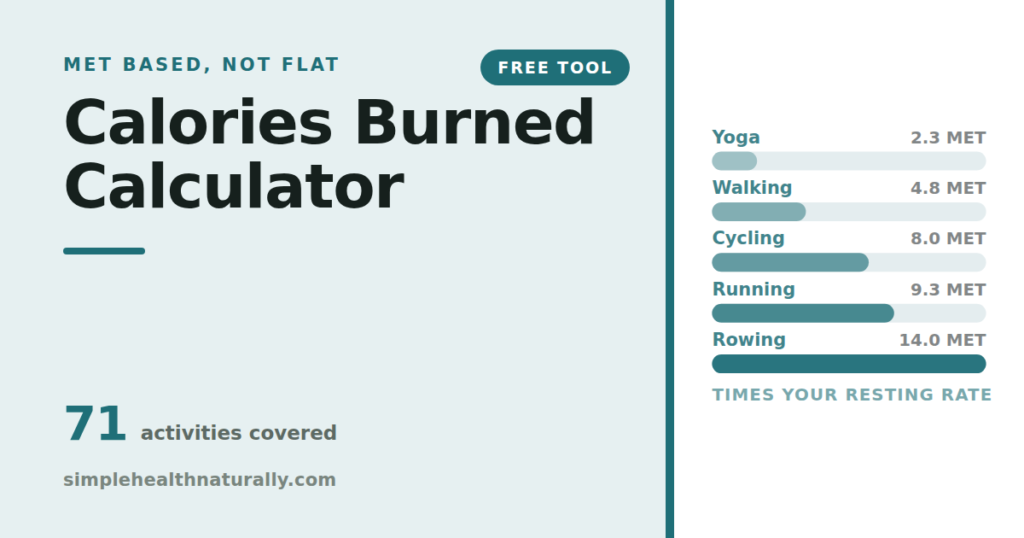
This calories burned calculator works out what a session costs you using your own resting rate, rather than one flat number applied to every body. Pick an activity, enter the minutes and you get two figures side by side. One is the number this page calculates for you. The other is the number almost every other calculator shows.
The gap between those two is often wide. Heavier people, older people and women see the biggest difference, and effort has nothing to do with it.
| Target | Time | Above resting |
|---|
How This Calories Burned Calculator Works
Three numbers go into the answer. Your resting rate, the intensity of the activity and the time you spend on it.
Your resting rate comes from the Mifflin St Jeor equation, which uses your sex, age, height and weight. It tells you roughly what your body burns while you sit still.
The intensity comes from a MET value. One MET is your resting rate. An activity rated at 5 METs costs about five times what sitting costs.
The time is simply how long you kept going.
Multiply the three together and you have the answer. The MET values here come from the 2024 Adult Compendium of Physical Activities, a public database that researchers update roughly every decade.
Why This Calories Burned Calculator Reads Lower Than Your App
Most calculators skip the resting rate step. They use a shortcut that assumes every adult burns exactly 1 calorie per kilogram of body weight per hour at rest.
That shortcut works for a lean young man of average height. It fails for almost everyone else, and it always fails in the same direction.
Take a woman of 50 who is 5 feet 5 inches and 220 pounds. The shortcut assumes she burns about 2,500 calories a day at complete rest. Her predicted resting rate is closer to 1,620. Every activity number built on that shortcut runs roughly half again too high for her.
Why does the error land there? Fat tissue burns very little at rest. A heavier body carries more of it, so the resting rate per kilogram falls as weight rises. Age drops it further and women sit lower than men at the same size.
Researchers measured this directly. One study found the shortcut misclassified activity intensity for 19 percent of overweight participants against 8.5 percent of normal weight ones, and for 16 percent of 50 year olds against 7.6 percent of 20 year olds. The fix they recommend is the one used on this page. Replace the flat assumption with a predicted resting rate for the actual person.
Neither figure is measured truth. Both are estimates and the real answer probably sits between them. Only a lab with a metabolic cart settles it properly. The point of showing both is that you can see how much of the number is assumption.
What a MET Value Really Means
MET stands for metabolic equivalent of task. The scale starts at 1, which is you at rest.
| Activity | METs | What that means |
|---|---|---|
| Sitting quietly | 1.0 | your baseline |
| Cooking, light effort | 2.0 | twice resting |
| Walking, 3 mph | 3.8 | moderate territory starts near here |
| Mowing the lawn | 5.0 | five times resting |
| Jogging, general | 7.5 | vigorous |
| Running, 10 minute mile | 9.3 | nine times resting |
| Rowing machine, hard | 14.0 | near the top of the scale |
Public health guidance uses these bands. The CDC counts 3 to 5.9 METs as moderate intensity and 6.0 or more as vigorous intensity.
One warning about the database itself. Each MET value is an average taken from a group of people. Two people can walk the same speed and burn different amounts, because stride length, fitness and even shoe weight all shift the cost. The compendium authors say plainly that their values do not account for differences in body mass, body fat, age, sex or efficiency of movement.
Gross Calories Against Net Calories
Your body burns calories whether you exercise or not. A 45 minute run replaces 45 minutes of sitting, so part of that total would have happened anyway.
Gross calories is the full figure for the session. That is the big number at the top.
Net calories subtracts what you would have burned resting. The card labelled above resting shows this.
For hard exercise the two land close together, since resting is a small share of a big total. For gentle activity the gap matters a great deal. An hour of hatha yoga might read 120 calories gross and only 69 above resting, because most of that hour was your body ticking over.
Use the net figure when you plan food around exercise. Our calorie deficit calculator already counts your daily activity, so adding the gross number on top double counts the resting part.
What Changes How Much You Burn
Five things move the number, in rough order of size.
- Body weight. A 220 pound woman burns about a quarter more than a 150 pound woman of the same height and age on the same brisk walk, because more mass costs more to move.
- Intensity. A brisk walk costs about 60 percent more per minute than a slow one. Speed moves the number faster than duration does.
- Duration. Simple and linear. Twice the minutes means twice the calories.
- Fitness. Trained people move more efficiently, so a fit runner burns slightly less than an untrained one at identical pace. The difference is small.
- Terrain and conditions. Hills, sand, wind and cold all raise the cost, sometimes sharply. Walking backward up a 5 percent grade rates 7.8 METs against 6.0 on the flat.
Notice what is missing from that list. Fasted training, fat burning zones and metabolism boosting foods change the number so little that they disappear inside the error bars of the estimate itself. Our heart rate zone calculator covers the fat burning zone claim properly.
Why You Should Not Eat Back Every Calorie
This is where good intentions go wrong most often.
Every calorie burn estimate carries error. A Stanford study tested seven wrist worn trackers and not one estimated energy expenditure within 20 percent. The best device missed by 27 percent and the worst by 93 percent, even though the same devices read heart rate accurately. Gym machines run high too, and the careful figure on this page still rests on a predicted resting rate rather than a measured one.
Food estimates carry error in the other direction. One study checked diet recalls against the doubly labelled water method and found half of them came in under the measured figure, with the group average about 10 percent low.
Stack an overstated burn on top of an understated intake and a careful plan quietly stops working. That is the whole story behind most stalled weight loss.
A safer habit. Set your daily target from your activity level once, then leave it alone. Our daily calorie calculator builds that target with an activity multiplier already included. Treat exercise as a bonus you do not spend, and let the scale over three or four weeks tell you whether the number was right.
Frequently Asked Questions
How many calories do I burn in a day?
That depends on your resting rate plus everything you do on top of it. A moderately active adult usually lands somewhere between 1,800 and 2,600 calories. Our daily calorie calculator works out your own figure from height, weight, age and activity level.
How accurate are calories burned calculators?
Treat any figure as a rough guide. MET values are group averages that ignore fitness, movement efficiency and body composition, and the resting rate behind them is predicted rather than measured. A range of plus or minus 20 percent is realistic even for a careful estimate.
How many calories does walking a mile burn?
Roughly 70 to 100 calories for most adults at a moderate pace, with heavier people at the top of that range. The familiar rule of 100 calories a mile comes from the flat textbook formula and usually runs a little high.
Why is my number lower than my fitness tracker says?
Most trackers assume every adult rests at 1 calorie per kilogram per hour. This page uses your predicted resting rate instead, which is usually lower. A Stanford study of wrist worn trackers found errors of 27 percent at best and 93 percent at worst for energy expenditure.
Should I eat back the calories I burn?
Better not to. Burn estimates run high and food estimates run low, so eating back the full amount often wipes out the deficit. Set a daily target that already includes your activity level and treat exercise as a bonus.
What is a MET value?
MET stands for metabolic equivalent of task. One MET is your body at rest, so an activity rated at 5 METs costs about five times that. The CDC calls 3 to 5.9 METs moderate intensity and 6.0 or more vigorous intensity.
Do I burn more calories at a higher weight?
Yes. More mass costs more to move, so a heavier person burns more for the same activity and pace. The effect is smaller than a simple weight ratio suggests, because fat tissue burns very little at rest.
Does building muscle raise my calorie burn much?
Less than most people expect. Muscle is more active at rest than fat, but the difference per pound is small, so ten pounds of new muscle changes your daily resting burn only modestly. Build muscle for strength and bone health rather than as a metabolism shortcut.
Is gross or net calories the right number to use?
Use the net figure when you plan food around exercise, since your body would have burned the resting share anyway. Gross calories answers a different question, which is what the session cost in total.
Final Thoughts on Your Calories Burned Calculator Result
A calories burned calculator answers a narrow question well. It tells you roughly what one session cost, and it lets you compare two activities fairly.
Ask it to do more than that and it starts to mislead. The number carries real error, and the flat formula behind most tools runs high for exactly the people who care most about the answer.
Two habits make the number useful. Use the net figure rather than the gross one when food is involved. And judge your plan by what the scale does over a month, not by what any calculator predicted on a Tuesday.
References
- Herrmann SD, Willis EA, Ainsworth BE, et al. 2024 Adult Compendium of Physical Activities. pacompendium.com
- Kozey S, Lyden K, Staudenmayer J, Freedson P. Errors in MET estimates of physical activities using 3.5 ml per kg per min as the baseline oxygen consumption. umass.edu
- Shcherbina A, Mattsson CM, Waggott D, et al. Accuracy in wrist worn, sensor based measurements of heart rate and energy expenditure in a diverse cohort. Journal of Personalized Medicine. mdpi.com
- Centers for Disease Control and Prevention. Measuring Physical Activity Intensity. cdc.gov
- American Council on Exercise. 5 Things to Know About Metabolic Equivalents. acefitness.org
- Dietary misreporting: a comparative study of recalls versus energy expenditure and energy intake by doubly labeled water in older adults with overweight or obesity. BMC Medical Research Methodology. springer.com
This calculator provides general estimates for healthy adults and does not replace advice from your doctor or a registered dietitian. Read our full medical disclaimer and fact checking policy.