
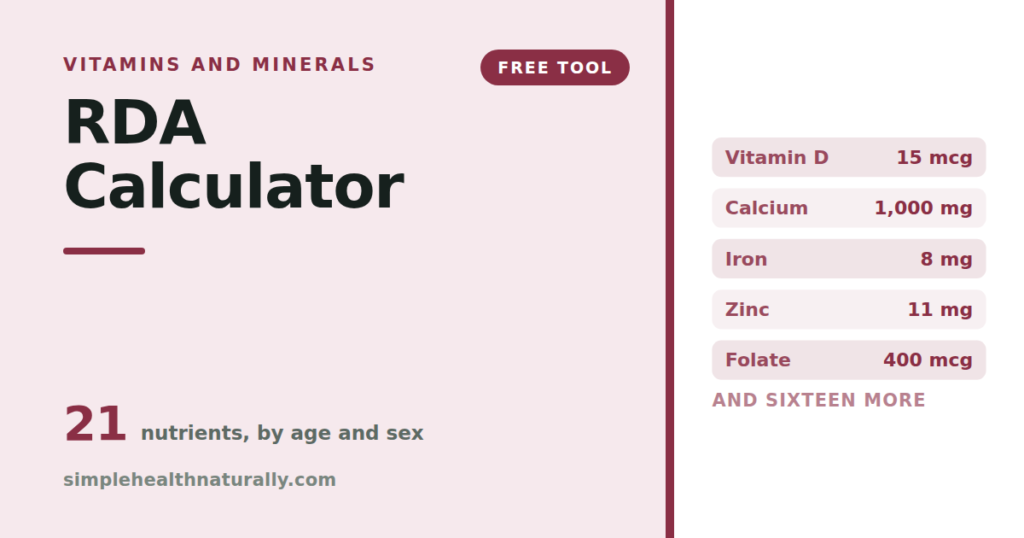
This RDA calculator shows the daily vitamin and mineral targets set for your age and sex, along with the upper limit for each one. Every figure comes from the Dietary Reference Intakes published by the National Academies rather than from a supplement label.
Seven of these numbers move as you get older and several differ between men and women, which is why a single chart pinned to the fridge goes out of date. Pick your sex and age and the table updates to the bracket you actually sit in.
| Nutrient | Daily target | Type | Upper limit |
|---|
| Nutrient | Daily target | Type | Upper limit |
|---|
Upper limits apply to everything combined, food and supplements together. The magnesium limit is the exception and counts supplements only. Two nutrients carry advice rather than a limit: sodium, where the guidance is to come down if you sit above 2,300 mg, and folate, where women who could become pregnant are advised to take 400 micrograms from fortified food or a supplement.
These figures cover healthy adults who are not pregnant or breastfeeding. Needs rise in pregnancy and lactation, and several of these numbers change with kidney disease, absorption problems or long term medication, so your clinician sets those rather than a table.
What RDA, AI and UL Actually Mean
Three labels appear in the tables above, and they carry different weight.
RDA, the recommended dietary allowance. The amount that meets the needs of almost every healthy person in that age and sex group. That figure covers roughly 97 to 98 percent of people, which makes it a generous target rather than a bare minimum.
AI, the adequate intake. The label used where the evidence will not support an RDA. It comes from what healthy people appear to eat rather than from a measured requirement, so treat it as a good estimate with more uncertainty attached.
UL, the tolerable upper intake level. The highest daily amount that looks safe over the long term. Several nutrients have no UL, which means the evidence was too thin to set one rather than that unlimited amounts are fine.
The gap between the target and the limit varies enormously. Vitamin C runs from 90 milligrams up to 2,000, a factor of more than 20. Zinc runs from 11 milligrams up to 40, less than a factor of four. That second gap is where supplement stacking causes trouble.
Why Your Numbers Change With Age and Sex
Seven of the figures in this table move as you get older or differ between men and women, and each shift has a reason behind it.
| Nutrient | What changes | Why |
|---|---|---|
| Iron | 18 mg for women 19 to 50, then 8 mg | Menstrual losses stop after menopause |
| Calcium | Rises to 1,200 mg for women at 51 and men at 71 | Bone loss accelerates after those points |
| Vitamin D | Rises from 15 to 20 micrograms at 71 | Skin makes less of it with age |
| Vitamin B6 | Rises at 51 for both sexes | Status markers fall in older adults at the younger dose |
| Magnesium | Rises slightly at 31 | Body size and turnover shift after early adulthood |
| Vitamin A, C and K | Higher for men throughout | Larger average body size |
| Potassium | 3,400 mg for men, 2,600 mg for women | Set from intakes linked to lower blood pressure |
The calcium and iron switches matter most in practice. A woman turning 51 sees her iron target drop by more than half and her calcium target rise by a fifth in the same year, which is a bigger change than most people notice.
Upper Limits Deserve More Attention Than They Get
Food alone rarely pushes anyone past an upper limit. Supplements do it easily, and multivitamins stacked with single nutrient pills do it fastest.
Four limits sit close enough to normal supplement doses to matter.
- Niacin at 35 mg. Plenty of B complex products carry more than that in one capsule.
- Zinc at 40 mg. Cold remedies often supply 25 mg or more per dose.
- Vitamin A at 3,000 micrograms. The limit applies to retinol from supplements and liver rather than to beta carotene from vegetables.
- Magnesium at 350 mg. The only limit here that counts supplements alone, because magnesium from food carries no such ceiling.
Sodium and potassium work differently again. Both were revised in 2019, and sodium gained a reduction target of 2,300 mg rather than a true upper limit. Our sodium intake calculator shows where yours actually comes from.
What an RDA Calculator Cannot Tell You
The table gives targets. It says nothing about what you currently eat, and that gap is the whole job.
Reference intakes describe groups rather than individuals. Your own requirement sits somewhere below the RDA with high probability, and nobody can say exactly where without testing.
Absorption varies with the meal. Iron from meat absorbs several times better than iron from spinach, and vitamin C alongside a plant source narrows that gap. The same 18 milligrams on paper delivers different amounts to different people.
Blood tests answer questions this table cannot. Ferritin, vitamin D and B12 all have established tests, and a result beats an estimate every time.
How to Use Your RDA Calculator Result
Check three nutrients rather than twenty. Most people who improve their diet do it by fixing one or two gaps. Pick the ones your eating pattern makes likely, such as B12 on a plant based diet or iron for a menstruating vegetarian.
Read labels against these numbers. Supplement panels list a percent daily value that uses a separate reference set, so the milligram figure on the bottle matched against this table tells you more.
Add up everything you take. A multivitamin, a separate zinc tablet and a fortified cereal can clear a limit between them while each one looks reasonable alone.
Start with food. Ordinary meals cover these targets more reliably than pills do, and our fiber intake calculator and protein intake calculator cover the two daily numbers that need the most attention.
Who Needs Different Numbers
- Pregnancy and breastfeeding. Almost every figure here rises, several of them steeply, and folate and iron change most. Your midwife or doctor sets those.
- Chronic kidney disease. Potassium and phosphorus often need restricting rather than meeting, which reverses two rows of this table.
- Coeliac disease, Crohn’s disease or bariatric surgery. Absorption changes enough that targets become unreliable and blood tests take over.
- Long term medication. Metformin affects B12, proton pump inhibitors affect B12 and magnesium, and diuretics affect potassium.
- Anyone under 19. Children and teenagers have their own tables, and this one does not apply to them.
Frequently Asked Questions
What is the difference between RDA and daily value?
The RDA comes from the National Academies and varies by age and sex. The daily value on a food label is a single figure chosen for labelling so one number fits everyone. The two often differ, which is why the milligram amount on a label is more useful than the percentage.
Is the RDA a minimum or a target?
A target, and a generous one. The RDA is set to cover almost every healthy person in the group, so most individuals need less than the figure shown.
How much vitamin D do adults need?
15 micrograms a day, which is 600 international units, up to age 70. That rises to 20 micrograms or 800 units from 71. The upper limit sits at 100 micrograms or 4,000 units.
Why do some nutrients have no upper limit?
Because the evidence was too thin to set one rather than because large amounts are safe. Vitamin K, thiamin, riboflavin and B12 all fall into that group.
Do I need a multivitamin?
Most healthy adults who eat a varied diet do not. A multivitamin makes more sense for specific gaps, such as B12 on a plant based diet, and your doctor can tell you whether your situation is one of those.
Why does iron drop so much for women after 50?
Menstrual losses stop at menopause, so the requirement falls from 18 milligrams to 8. Anyone still menstruating past 50 keeps the higher figure.
Can I get too much from food alone?
Rarely. Upper limits are almost always reached through supplements or heavily fortified products. Liver is the one common food that can push vitamin A past its limit.
Final Thoughts on Your RDA Calculator Result
The RDA calculator gives you the reference figures for your age and sex in one place, which saves a lot of searching. Treat the targets as generous rather than minimal, because an RDA already covers almost everyone in your group.
Pick the two or three nutrients your eating pattern puts at risk and work on those. Add up every supplement against the upper limit column before you add another bottle, and let a blood test settle anything that matters.
This calculator provides general reference values for healthy adults and does not replace advice from your doctor or a registered dietitian. Read our full medical disclaimer and fact checking policy.