
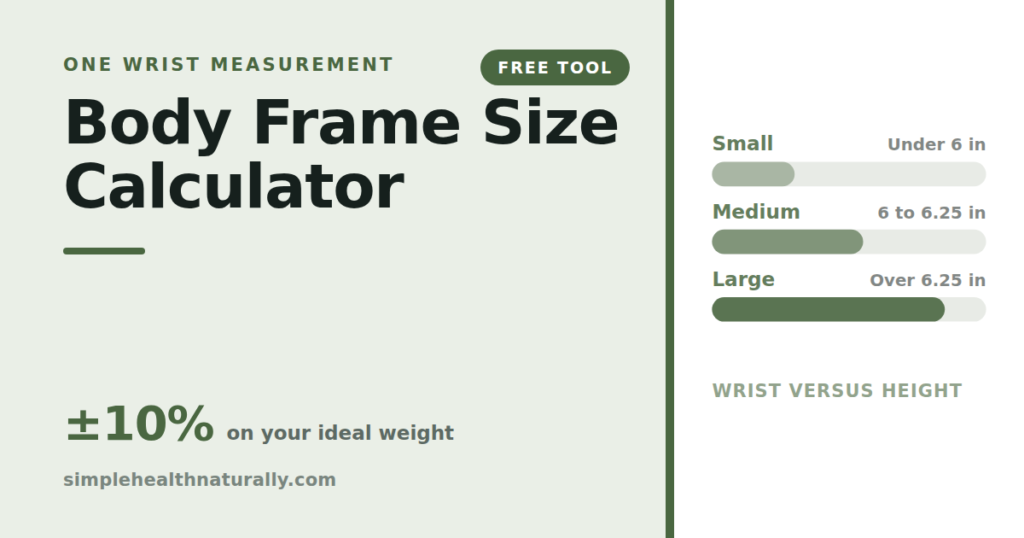
This body frame size calculator tells you whether your skeleton is small, medium or large from one wrist measurement and your height. The answer shifts a height based weight target by about 10 percent, which is enough to explain why two people of the same height can both sit at a healthy weight ten pounds apart.
Measure the wrist on the hand you write with, just below the wrist bone. The calculator then shows which band you fall into and what it does to your ideal weight figure.
Measure just below the wrist bone, on the hand you write with, with the tape snug rather than tight.
| Group | Small | Medium | Large |
|---|
How to Measure Your Wrist Properly
The measurement decides the answer, so a sloppy one moves you a whole category. Four points cover it.
- Measure the narrowest part. Sit the tape just below the wrist bone, on the forearm side of it, where the wrist is thinnest.
- Use your dominant hand. The wrist on the side you write with usually measures slightly larger, and the reference table assumes that one.
- Keep the tape snug rather than tight. Tight enough to stay put, loose enough not to dent the skin.
- Take it twice. A quarter of an inch changes the result at some heights, so measure again and use the same number twice before you trust it.
A soft tailoring tape works best. A piece of string marked with a pen and laid against a ruler works nearly as well.
The Finger Test and When It Works
Wrap your thumb and middle finger around the opposite wrist. Fingers that overlap point to a small frame, fingers that just touch point to medium, and fingers that do not meet point to large.
The test is quick and it has an obvious flaw. Long fingers make everyone look small framed and short fingers do the opposite, so the result depends on your hand as much as your wrist. Treat it as a rough sort and use the tape when the answer matters.
What Body Frame Size Actually Measures
Frame size stands in for skeletal size. The wrist works as the measuring point because it carries almost no muscle and very little fat, so what the tape goes around is mostly bone.
That matters because bone weighs something. Two women at 5 feet 4 inches, one with a 5.5 inch wrist and one with a 6.5 inch wrist, carry different amounts of skeleton before any discussion of fat or muscle starts. The thresholds in this calculator come from MedlinePlus, run by the US National Library of Medicine.
Elbow breadth is the other standard method, measured with callipers across the two bones at the elbow. It gives a similar answer and needs equipment most people do not own, which is why the wrist method is the one that spread.
Does Frame Size Change Over Time
Adult skeletons stop growing, so the answer is no for almost everyone. Measure it once in your twenties and the same result holds in your fifties.
Two things move the tape without moving your frame. Fluid retention swells the wrist, which is why a measurement taken on a hot day or after a salty meal can read a quarter inch higher. Pregnancy does the same thing, and both settle on their own.
Bone density is a separate matter entirely. It falls with age, particularly after menopause, and that change affects fracture risk rather than frame size. A wrist that measures 6 inches at 30 still measures about 6 inches at 70 even when the bone inside has thinned, so this calculator says nothing about bone health.
How Frame Size Changes Your Ideal Weight
The standard adjustment moves an ideal weight figure by 10 percent in either direction. Small frame comes down 10 percent, large frame goes up 10 percent, and medium stays where the formula puts it.
| Height | Small frame | Medium frame | Large frame |
|---|---|---|---|
| Women 5 ft 2 in | 99 lb | 110 lb | 121 lb |
| Women 5 ft 6 in | 118 lb | 131 lb | 144 lb |
| Women 5 ft 10 in | 136 lb | 151 lb | 166 lb |
| Men 5 ft 8 in | 136 lb | 151 lb | 166 lb |
| Men 6 ft 0 in | 154 lb | 171 lb | 188 lb |
| Men 6 ft 4 in | 172 lb | 191 lb | 210 lb |
The spread between small and large at the same height runs to more than 20 pounds. That gap explains a lot of frustration, because two people of identical height comparing their weights are often not comparing the same thing at all. Our ideal weight calculator runs four formulas rather than the single one used above.
What the Body Frame Size Calculator Cannot Tell You
Three limits are worth stating plainly.
Frame size is not a health measure. A large frame is not a risk factor and a small frame is not an advantage. The number exists only to make a weight target fit the person better.
The thresholds are old and coarse. Three categories built on one measurement cannot capture skeletal size precisely, and nobody has revised the reference table in decades.
It says nothing about body composition. Frame size cannot see muscle or fat. For that, our body fat calculator and waist to height ratio calculator answer more useful questions.
How to Use Your Body Frame Size Result
Use it once and remember it. Adult skeletons do not change, so this is a measurement you take a single time rather than track.
Shift your target rather than your effort. A large frame result means the number on the scale sits higher at the same level of health, and that is information rather than an excuse.
Stop comparing weights with friends. Height alone was never a fair comparison, and frame size is one of the reasons why.
Put more weight on waist measurements. Frame size adjusts a target. Waist size tells you something about risk, which is the more useful of the two.
Frequently Asked Questions
How do I know if I have a small or large frame?
Measure your wrist just below the wrist bone and compare it against your height. A woman of 5 feet 4 inches has a small frame under 6 inches, medium from 6 to 6.25 inches, and large above that. Men over 5 feet 5 inches sit at small under 6.5 inches, medium from 6.5 to 7.5, and large above 7.5.
Does body frame size affect weight?
It affects the target rather than the scale. The standard adjustment moves an ideal weight figure 10 percent down for a small frame and 10 percent up for a large one, which is more than 20 pounds of spread at some heights.
Can frame size change?
No for adults, because the skeleton stops growing. Swelling from heat, salt or pregnancy can make the wrist measure larger for a while, and that settles on its own.
Is the finger test accurate?
Only roughly. Long fingers make everyone look small framed and short fingers do the opposite, so the result depends partly on your hand. Use a tape measure when the answer matters.
Which wrist should I measure?
The one on the hand you write with. That side usually measures slightly larger and the reference table assumes it.
Does a large frame mean I am big boned rather than overweight?
A large frame raises a healthy weight target by about 10 percent and no further. Anything beyond that comes from fat or muscle rather than bone, and a waist measurement answers that question better than a wrist one.
Does frame size tell me anything about bone health?
No. Frame size describes skeletal width, while bone density describes how solid the bone is. Density falls with age and affects fracture risk, and only a scan measures it.
Final Thoughts on Your Body Frame Size
Body frame size settles one small question well. It tells you whether a height based weight target should sit 10 percent higher or lower for you, and it takes a tape measure and thirty seconds to find out.
Take it once, write it down and move on to the measurements that say something about health. Your waist and your body fat percentage both answer bigger questions than your wrist ever will.
This calculator provides general estimates for healthy adults and does not replace advice from your doctor or a registered dietitian. Read our full medical disclaimer and fact checking policy.