
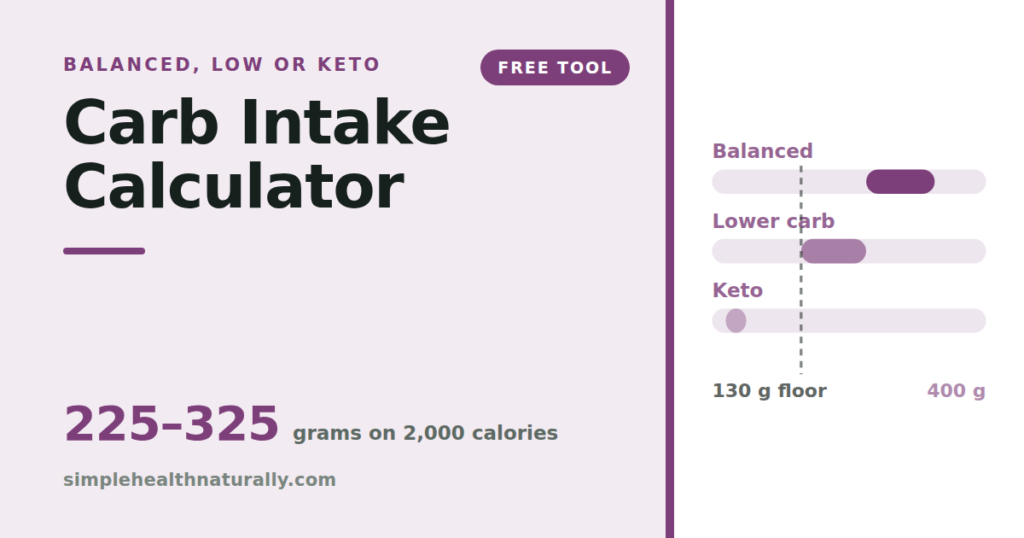
This carb intake calculator gives you a daily gram target rather than a percentage you have to work out yourself. Tell it your body, your activity and the approach you want to follow, and it returns a range in grams, a fibre target, an added sugar ceiling and a rough per meal figure. Athletes get a separate tab that works from body weight instead, because that is how sports nutrition actually prescribes carbs.
Carbohydrate is the one macronutrient people argue about most, and the arguments usually happen because two people are talking about different numbers. One means total grams, the other means percentage of calories, and a third means net carbs after fibre. The calculator shows all of them side by side so you can see where your plan actually sits.
Ranges from the joint position stand on nutrition and athletic performance from the American College of Sports Medicine, the Academy of Nutrition and Dietetics and Dietitians of Canada.
| Approach | Carbs a day | What it means |
|---|
How Many Carbs a Day Is Normal
Four reference numbers cover almost every situation, and they come from different places for different reasons.
130 grams a day is the recommended intake. That figure exists because the brain runs on roughly that much glucose in a day. The National Academies report that set the macronutrient reference intakes put it at 130 grams for both children and adults. Treat it as a floor rather than a target.
45 to 65 percent of calories is the accepted range. The same report gives that band for carbohydrate, with 20 to 35 percent for fat and 10 to 35 percent for protein. On 2,000 calories a day the carb band works out at 225 to 325 grams, which is a very wide space to live in.
Under 10 percent of calories from added sugar. That is the ceiling in the Dietary Guidelines, and it sits inside your carb total rather than on top of it. On 2,000 calories it comes to 50 grams, or about 12 teaspoons.
14 grams of fibre for every 1,000 calories. Fibre is carbohydrate too, which is why a high fibre day and a low fibre day at the same gram total feel completely different.
| Daily calories | Balanced carbs (45 to 65%) | Fibre target | Added sugar cap |
|---|---|---|---|
| 1,600 | 180 to 260 g | 22 g | 40 g |
| 2,000 | 225 to 325 g | 28 g | 50 g |
| 2,400 | 270 to 390 g | 34 g | 60 g |
| 2,800 | 315 to 455 g | 39 g | 70 g |
| 3,200 | 360 to 520 g | 45 g | 80 g |
The gap between the bottom and the top of each row is enormous. Someone on 2,000 calories can eat 225 grams of carbs or 325 grams and both fall inside official guidance. That is the point people miss when they ask whether a number is too high.
Low Carb, Very Low Carb and Keto Are Three Different Things
People use these words loosely, so here is what they mean in clinical practice.
Low carb sits at 26 to 45 percent of calories. The American Diabetes Association uses that band. On 2,000 calories it means 130 to 225 grams a day, which surprises people who assume low carb bans bread. It mostly means the portion of rice shrinks and the plate fills with something else.
Very low carb is 26 percent of calories or less. That is the same body's definition, and it usually comes with a working goal of 20 to 50 grams of non fibre carbs a day.
Ketogenic means under about 50 grams. Most people reach ketosis somewhere between 20 and 50 grams a day, though the exact point varies with muscle mass and training. Our keto macro calculator handles the fat and protein side of that.
Percentages and grams disagree at the extremes, which causes real confusion. Someone eating 3,000 calories at 26 percent carbs takes in 195 grams a day. That counts as very low carb by percentage and is nowhere near ketosis. Grams are the more honest measure once you go low, which is why the calculator switches to grams for that setting.
Athletes Get Carbs by Body Weight, Not Percentage
Muscle stores carbohydrate as glycogen, and it needs to refill on a schedule set by training rather than by how much you happen to eat. Sports nutrition therefore prescribes carbs per kilo of body weight. The joint position stand from the American College of Sports Medicine, the Academy of Nutrition and Dietetics and Dietitians of Canada lays the targets out clearly.
| Training load | Carbs per kg per day | What that looks like |
|---|---|---|
| Light | 3 to 5 g | Low intensity or skill based sessions |
| Moderate | 5 to 7 g | About an hour of exercise a day |
| High | 6 to 10 g | 1 to 3 hours of moderate to hard training daily |
| Very high | 8 to 12 g | 4 to 5 hours a day, which few people sustain |
A 70 kg runner on a high training block needs 420 to 700 grams of carbohydrate a day. That is roughly double what a sedentary person of the same weight would eat, and it explains why endurance athletes struggle on low carb plans in a way that gym goers often do not.
Two more numbers matter once sessions get long. During exercise lasting one to two and a half hours, 30 to 60 grams an hour keeps performance up. Past two and a half hours, up to 90 grams an hour becomes useful, and that usually needs a mix of glucose and fructose because the gut absorbs them through different routes. For back to back sessions inside eight hours, 1 to 1.2 grams per kilo per hour for the first four hours refills glycogen fastest.
Fibre Changes What Your Number Means
Fibre appears in the carbohydrate line on every nutrition label, yet the body cannot digest most of it. Two people can hit 250 grams of carbs a day and have completely different blood sugar patterns depending on how much of that total came from fibre.
That gap is what net carbs try to capture. Total carbohydrate minus fibre gives the portion that actually raises blood glucose, and our net carb calculator handles the sugar alcohol complications that come with packaged low carb food.
Most adults fall well short on fibre. The target works out at 25 to 38 grams a day for most people, and the average intake in developed countries sits closer to 15. Check where you land with the fiber intake calculator before you worry about your total carb number, because raising fibre usually fixes more problems than cutting carbs does.
Which Carbs Matters More Than How Many
Research keeps finding that carbohydrate quality predicts health outcomes better than carbohydrate quantity across the normal range. A day built on oats, beans, fruit and potatoes lands very differently from the same gram total built on white bread and soft drinks.
Three practical filters cover most of it.
- Fibre per 100 grams. Above 6 grams is good, below 3 is worth a second look.
- Added sugar versus total sugar. Fruit and plain dairy carry natural sugar and count differently from the sugar poured in at the factory. Our added sugar calculator converts a normal day into teaspoons.
- How processed the starch is. Whole oats behave differently from instant oats, and both behave differently from a rice cake.
Someone eating 300 grams of high fibre carbs a day is usually healthier than someone eating 150 grams of refined ones. The total on its own tells you very little.
How to Use Your Carb Intake Calculator Result
The carb intake calculator hands you a range rather than a single figure. Treat the two ends as your working boundaries.
Start in the middle. Take the midpoint of your range and eat there for two or three weeks before you change anything. Most people need that long to see a pattern.
Move toward the top on hard training days. Carbs are the fuel your muscles reach for first during intense work, so the days you train hardest are the days to eat more of them.
Move toward the bottom on rest days. Energy needs drop when training does, and shifting carbs down is usually easier than shifting protein or fat.
Check your calories first if the number looks wrong. The carb range only makes sense on top of an accurate calorie figure. Run the daily calorie calculator and use its result as your input here.
When to Talk to Someone First
Cutting carbs sharply is a medical decision for some people rather than a diet choice.
- Type 1 diabetes, or type 2 managed with insulin or sulfonylureas. Carb reduction changes medication needs quickly, and the risk of a hypo is real. Your prescriber needs to know before you change anything.
- Pregnancy and breastfeeding. Carbohydrate needs rise rather than fall, and ketogenic eating is not recommended.
- Chronic kidney disease. Low carb plans usually push protein up, which is the opposite of what most kidney diets want.
- Any history of disordered eating. Rules around a whole food group can make things worse rather than better.
- Endurance training at volume. The evidence for low carb endurance performance is thin, and glycogen depletion shows up in your times before it shows up anywhere else.
Frequently Asked Questions
How many carbs should I eat a day to lose weight?
Carbs do not need to come down for weight loss to happen. The calorie deficit is what drives it, and carbohydrate is simply the easiest place for most people to take calories out. Set your calories first, then pick a carb approach you can actually stick to.
Is 100 grams of carbs a day low?
Yes. That sits below the 130 gram reference intake and well under the 45 percent lower bound for most calorie levels. Plenty of people eat there deliberately and feel fine, but it is a low carb plan rather than a normal one.
Does fibre count toward my carb total?
It appears in the total carbohydrate line on the label, so technically yes. The body cannot digest most of it, which is why net carbs subtract fibre out. Keto plans usually count net carbs while general guidance uses the total.
What happens if I eat under 130 grams a day?
The liver makes glucose from protein and glycerol, and after a few weeks the brain shifts part of its fuel supply to ketones. Most healthy adults handle this without trouble. Anyone on insulin or a sulfonylurea should speak to their prescriber first, because medication doses often need changing.
How many carbs do I need for ketosis?
Usually 20 to 50 grams of non fibre carbs a day. The exact point varies with muscle mass, training volume and how long you have been eating that way. Active people often stay in ketosis at the higher end.
Why do athletes get such large carb numbers?
Muscle glycogen empties during hard training and has to refill before the next session. That demand scales with body weight and training hours rather than with total calories, so sports nutrition prescribes grams per kilo instead of a percentage.
Should I use total carbs or net carbs?
Total carbs for general health guidance, net carbs if you are following a keto or very low carb plan. Most tracking errors come from mixing the two.
Final Thoughts on Your Carb Intake Calculator Result
The carb intake calculator gives you a range and not a rule. That range is wide on purpose. Anywhere between 45 and 65 percent of calories counts as normal, low carb starts at 26 percent, and ketosis needs grams rather than percentages to describe properly. Athletes sit outside all of that because their muscles set the demand.
Pick the midpoint of your range, eat there for a few weeks and watch what happens to your energy, your training and your weight. Adjust from what you observe rather than from what the calculator says. Quality does more work than quantity across most of the range, so raise your fibre before you drop your total.
This calculator provides general estimates for healthy adults and does not replace advice from your doctor or a registered dietitian. Read our full medical disclaimer and fact checking policy.