
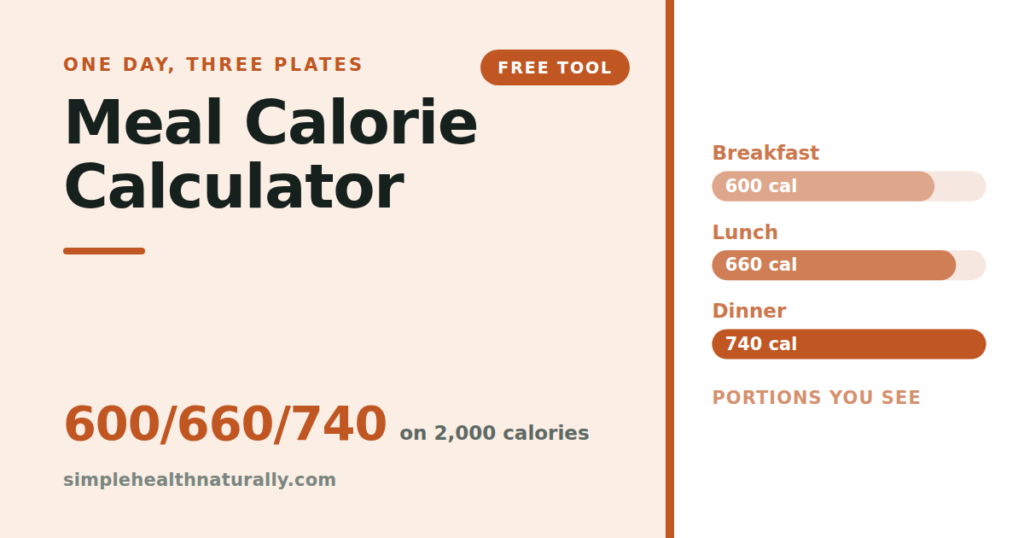
This meal calorie calculator takes your daily target and splits it across the sittings you actually eat, so a number like 2,000 turns into a breakfast, a lunch and a dinner you can picture. Pick the pattern that matches your day and the calculator does the arithmetic.
One thing worth saying up front. No official guidance tells you how to divide calories across the day, so the percentages here are a planning convenience rather than a rule. Protein is the exception, and the calculator handles that separately.
| Sitting | Share | Calories |
|---|
How Many Calories Per Meal Is Normal
No health body sets a calorie split across the day. The Dietary Guidelines, the National Academies and every major clinical body address the daily total and stop there. Everything you read about 30 percent at breakfast comes from planning habit rather than published guidance.
That leaves a practical question rather than a scientific one. Most people find three meals easiest to plan, so the table below shows what that looks like at common calorie levels.
| Daily calories | Breakfast 30% | Lunch 33% | Dinner 37% |
|---|---|---|---|
| 1,500 | 450 cal | 495 cal | 555 cal |
| 1,800 | 540 cal | 594 cal | 666 cal |
| 2,000 | 600 cal | 660 cal | 740 cal |
| 2,500 | 750 cal | 825 cal | 925 cal |
| 3,000 | 900 cal | 990 cal | 1,110 cal |
Those numbers land higher than most people guess. A 660 calorie lunch is a sandwich, a piece of fruit and a yogurt, not a bare salad. People who undershoot at lunch usually make it back after dinner.
Protein Is the One Thing Worth Spacing
Calories behave the same whenever you eat them. Protein does not, because muscle responds to the size of each dose rather than the daily pile.
A review of protein dosing by Schoenfeld and Aragon puts the useful dose at 0.4 to 0.55 grams per kilogram of bodyweight at each meal, spread across four meals. For a 78 kilogram person that means 31 to 43 grams a sitting, which adds up to the 1.6 to 2.2 grams per kilogram a day that most strength guidance lands on.
The practical version is simpler than the numbers suggest. Most people load protein at dinner and skip it at breakfast, so a move of eggs, yogurt or a shake into the morning fixes the pattern without changing the daily total. Our protein intake calculator works out the daily figure that sits behind this.
Which Eating Pattern to Pick
Five patterns cover most real days, and the right one is the one you can repeat.
- Three meals. The simplest to plan and the easiest to shop for. Works well for anyone who eats at set times.
- Three meals and a snack. Useful when the gap between lunch and dinner runs past six hours.
- Three meals and two snacks. Smaller sittings suit people who feel heavy after large meals, and it keeps a training snack in the plan.
- Four even meals. The pattern that fits the protein research best, and the one most lifters end up on.
- Two meals. A time restricted day. Each sitting gets large, so protein and vegetables need deliberate planning.
Adherence decides the result far more than the pattern does. A plan you follow four days out of seven loses to a plan you follow every day, whatever the split looks like on paper.
What the Meal Calorie Calculator Assumes
Three assumptions sit behind every number here, and each one has a limit worth knowing.
Your daily total is right. The split means nothing on top of a wrong total. The calculator estimates energy needs with the Mifflin St Jeor equation, and two people with identical measurements can differ by 10 to 20 percent. Run the daily calorie calculator and adjust from what the scale does over three weeks.
Every day looks the same. Real weeks contain a birthday, a late meeting and a long run. Treat the figures as a weekly average rather than a daily quota.
The percentages are a convenience. Nothing breaks if breakfast runs at 20 percent and dinner at 45 percent. The split exists to give you a starting portion size, not a target to hit.
How to Use Your Meal Calorie Calculator Result
Build three or four repeatable meals. Most people who eat well run a short rotation rather than a new recipe every night. Hit your per meal figure once and you can reuse it all week.
Put protein in every sitting first. Fill the rest with vegetables, then starch, then fat. That order keeps the calorie figure honest without any weighing.
Give the biggest meal to your hungriest window. Some people wake up ravenous and some cannot face food before noon. Match the largest number to whichever window that is.
Leave a buffer on days you train hard. Appetite rises after heavy sessions, and a planned extra snack beats an unplanned raid on the cupboard. Our calorie deficit calculator covers how large that weekly gap should be.
When a Fixed Split Backfires
- Type 1 diabetes, or type 2 managed with insulin. Carbohydrate at each meal drives the dose, so your care team sets the pattern rather than a calculator.
- Reactive hypoglycaemia. Large gaps between sittings cause trouble, and smaller frequent meals usually work better.
- Gastroparesis or after bariatric surgery. Meal volume matters more than meal calories, and the guidance comes from your clinician.
- Pregnancy. Needs rise through the trimesters and nausea reshapes the day.
- Any history of disordered eating. Fixed numbers at fixed times can turn into rules that are hard to put down.
Frequently Asked Questions
How many calories should each meal be?
On 2,000 calories a day across three meals, roughly 600 at breakfast, 660 at lunch and 740 at dinner. The exact split is a planning convenience, so shift it toward whichever meal you actually feel hungry for.
Does eating more meals speed up your metabolism?
No. Digestion burns a small share of what you eat, and that share tracks the total rather than the number of sittings. Six small meals and three large ones with the same food burn the same amount.
Should breakfast be the biggest meal?
Only if you are hungry in the morning. No official guidance sets a size for any meal, and appetite patterns vary enough that the same split suits nobody universally.
Is eating late at night bad?
The time on the clock matters less than what the late meal adds to your day. Late eating causes problems mainly when it comes on top of a full day rather than as part of it, and reflux or poor sleep are separate reasons some people avoid it.
How much protein should each meal have?
Around 0.4 to 0.55 grams per kilogram of bodyweight, which is 31 to 43 grams for a 78 kilogram person. Four meals at that dose covers the daily range most strength guidance recommends.
Can I skip a meal and add the calories to another one?
Yes. The daily total is what matters for weight. Larger sittings make protein spacing harder, so anyone training for muscle should keep at least three protein meals in the day.
How accurate are these numbers?
The split itself is exact arithmetic. The daily total behind it is an estimate, and energy needs vary by 10 to 20 percent between people with identical measurements, so adjust from what happens over three weeks.
Final Thoughts on Your Meal Calorie Calculator Result
The meal calorie calculator turns one daily number into portions you can actually picture, which is the step most people skip. A 2,000 calorie day means very little. A 740 calorie dinner means something you can shop for.
Treat the percentages as a starting shape rather than a rule. Put protein in every sitting, give the largest meal to your hungriest window, and judge the plan by what happens over three weeks rather than by how neatly the numbers divide.
This calculator provides general estimates for healthy adults and does not replace advice from your doctor or a registered dietitian. Read our full medical disclaimer and fact checking policy.