
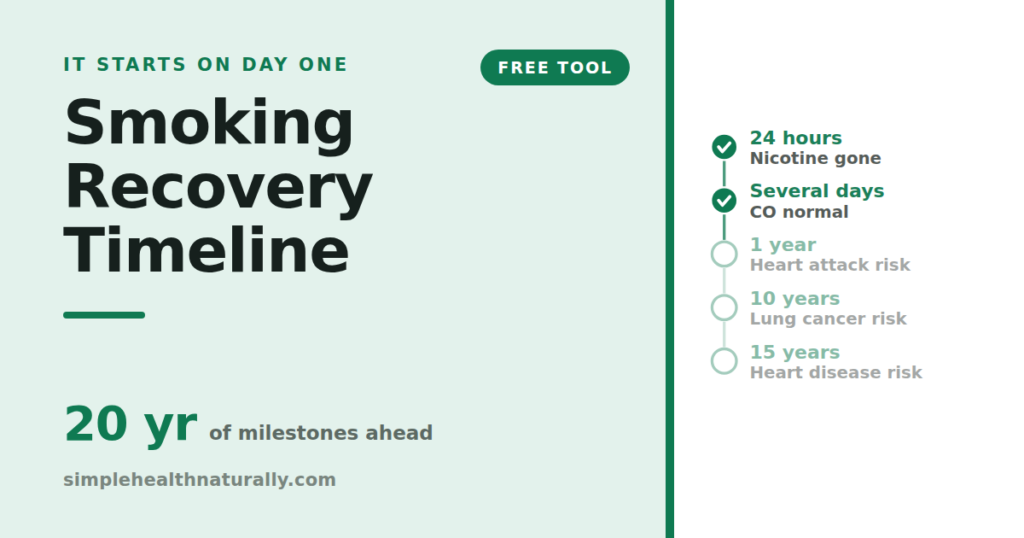
This smoking recovery timeline shows what your body repairs after your last cigarette and when each step arrives. Enter your quit date and the calculator marks off the milestones you have already passed, then tells you how long the next one takes.
It also counts the cigarettes you have not smoked, the money still in your pocket, and your pack years, which is the figure doctors use to describe a smoking history.
Your recovery timeline
The Smoking Recovery Timeline in Full
Recovery starts faster than most people expect and keeps going for decades. The CDC sets out the milestones as a series of time points rather than a single finish line.
| Time since quitting | What changes |
|---|---|
| Within minutes | Heart rate drops |
| 24 hours | Nicotine in the blood drops to zero |
| Several days | Carbon monoxide falls to the level of someone who does not smoke |
| 1 to 12 months | Coughing and shortness of breath decrease |
| 1 to 2 years | Risk of heart attack drops sharply |
| 3 to 6 years | Added risk of coronary heart disease drops by half |
| 5 to 10 years | Added risk of mouth, throat and voice box cancers drops by half, and stroke risk decreases |
| 10 to 15 years | Added risk of lung cancer drops by half |
| 15 years | Coronary heart disease risk comes close to that of someone who does not smoke |
| 20 years | Oral cancer risk approaches that of someone who never smoked, and cervical cancer risk drops by about half |
Older versions of this list circulate widely with tighter claims, such as 20 minutes for heart rate and 12 hours for carbon monoxide. The CDC now phrases those first steps more loosely, and the table above follows the current wording rather than the version copied around the internet.
What a Pack Year Measures
Pack years put how much and how long into one figure. One pack year means smoking an average of one pack a day for a year, so 20 cigarettes a day for 15 years comes to 15 pack years, and 10 a day for 30 years comes to the same.
The number matters because lung cancer screening uses it. The CDC screening criteria ask for a 20 pack year history or more, an age between 50 and 80, and either current smoking or quitting within the past 15 years.
A match with those criteria does not mean anything is wrong. The point of screening is to catch problems early in people whose history puts them at higher risk, and a doctor decides whether it fits your situation.
What the First Month Actually Feels Like
The timeline shows what improves. The first weeks also bring things the table leaves out, and knowing about them in advance makes them easier to sit through.
- Cravings peak early and get shorter. Most last a few minutes, and the gaps between them widen through the first month.
- A cough can get worse before it improves. The tiny hairs that clear your airways start working again, which brings up what was sitting there.
- Sleep and mood often wobble. Irritability and broken sleep in the first weeks are part of withdrawal rather than a sign the decision was wrong.
- Appetite usually rises. Nicotine suppresses appetite, so its absence shows up at the table.
Weight gain worries a lot of people enough to keep them smoking. The trade is worth naming plainly: a few kilograms carries nothing like the risk that continued smoking does, and the weight is a separate problem you can address later. Our daily calorie calculator is there when you get to it.
What This Smoking Recovery Timeline Cannot Tell You
Every figure here describes populations rather than individuals.
Your own pace depends on your history. Someone who smoked 5 a day for 3 years and someone who smoked 40 a day for 30 years both follow the same timeline on paper and not in reality. The heavier history takes longer and does not reach the same endpoint.
Risk drops rather than disappears. Several milestones say the added risk halves, which is not the same as returning to a never smoker level. Lung cancer risk stays somewhat higher for life after a heavy history.
Damage already done stays done. Emphysema does not reverse. A quit date stops it getting worse, which is a real and large benefit on its own.
How to Use Your Recovery Timeline
Look at the next milestone rather than the last one. A date three years out feels abstract. The one arriving in three weeks does not, and short horizons hold people through the hard part.
Check the money figure on a bad day. The number climbs every day whether you look at it or not, and seeing it grow gives the decision something concrete behind it.
Treat a slip as a data point. Most people who stop for good do it after several attempts. One cigarette resets nothing except the counter on this page.
Get help rather than relying on willpower. Stop smoking medication and behavioural support both improve the odds, and using them together works better than either alone. Your doctor or a national quitline can set that up.
When to Talk to a Doctor
- Before you start any stop smoking medication. Several options exist and they suit different people, so a short conversation saves a lot of trial and error.
- A cough that lasts beyond a few weeks, or any blood. That needs assessment rather than patience.
- Breathlessness that limits what you can do. Lung function testing gives you a real number rather than a guess.
- A history of 20 pack years or more, aged 50 to 80. Ask about lung cancer screening, whether you have quit or not.
- Low mood that persists past the first weeks. Withdrawal lifts. A mood that does not lift deserves attention on its own.
Frequently Asked Questions
How long does it take to recover from smoking?
Recovery runs in stages rather than finishing on one date. Heart rate drops within minutes, nicotine clears within 24 hours, and carbon monoxide falls to a non smoker level within several days. Coronary heart disease risk comes close to that of someone who never smoked at around 15 years.
Do your lungs go back to normal after quitting?
Partly. Coughing and shortness of breath decrease over the first year and the added risk of lung cancer drops by half after 10 to 15 years. Damage such as emphysema does not reverse, and quitting stops it getting worse.
What is a pack year?
Smoking an average of one pack a day for one year. Twenty cigarettes a day for 15 years gives 15 pack years, and so does 10 a day for 30 years. Doctors use the figure to describe how heavy a smoking history was.
Is it worth quitting after 30 years of smoking?
Yes. Quitting helps at every age and after any length of smoking. The early milestones arrive on the same schedule whatever your history, and the later ones still deliver a large drop in risk even though a heavy history does not return all the way to never smoker levels.
Why is my cough worse since I quit?
The tiny hairs that sweep your airways start working again once the smoke stops, so they clear material that had been sitting there. This usually settles within a few weeks. A cough that carries on or brings up blood needs a doctor.
Does one cigarette undo my progress?
No. It resets the counter on this page and not your recovery. Most people who stop for good get there after several attempts, so treat a slip as information about what triggered it.
Should I worry about gaining weight?
Some weight gain is common because nicotine suppresses appetite. A few kilograms carries nothing like the risk that continued smoking does, and the weight is a separate problem you can work on once the quit is settled.
Final Thoughts on Your Smoking Recovery Timeline
The smoking recovery timeline starts working within minutes and keeps paying out for twenty years. Nothing on that list requires perfection, and every milestone arrives simply because time passes without a cigarette.
Watch the next milestone rather than the far end. Ask your doctor about medication and support rather than relying on willpower alone, and check back here on the days the decision feels heavy.
This tool provides general information based on population averages and does not replace advice from your doctor. Read our full medical disclaimer and fact checking policy.