
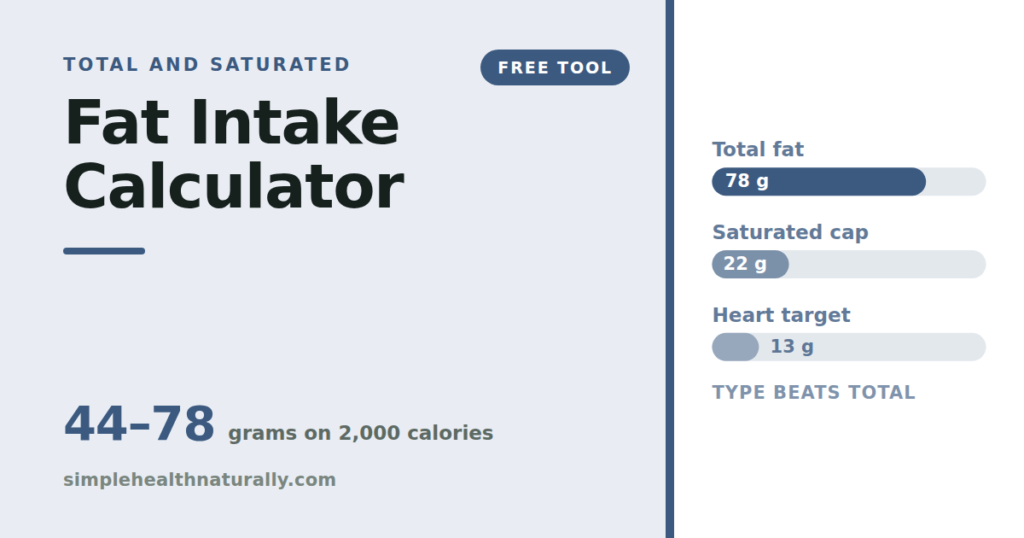
This fat intake calculator turns your daily calories into a fat target in grams, then shows the saturated fat ceiling that sits inside it. Fat carries more than twice the calories of carbohydrate or protein, so small changes in grams move your total further than people expect.
Total fat matters far less than the type these days. Guidance moved on from cutting fat to swapping one kind for another, and the calculator reflects that by showing your range, your saturated ceiling and the two essential fats your body cannot build on its own.
| Fatty acid | Your daily target | Where to get it |
|---|
| Approach | Fat a day | What it means |
|---|
How Much Fat a Day Is Normal
Fat carries 9 calories per gram, more than double the 4 that carbohydrate and protein carry. That density is why fat targets look small next to carb targets even when fat supplies a third of your energy.
The accepted range runs from 20 to 35 percent of calories. That figure comes from the National Academies report that set the macronutrient reference intakes, which also gives 45 to 65 percent for carbohydrate and 10 to 35 percent for protein.
| Daily calories | Fat at 20 to 35% | Saturated cap at 10% | AHA target at 6% |
|---|---|---|---|
| 1,600 | 36 to 62 g | 18 g | 11 g |
| 2,000 | 44 to 78 g | 22 g | 13 g |
| 2,400 | 53 to 93 g | 27 g | 16 g |
| 2,800 | 62 to 109 g | 31 g | 19 g |
| 3,200 | 71 to 124 g | 36 g | 21 g |
The gap between the two ends is wide on purpose. Someone on 2,000 calories can eat 44 grams of fat or 78 grams and both sit inside official guidance. What fills those grams matters far more than where in the range you land.
Saturated Fat Is the Number That Actually Matters
Total fat stopped being the main concern in nutrition guidance years ago. The type replaced the total, and saturated fat carries the clearest evidence for raising LDL cholesterol.
Two ceilings exist and they serve different people.
Under 10 percent of calories. The Dietary Guidelines figure, which works out at 22 grams a day on 2,000 calories. Treat this as the general population ceiling.
Under 6 percent of calories. The American Heart Association target, about 13 grams a day on 2,000 calories. This one applies to people who need to bring cholesterol down.
Thirteen grams goes faster than it sounds. A tablespoon of butter carries about 7. Two ounces of cheddar carries about 12. A large fast food burger can clear the whole day on its own.
The swap matters as much as the cut. Saturated fat replaced by refined carbohydrate does very little. Saturated fat replaced by unsaturated fat from olive oil, nuts or fish shows a consistent benefit across studies.
The Two Fats Your Body Cannot Make
Your body builds most fats from scratch. Two exceptions exist, and both have to come from food.
| Essential fat | Adequate intake | Common sources |
|---|---|---|
| Linoleic acid, omega 6 | 17 g for men 19 to 50, 14 g for men 51 and over, 12 g for women 19 to 50, 11 g for women 51 and over | Sunflower and soybean oil, walnuts, seeds |
| Alpha linolenic acid, omega 3 | 1.6 g for men, 1.1 g for women | Walnuts, flaxseed, chia, rapeseed oil |
Most people in developed countries clear the omega 6 target easily and fall short on omega 3. The calculator shows both so you can see which one needs attention.
EPA and DHA sit in a separate category. Your body converts a small share of alpha linolenic acid into them, and that conversion runs at a low rate, which is why oily fish twice a week appears in so much guidance. No official daily requirement exists for either one.
Trans Fat and Why It Nearly Vanished
Partially hydrogenated oil was the main source of industrial trans fat for decades. US regulators removed it from the generally recognised as safe list in 2015, and manufacturers reformulated through the following years.
Two things still catch people out. Labels round anything under 0.5 grams per serving down to zero, so several servings of a product listing zero can still add up. And small amounts occur naturally in dairy and beef, which behave differently from the industrial kind.
Check the ingredient list rather than the label figure. The words partially hydrogenated tell you more than the number does.
What the Fat Intake Calculator Cannot See
A gram target treats every fat as equivalent, and the research does not. Two people can hit 78 grams and end up in very different places.
- Olive oil, nuts and avocado. Mostly monounsaturated. The Mediterranean pattern built on these has the strongest evidence of any whole diet studied.
- Oily fish, walnuts and seeds. Polyunsaturated, and the source of the fats you cannot make yourself.
- Butter, cheese, fatty meat and coconut oil. Mostly saturated. These count against the ceiling rather than the total.
A 78 gram day of olive oil and salmon and a 78 gram day of butter and processed meat produce the same number here and different blood work six months later.
How to Use Your Fat Intake Calculator Result
Set fat last, not first. Protein comes first because it protects muscle. Carbohydrate follows because it fuels training. Fat fills whatever calories remain, which is how our keto macro calculator and carb intake calculator both work.
Watch the saturated line rather than the total. Most people who improve their blood work do it by changing the type rather than cutting the amount.
Measure oil for a week. Olive oil poured by eye runs at two or three tablespoons where people estimate one. That single habit accounts for a large share of the gap between what people think they eat and what they actually eat.
Start from an accurate calorie figure. The percentage means nothing on top of a wrong total, so run the daily calorie calculator first and paste its result in.
When to Talk to Someone First
- Familial hypercholesterolaemia or very high LDL. The saturated fat target usually drops below the general figure and medication often comes with it.
- Gallbladder removal or gallstones. Large fat loads at one sitting cause trouble, so the same daily total spread differently often solves it.
- Pancreatitis. Fat restriction is part of the treatment rather than a preference.
- Fat malabsorption, coeliac disease or Crohn's disease. Both the amount and the type need clinical input.
- Any history of disordered eating. Macro targets can make things worse rather than better.
Frequently Asked Questions
How many grams of fat should I eat a day?
Between 20 and 35 percent of your calories, which lands at 44 to 78 grams on a 2,000 calorie day. Fat carries 9 calories per gram, so the gram figure always looks small next to carbohydrate.
Is low fat better than low carb?
Neither wins outright. Head to head trials show similar weight loss when calories and protein match. Pick the one you can keep up, then focus on the quality of the fat or the carbs you eat.
How much saturated fat is too much?
Above 10 percent of calories for most people, which is 22 grams on a 2,000 calorie day. The American Heart Association sets a stricter 6 percent target for anyone who needs to lower cholesterol, which comes to about 13 grams.
Does eating fat make you fat?
No. A calorie surplus does that, whatever it comes from. Fat is easy to overeat because it is calorie dense, so measured portions matter more with oil and nuts than with most other foods.
Is coconut oil healthy?
It sits at roughly 82 percent saturated fat, higher than butter, and it raises LDL cholesterol in controlled trials. Treat it as a saturated fat rather than a health food, and count it against your ceiling.
Do I need an omega 3 supplement?
Not if you eat oily fish twice a week. Anyone who eats none has a reasonable case for an algae or fish oil supplement, and your doctor can tell you whether it fits your situation.
Should I cut fat to lower my cholesterol?
Cut saturated fat rather than total fat. Replacements matter too, because unsaturated fat lowers LDL while refined carbohydrate mostly does not.
Final Thoughts on Your Fat Intake Calculator Result
The fat intake calculator gives you a range rather than a rule, and 20 to 35 percent of calories covers almost everyone. Where you land inside that range matters far less than what fills the grams.
Watch the saturated line, put olive oil and nuts and oily fish in the rest, and measure your cooking oil for a week to see what you actually pour. Those three habits move your blood work more than any decimal point in the total ever will.
This calculator provides general estimates for healthy adults and does not replace advice from your doctor or a registered dietitian. Read our full medical disclaimer and fact checking policy.