A cough for three days means very little. A cough for three months means something. Duration separates the symptoms worth checking from the ones your body sorts out alone, and most people get that line wrong in both directions.
This guide gives ten common complaints with the usual harmless causes, the duration threshold that changes the answer and the extra signs that matter. One of them needs 911 rather than an appointment, and that one comes first.
Call 911 For This One, Even If It Stops
Sudden numbness or weakness on one side of the body needs emergency care right now.
Symptoms that vanish after a few minutes still count. A transient ischemic attack, sometimes called a mini stroke, produces the same symptoms as a stroke and then resolves. The American Stroke Association reports that a TIA occurs before about 15 percent of strokes, and about a third of people who have one go on to have a more severe stroke within a year.
Timing is brutal here. Half the strokes that follow a TIA happen within the next two days.
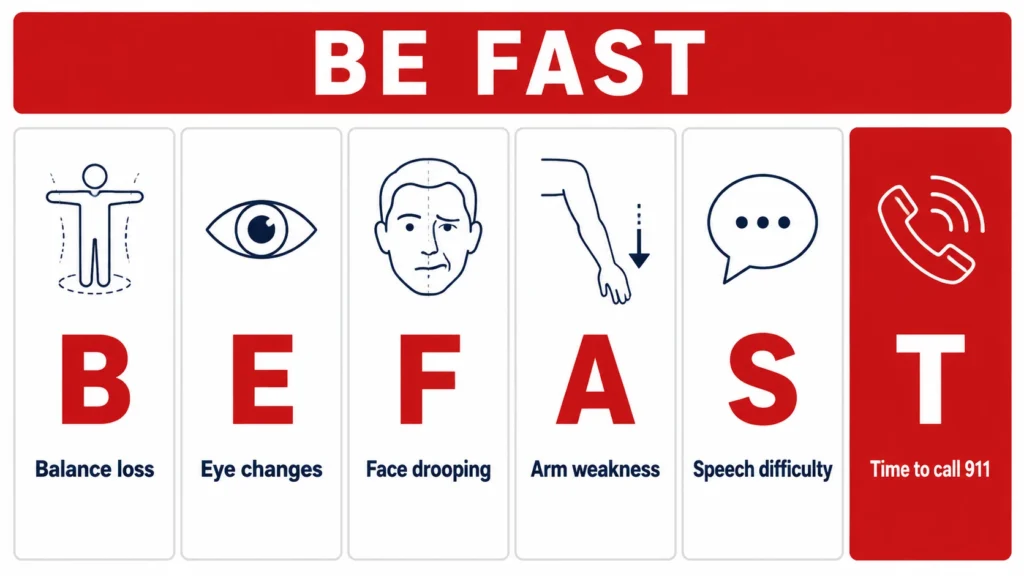
Remember BE FAST.
- Balance loss or sudden dizziness
- Eye changes, blurred or lost vision
- Face drooping on one side
- Arm weakness, one arm drifting down
- Speech slurred or hard to understand
- Time to call 911
Do not drive yourself. Do not wait to see whether it settles. Clot dissolving treatment works within a narrow window and ambulance crews start assessment on the way.
Everything else on this list can wait for an appointment. This one cannot.
How to Use This List
Three principles keep you out of a symptom checker spiral.
Common things are common. A persistent cough is usually post viral irritation, asthma, reflux or postnasal drip. Lung cancer exists and sits far down the list of likely causes. Start with the likely explanation.
Duration is the real signal. Almost everything here becomes worth checking at a specific point. Below that threshold, watchful waiting is reasonable.
Combinations matter more than single symptoms. Fatigue alone tells you little. Fatigue with unplanned weight loss and night sweats tells you a lot.
This list helps you decide when to book an appointment. It cannot diagnose anything and neither can any chart.
The 10 Symptoms and Their Thresholds
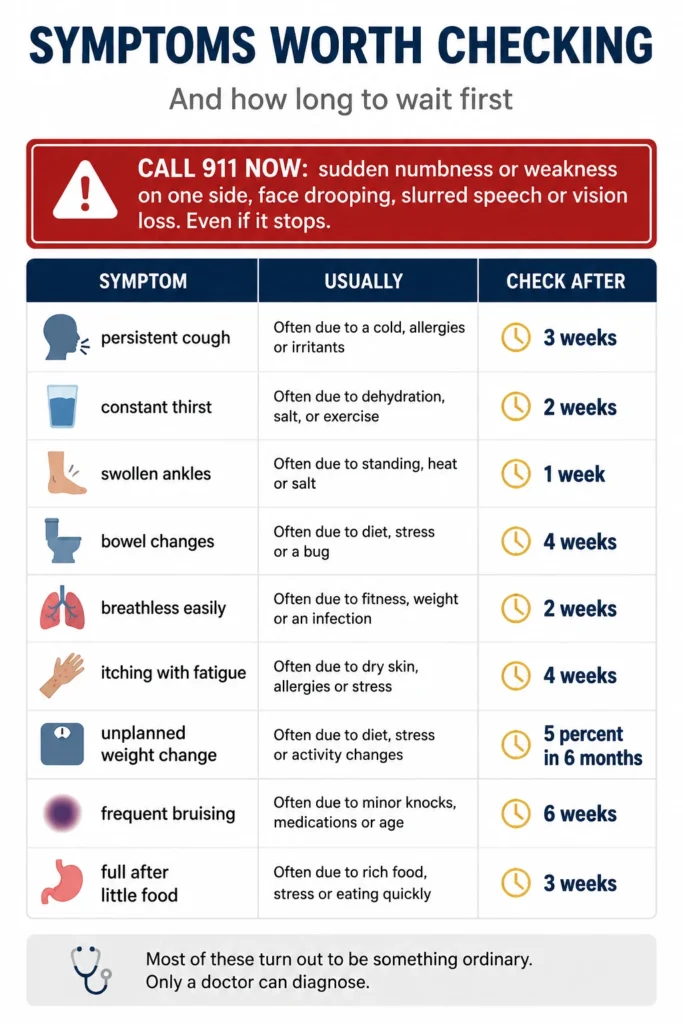
| Symptom | Usually | Check It After |
|---|---|---|
| Persistent cough | Post viral, asthma, reflux | 3 weeks |
| Constant thirst and urination | Heat, medication, habit | 2 weeks |
| Swollen feet or ankles | Standing, heat, salt, sitting still | 1 week, sooner if one leg |
| Change in bowel habits | Diet, stress, medication | 4 weeks |
| Breathless during easy activity | Deconditioning, weight, anemia | 2 weeks |
| Persistent itching with fatigue | Dry skin, eczema, allergy | 4 weeks |
| Unexplained weight change | Diet, stress, activity change | 5 percent in 6 months |
| Frequent infections or bruising | Normal variation, medication | 6 to 8 weeks |
| Full after very little food | Reflux, gastritis, stress | 3 to 4 weeks |
| Numbness on one side | Nothing benign | Call 911 immediately |
1. A Cough That Will Not Go Away
Usually. Post viral cough after a cold, which can persist for weeks. Asthma, acid reflux, postnasal drip and blood pressure medications called ACE inhibitors all cause chronic cough too. Smoking causes plenty of it.
Check it after three weeks. Doctors call a cough chronic at eight weeks, and three is a sensible point to get looked at.
Go sooner for these. Coughing blood, chest pain, breathlessness, unplanned weight loss, hoarseness lasting weeks, or a cough that changes character in a long term smoker.
What they might do. Listen to your chest, ask about reflux and medications, possibly a chest X ray.
2. Constant Thirst and Frequent Urination
Usually. Hot weather, high salt intake, caffeine, diuretic medications or simply drinking a lot out of habit.
Check it after two weeks. Persistent thirst that water does not satisfy is one of the more specific early diabetes signs.
Go sooner for these. Blurred vision, unplanned weight loss, extreme fatigue, slow healing cuts, frequent thrush or urinary infections.
What they might do. A finger prick glucose test or an A1C blood test. Both are quick and settle the question.
Type 2 diabetes often causes nothing noticeable for years. Testing catches it early enough to matter.
3. Swollen Feet or Ankles
Usually. Standing all day, sitting on a long flight, hot weather, high salt intake, pregnancy or certain blood pressure medications.
Check it after a week if both legs stay swollen and elevation does not help.
Go the same day if one leg swells alone, especially with warmth, redness or calf pain. That pattern can indicate a blood clot, which can travel to the lungs.
Go sooner for these. Breathlessness, swelling that reaches the thighs, reduced urination, or swelling with facial puffiness in the morning.
What they might do. Check your heart, kidneys and liver with blood tests and possibly an ultrasound.
4. A Change in Bowel Habits
Usually. Diet changes, stress, travel, new medication, or irritable bowel syndrome.
Check it after four weeks of a genuinely changed pattern. That means looser or firmer stools, going more or less often, or a persistent change in shape.
Go sooner for these. Blood in stool, black tarry stools, unplanned weight loss, persistent abdominal pain, or a feeling of not emptying completely.
Anyone over 45 should be up to date on colorectal cancer screening regardless of symptoms. Screening catches things before symptoms appear at all.
What they might do. Examine your abdomen, order blood tests, possibly a stool test or referral for colonoscopy.
5. Getting Breathless During Easy Activity
Usually. Loss of fitness, weight gain, anemia, anxiety or asthma. Most breathlessness has a straightforward explanation.
Check it after two weeks if activities you managed easily last year now leave you winded.
Go sooner for these. Chest pain or pressure, breathlessness lying flat, waking at night gasping, ankle swelling alongside it, or a sudden onset.
Chest pain with breathlessness means 911. Do not wait on that combination.
What they might do. Blood tests for anemia and thyroid, an ECG, possibly a chest X ray or echocardiogram.
Our guide to body pain and when to see a doctor covers the chest pain red flags in more detail.
6. Persistent Itching With Fatigue
Usually. Dry skin, eczema, allergies, dermatitis or simply winter air. Skin conditions explain the vast majority of itching.
Check it after four weeks of itching with no rash, especially alongside fatigue.
Go sooner for these. Yellowing of the skin or eyes, dark urine, pale stools, swelling in the abdomen, or itching that wakes you at night.
What they might do. Liver function blood tests, kidney function, thyroid and a full blood count.
Itching without a rash occasionally points to liver, kidney or thyroid problems. Itching with a rash almost always means a skin condition.
7. Weight Loss or Gain You Did Not Plan
Usually. Changes in appetite from stress, altered activity levels, medication side effects or a diet shift you did not register.
Check it if you lose more than 5 percent of your body weight in six months without trying. For someone weighing 160 pounds that is 8 pounds.
Unplanned gain with swelling, fatigue and cold intolerance points more toward thyroid.
Go sooner for these. Night sweats, fever, lumps, persistent pain, or appetite loss alongside the weight change.
What they might do. Thyroid tests, blood count, blood glucose and a general examination.
Unexplained weight loss is one of the symptoms doctors take most seriously across nearly every specialty.
8. Frequent Infections or Easy Bruising
Usually. Normal variation, young children in the house, medications including steroids and blood thinners, or simply bumping into things more than you notice.
Check it after six to eight weeks of a genuine pattern change. Several infections in a season, or bruises appearing without any remembered knock.
Go sooner for these. Bruising in unusual places like your torso, bleeding gums, frequent nosebleeds, tiny red pinpoint spots on the skin, bone pain, night sweats, or swollen lymph nodes.
What they might do. A full blood count, which is a simple test that answers most of the question.
9. Feeling Full After Very Little Food
Usually. Acid reflux, gastritis, stress, or slowed stomach emptying which is common with diabetes.
Check it after three to four weeks of consistently eating far less than usual because you feel full quickly.
Go sooner for these. Weight loss alongside it, difficulty swallowing, persistent vomiting, black stools, or abdominal pain.
What they might do. Blood tests, possibly a referral for endoscopy.
Difficulty swallowing that worsens over weeks deserves prompt attention rather than watchful waiting.
10. Persistent Fatigue
Usually. Poor sleep, stress, low activity, iron deficiency, thyroid problems, sleep apnea or depression. Those account for the overwhelming majority.
Check it after four weeks of fatigue that rest does not fix.
Go sooner for these. Fatigue with weight loss, night sweats, fever, breathlessness, or swollen lymph nodes.
What they might do. Blood count, iron studies, thyroid tests, blood glucose and vitamin levels.
Our list of iron-rich vegetables ranked by iron content covers dietary iron, though persistent fatigue needs a blood test rather than a grocery list.
Screening Catches What Symptoms Miss
Waiting for symptoms is the weakest strategy available for several conditions. These cause nothing noticeable until they cause damage.
| Screening | Who and When |
|---|---|
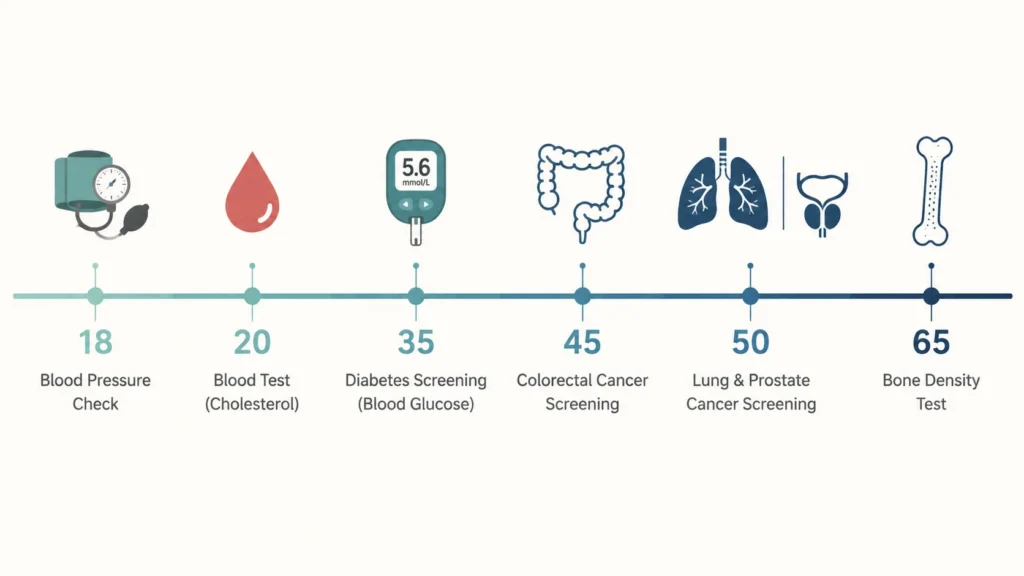
| Blood pressure | Every adult, at least every 2 years from 18 |
| Cholesterol | From age 20, every 4 to 6 years, sooner with risk factors |
| Type 2 diabetes | From age 35, every 3 years, earlier with excess weight |
| Colorectal cancer | From age 45 through 75 |
| Cervical cancer | Women from 21, every 3 to 5 years depending on the test |
| Breast cancer | Women, mammogram discussion from 40, routinely from 50 |
| Lung cancer | Yearly CT for adults 50 to 80 with significant smoking history |
| Prostate cancer | Men, discuss with your doctor from 50, or 45 with family history |
| Hepatitis C | At least once for every adult |
| Osteoporosis | Women from 65, earlier with risk factors |
These ages follow US Preventive Services Task Force recommendations, which are revised as evidence changes. Your own history matters too, since family history, ethnicity, weight and smoking all move these dates earlier.
Three of these deserve emphasis.
Blood pressure. Completely silent until it damages your heart, kidneys or eyes. A two minute check catches it.
Type 2 diabetes. Often present for years before thirst or fatigue appear. A blood test finds it far earlier.
Colorectal cancer. Screening finds and removes growths before they become cancer at all. This is prevention rather than early detection, which makes it unusually valuable.
Ask your doctor which of these apply to you at your next visit. That single question does more than any symptom list.
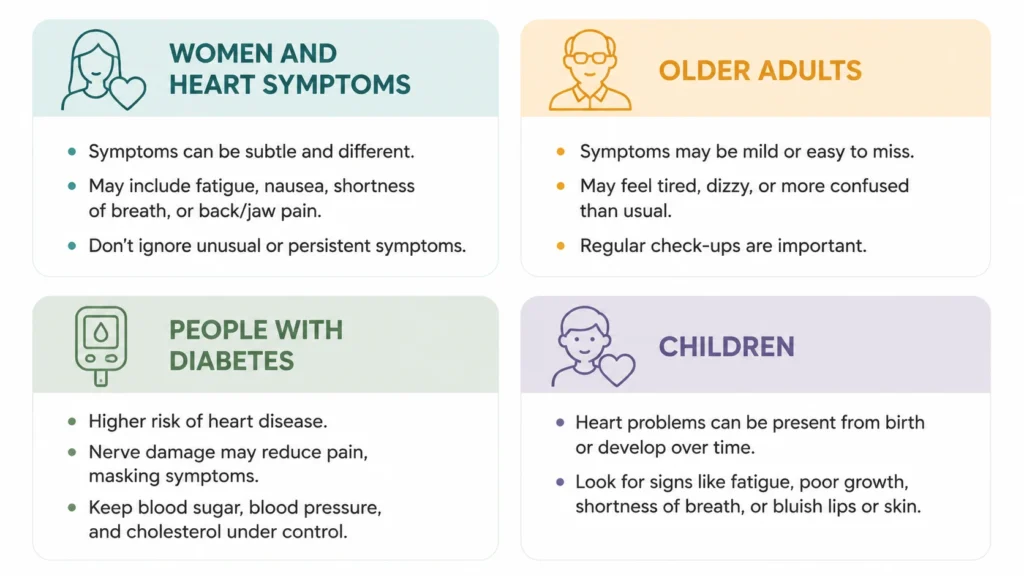
Symptoms Present Differently in Some Groups
Standard symptom descriptions assume a middle aged adult in reasonable health. Several groups do not match that template.
Women and heart symptoms. Classic crushing chest pain is more typical in men. Women more often report shortness of breath, nausea, jaw or back pain, and unusual fatigue. Those get dismissed as stress or indigestion far too often.
Older adults. Infections may cause confusion rather than fever. Heart attacks may cause breathlessness rather than chest pain. Serious abdominal problems may produce surprisingly mild pain. A lower threshold for getting checked makes sense with age.
People with diabetes. Nerve damage blunts pain signals. Heart attacks can be silent and foot injuries can go unnoticed until they become serious.
Children. Young children cannot describe symptoms well. Watch behavior instead. Refusing to walk, unusual stillness, inconsolable crying or a marked drop in activity all warrant a call.
During pregnancy. Severe headache with vision changes, sudden swelling, severe abdominal pain or calf swelling all need same day contact with your provider.
People taking blood thinners. Bruising and bleeding carry more weight, and head injuries need assessment even when they seem minor.
Why People Wait Too Long
Understanding the delay helps you avoid it.
It comes and goes. Intermittent symptoms feel less serious than constant ones. They are not.
It improved slightly. Small improvement feels like resolution. Track the overall trend rather than the last two days.
Life is busy. Appointments get postponed until the symptom becomes impossible to ignore.
Fear of what they might find. This is the most common and the most costly. Almost every condition on this list responds better to early treatment.
Not wanting to waste anyone’s time. Doctors would far rather see ten people with nothing wrong than miss one person who needed help. Being sent home reassured is a good outcome.
Assuming it is age. Fatigue, breathlessness and joint problems get attributed to getting older. Sometimes correctly and often not.
Book the appointment while it feels unnecessary. That is exactly when it is most useful.
Red Flags That Apply to Any Symptom
These matter regardless of what else is happening.
- Unplanned weight loss
- Night sweats that soak through clothing
- Fever lasting more than a few days with no clear cause
- A new lump anywhere
- Bleeding from anywhere without explanation
- Symptoms that steadily worsen rather than fluctuating
- Anything that wakes you from sleep consistently
- A symptom that feels completely unlike anything you have had before
That last one deserves weight. People know their own bodies.
What This List Cannot Do
Straight talk protects you here.
No chart diagnoses anything. Every symptom on this list has many possible causes, and the common ones far outnumber the serious ones.
Symptom checking online increases anxiety without improving outcomes. Searching a symptom reliably surfaces the worst possibility rather than the likeliest one.
Absence of symptoms does not mean absence of disease. High blood pressure, early diabetes and early kidney disease all cause nothing at first. Screening catches those, not symptom watching.
A normal test result is genuinely reassuring. Getting checked and being told nothing is wrong is a good outcome rather than a wasted visit.
Book the appointment, describe what changed and let your doctor sort the likelihood.

How to Describe Symptoms to Your Doctor
Better description gets better answers. Bring these.
When it started. An actual date beats “a while ago”.
What changed. Compared with your normal, not compared with anyone else.
Whether it is steady or comes and goes.
What makes it better or worse. Food, position, time of day, activity.
What else is happening. Weight, sleep, appetite, mood, bowel habits.
What you have tried. Medications, doses and whether they helped.
Writing this down beforehand takes five minutes and makes a short appointment far more useful.
Frequently Asked Questions
How long should I wait before seeing a doctor?
Roughly three to four weeks for most persistent symptoms. Sooner if it worsens, and immediately for numbness on one side, chest pain or difficulty breathing.
Should I go to the ER or my regular doctor?
Regular doctor for anything on this list except one sided numbness or weakness, which needs 911. Chest pain and severe breathlessness also need emergency care.
What if my symptoms come and go?
Intermittent symptoms still count if the pattern persists. Track when they happen and bring that record to your appointment.
Is a persistent cough always serious?
No. Most chronic cough comes from post viral irritation, asthma, reflux or postnasal drip. Three weeks is a reasonable point to get it checked.
Why does numbness need 911 even if it stops?
Because a TIA and a stroke look identical while they are happening, and half the strokes that follow a TIA occur within two days. Treatment works in a narrow window.
Can anxiety cause physical symptoms?
Yes, and commonly. Breathlessness, chest tightness, fatigue and digestive changes all occur with anxiety. That does not mean skipping the check, since anxiety is a diagnosis of exclusion.
What tests will my doctor probably order?
A full blood count, thyroid function, blood glucose and iron studies cover a great deal. Specific symptoms add specific tests.
Should I get screened even without symptoms?
Yes. Blood pressure, cholesterol, diabetes and colorectal cancer screening all catch problems before symptoms appear. Ask which apply to your age and history.
At what age should screening start?
Blood pressure from 18, cholesterol from 20, diabetes from 35, colorectal cancer from 45. Family history and risk factors move several of these earlier.
Do heart symptoms differ in women?
Often. Women more frequently report shortness of breath, nausea, jaw or back pain and unusual fatigue rather than classic chest pressure. Those signs get dismissed too readily.
Why do older adults get different symptoms?
Pain and fever responses blunt with age. Infections may cause confusion instead of fever, and heart attacks may cause breathlessness instead of chest pain. A lower threshold for seeking care makes sense.
What if I cannot tell whether it is serious?
Call your doctor’s office nurse line and describe what is happening. Trained staff will tell you whether to come in, and that call costs nothing.
Final Thoughts on Symptoms Worth Checking
Duration does most of the work in deciding what matters. The symptoms worth checking here almost all share a threshold, usually somewhere around three to four weeks, past which watchful waiting stops being reasonable.
One exception overrides everything. Sudden numbness or weakness on one side means 911 immediately, even when it stops on its own.
Everything else on this list usually turns out to be something ordinary. Book the appointment anyway once it passes the threshold. Being told nothing is wrong is the most common outcome and a genuinely good one.
References
- American Stroke Association. Transient Ischemic Attack (TIA). stroke.org
- National Institute of Neurological Disorders and Stroke. Know Stroke: See the Signs. Act F.A.S.T. ninds.nih.gov
This article shares general health information. It does not replace advice from your doctor and it cannot diagnose any condition. Call emergency services for sudden numbness or weakness on one side, face drooping, speech difficulty, chest pain or severe breathlessness. Talk with a healthcare provider about any symptom that persists or worries you. Read our full medical disclaimer and fact checking policy.
About the Author and Reviewer
Mezbaul Islam, MSc Nutrition owns and writes Simple Health Naturally. He researches each article from public health guidance, clinical guidelines and peer reviewed studies, and traces every figure back to a named source.
Dr. Obeydur Rahman, MBBS, MD in Medicine edits the articles, checks the sources cited and is responsible for the site’s editorial standards. MD in Medicine is the specialty for adult conditions such as liver disease, type 2 diabetes and high blood pressure.
Read more about our authors and reviewers or see our editorial policy.
Edited by Dr. Obeydur Rahman, MBBS, MD in Medicine.