
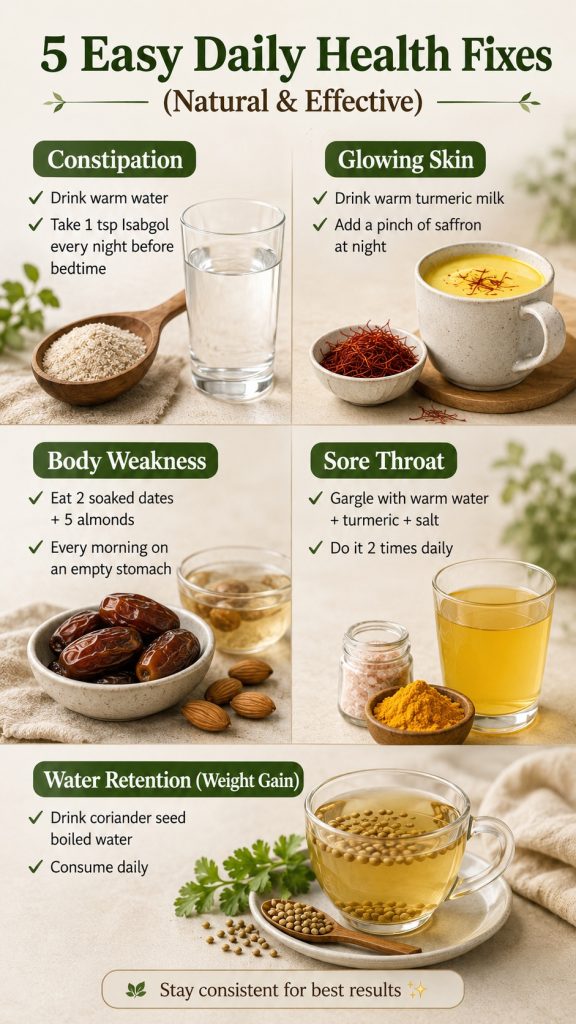
Most advice about daily wellness habits skips the numbers, which is exactly what makes it useless. So here are five habits with a target attached to each one: 25 to 38 g of fibre, sunscreen every morning, a snack that clears 20 g of protein, a 30 second gargle, and roughly 7,000 steps. Every figure below comes from a named study or a government source, and each habit is one you can start tomorrow.
You will also find the honest limits. Turmeric milk does not clear your skin, coriander water does not treat fluid retention, and nothing here replaces a doctor when a symptom persists.
Medical Disclaimer: This is educational and is not medical advice. Speak to a doctor or dietitian before starting a supplement, changing your diet substantially, or self treating a symptom that keeps coming back. Read our medical disclaimer, editorial policy and fact checking policy.
Habit 1. Hit a Real Fibre Number
The target is 25 g a day for women and 38 g for men, or about 14 g for every 1,000 calories you eat. Between 2017 and 2020, US adults averaged around 17 g. Roughly 90 percent of women and 97 percent of men fall short.
That gap is why constipation is so common, and it is also why vague advice to eat more vegetables rarely fixes it. Closing a 10 g gap takes specific foods.
| Food | Portion | Fibre |
|---|---|---|
| Cooked black beans | 1 cup | 15 g |
| Cooked lentils | 1 cup | 15.6 g |
| Chia seeds | 2 tbsp | 9.8 g |
| Raspberries | 1 cup | 8 g |
| Rolled oats, dry | Half cup | 4 g |
| Medium pear with skin | 1 | 5.5 g |
One cup of beans plus a cup of raspberries is 23 g, which on its own nearly meets the women’s target.
Where psyllium fits
Psyllium husk, also sold as isabgol, is the fibre supplement with the strongest evidence for constipation. A meta analysis of 16 randomised trials in 1,251 adults found that psyllium significantly increased stool frequency, and that doses above 10 g a day taken for at least 4 weeks worked best. It is a supplement, not a substitute for food fibre.
- Never swallow it dry, and always take it with a full glass of water
- Increase fibre gradually over a week or two to limit bloating and gas
- Do not take it right before lying down
- Stop and see a doctor for difficulty swallowing, severe abdominal pain, vomiting, or rectal bleeding
Habit 2. Sunscreen Every Morning, Not Just on Beach Days
This is the only skin habit here with a randomised trial behind it. In the Nambour trial in Australia, 903 adults under 55 were randomly assigned to apply broad spectrum sunscreen daily or to use it at their own discretion. After 4.5 years, the daily group showed 24 percent less skin ageing than the discretionary group, and no detectable increase in ageing over the trial period at all.
Nothing you drink comes close to that result. What actually supports skin over years is unglamorous and repetitive.
- Broad spectrum SPF 30 or higher, every morning, reapplied if you are outdoors
- Not smoking, which is the second best evidenced skin factor
- Seven or more hours of sleep
- A gentle cleanser and a plain moisturiser rather than a long routine
- A varied diet, covered in our guide to foods that support skin as you age
Persistent acne, a new or changing mole, unexplained pigmentation, or a rash that will not settle needs a doctor, not a longer skincare shelf.
Habit 3. Build the Morning Snack Around Protein
Dates and almonds are the classic morning pairing, so here is what they actually contain. Two Medjool dates plus 28 g of almonds comes to:
- 295 calories
- 6.8 g protein
- 6.7 g fibre
- 33 g sugar
- 7.2 mg vitamin E, about half the daily 15 mg target
- 102 mg magnesium
That is 295 calories for under 7 g of protein, which is a poor trade if your goal is to stay full until lunch. A better version keeps the same foods and adds a protein base:
1 Medjool date, 14 g almonds and 170 g plain Greek yogurt: 248 calories, 20.7 g protein, 3.4 g fibre. Fewer calories, three times the protein.
There is no medical reason to eat dates or almonds on an empty stomach. Timing does not change absorption in any way that matters. For more options built the same way, see our high protein breakfast ideas.
One caution worth repeating: ongoing tiredness is not a snacking problem. Persistent weakness can point to anaemia, thyroid disease, sleep apnoea, diabetes, infection, or a medication side effect. If it lasts more than a couple of weeks, get bloods done rather than eating more dates.
Habit 4. Gargle, and Know What It Does
Gargling has better evidence than most people expect. A randomised trial in 387 healthy adults aged 18 to 65 compared gargling with plain water three times a day, gargling with povidone iodine, and usual care over one cold season. The plain water group had roughly 36 percent fewer upper respiratory infections. The antiseptic group showed no clear advantage over doing nothing.
So plain water is the version that was tested. For an existing sore throat, warm salt water is a reasonable comfort measure.
- Dissolve about half a teaspoon of salt in one glass of warm water
- Gargle for 30 seconds, then spit it out. Do not swallow
- Repeat a few times a day while symptoms last
Turmeric adds nothing to the gargle. Salt water soothes, it does not treat strep throat or any other infection. Young children should not gargle unless they can do it without swallowing.
See a doctor if the sore throat lasts more than a week, comes with difficulty breathing or swallowing, prevents you drinking, or is paired with a persistent high fever.
Habit 5. Move to 7,000 Steps and Cut the Salt
A 2025 systematic review in The Lancet Public Health pooled 57 studies covering more than 160,000 adults and compared step counts against 2,000 steps a day. At 7,000 steps, the associations were:
| Outcome | Lower risk at 7,000 steps |
|---|---|
| All cause mortality | 47 percent |
| Dementia | 38 percent |
| Falls | 28 percent |
| Cardiovascular disease | 25 percent |
| Depression | 22 percent |
| Type 2 diabetes | 14 percent |
| Cancer incidence | 6 percent |
The old 10,000 figure came from a 1960s pedometer name, not research. 7,000 is both better evidenced and more achievable. Alongside steps, the CDC recommends at least 150 minutes of moderate activity a week plus 2 days of muscle strengthening.
Movement also handles mild ankle swelling
Temporary leg or ankle swelling after a long flight, a desk day, or a salty meal usually responds to the calf muscle pump rather than any drink. Walk for a few minutes every hour, elevate your legs above heart level when resting, and check your salt.
Americans average more than 3,300 mg of sodium a day against a recommended limit of under 2,300 mg. One teaspoon of table salt is about 2,400 mg on its own, and most of the excess comes from packaged and restaurant food rather than the salt shaker.
Get urgent care for sudden swelling in one leg, redness or severe calf pain, chest pain, breathlessness, fainting, or coughing up blood. Unexplained or persistent swelling needs assessment for heart, kidney, liver, vein, or medication causes.
Sleep Is What Makes the Other Five Work
The American Academy of Sleep Medicine recommends at least 7 hours a night for adults. According to CDC National Health Interview Survey data for 2024, 30.5 percent of US adults sleep less than that, only 54.8 percent wake up feeling well rested, 15.4 percent have trouble falling asleep most days, and 18.1 percent have trouble staying asleep.
Short sleep undermines every habit above. It raises appetite for high sugar food, cuts training capacity, and worsens mood. If you only fix one thing this month, a consistent bedtime and wake time is the change with the widest reach.
What Daily Wellness Habits Cannot Do
Three claims come up constantly and none of them hold.
- Turmeric milk and saffron for glowing skin. Culinary amounts are fine and pleasant. There is no trial showing they clear or brighten skin, and higher doses of turmeric can cause stomach upset or interact with medicines including blood thinners
- Coriander seed water for fluid retention. A traditional drink with no reliable evidence behind it. Persistent swelling is a signal to be investigated, not managed at home
- Anything eaten on an empty stomach. There is no mechanism that makes food more effective before other food. It is a marketing idea, not a physiological one
For a broader look at what food realistically can and cannot address, see our guides to everyday foods that support your health and the best foods for common health concerns.
The 5 Daily Wellness Habits at a Glance
| Habit | Daily target | Best evidence |
|---|---|---|
| 1. Fibre | 25 g women, 38 g men | US average is 17 g |
| 2. Sunscreen | SPF 30 plus, every morning | 24 percent less ageing over 4.5 years |
| 3. Protein snack | 20 g protein | 248 kcal version beats the 295 kcal one |
| 4. Gargle | Plain water, a few times daily | About 36 percent fewer colds in an RCT |
| 5. Steps | 7,000 | 47 percent lower all cause mortality |
| Sleep | 7 hours or more | 30.5 percent of adults fall short |
Pick one. Adding a single habit and keeping it for a month beats attempting all six for a week. Hydration supports all of them, and our list of the most hydrating foods is an easy place to start.
Frequently Asked Questions
What are the most important daily wellness habits?
The five with the clearest numbers behind them are: reaching 25 to 38 g of fibre, applying broad spectrum SPF 30 sunscreen every morning, building snacks around 20 g of protein, gargling with plain water, and walking about 7,000 steps. Getting 7 or more hours of sleep sits underneath all five, since short sleep undermines each one.
How many steps a day should I actually aim for?
About 7,000. A 2025 systematic review in The Lancet Public Health pooled 57 studies covering more than 160,000 adults and found that compared with 2,000 steps a day, 7,000 steps was associated with 47 percent lower all cause mortality, 38 percent lower dementia risk, 25 percent lower cardiovascular disease and 22 percent lower depression. The 10,000 figure came from a 1960s Japanese pedometer name, not from research.
How much fibre do I need each day?
25 g for women and 38 g for men, or roughly 14 g per 1,000 calories eaten. US adults averaged about 17 g between 2017 and 2020, and around 90 percent of women and 97 percent of men fall short. One cup of cooked black beans gives 15 g and a cup of raspberries adds 8 g, so the gap closes faster than most people expect.
Does psyllium husk really help constipation?
Yes, and it has the best evidence of the fibre supplements. A meta analysis of 16 randomised trials in 1,251 adults found psyllium significantly increased stool frequency, with doses above 10 g a day for at least 4 weeks working best. Always take it with a full glass of water, never swallow it dry, and increase fibre gradually to limit bloating.
Can turmeric milk give you glowing skin?
No. Culinary amounts are perfectly fine, but no trial shows turmeric milk or saffron clears or brightens skin. Larger doses of turmeric can cause stomach upset and may interact with medicines including blood thinners. The skin habit with actual randomised evidence is daily sunscreen.
Does daily sunscreen actually prevent skin ageing?
Yes. In the Nambour trial in Australia, 903 adults under 55 were randomly assigned to daily broad spectrum sunscreen or discretionary use. After 4.5 years the daily group showed 24 percent less skin ageing, and no detectable increase in ageing over the trial. Use SPF 30 or higher every morning, not only on sunny days.
Does gargling prevent colds?
There is real evidence for it. A randomised trial in 387 adults aged 18 to 65 found gargling with plain water three times a day was associated with roughly 36 percent fewer upper respiratory infections over a cold season. Interestingly, the povidone iodine antiseptic group showed no clear benefit over usual care. Plain water is what was tested.
Is it better to eat dates and almonds on an empty stomach?
No, and there is no mechanism that would make it so. Two Medjool dates with 28 g of almonds gives 295 calories, 33 g of sugar and only 6.8 g of protein at any time of day. A better version is 1 date, 14 g of almonds and 170 g of plain Greek yogurt, which is 248 calories with 20.7 g of protein.
What helps with swollen ankles at the end of the day?
Movement, elevation and less salt. Walk a few minutes every hour to engage the calf muscle pump, raise your legs above heart level when resting, and check your sodium. Americans average over 3,300 mg a day against a limit of under 2,300 mg. Get urgent care for sudden swelling in one leg, calf pain, chest pain or breathlessness.
How many hours of sleep do adults need?
At least 7 hours in 24, according to the American Academy of Sleep Medicine. CDC National Health Interview Survey data for 2024 found 30.5 percent of US adults sleep less than 7 hours, only 54.8 percent wake up feeling well rested, and 18.1 percent have trouble staying asleep most days. A consistent bedtime and wake time is usually the highest value change.
Related reading: to check your own fitness against a real benchmark, try the stair climb test. And for the symptoms that need a doctor rather than a habit change, see body pain: when to see a doctor and when to wait.
Work out your own numbers. Each habit on this page has a free calculator: your daily fibre target, your bedtime window based on sleep cycles, and where your salt actually comes from. All of them are in our free health calculators.
Final Thoughts
The daily wellness habits worth your attention are the ones with a number attached, because a number tells you whether you are actually doing it. 25 to 38 g of fibre. SPF 30 every morning. 20 g of protein in a snack. A 30 second gargle. 7,000 steps. 7 hours of sleep.
None of them is exciting, and that is the point. Consistency is what produced the 24 percent difference in the sunscreen trial and the 47 percent difference in the step data, not intensity. Add one habit, keep it for a month, then add the next. And when a symptom is persistent, severe, or unexplained, stop troubleshooting it at home and get it looked at.
Edited by Dr. Obeydur Rahman, MBBS, MD in Medicine.

Pingback: The Stair Climb Test: What Your Time Actually Means