Most body pain comes from muscles, joints and everyday wear. It fades within days and needs nothing beyond rest. A small share signals something that needs attention right now, and knowing which is which matters more than any home remedy.
This guide sorts pain by body area. You get the common causes, the warning signs that change the answer and a clear line between wait, book an appointment and call for help.
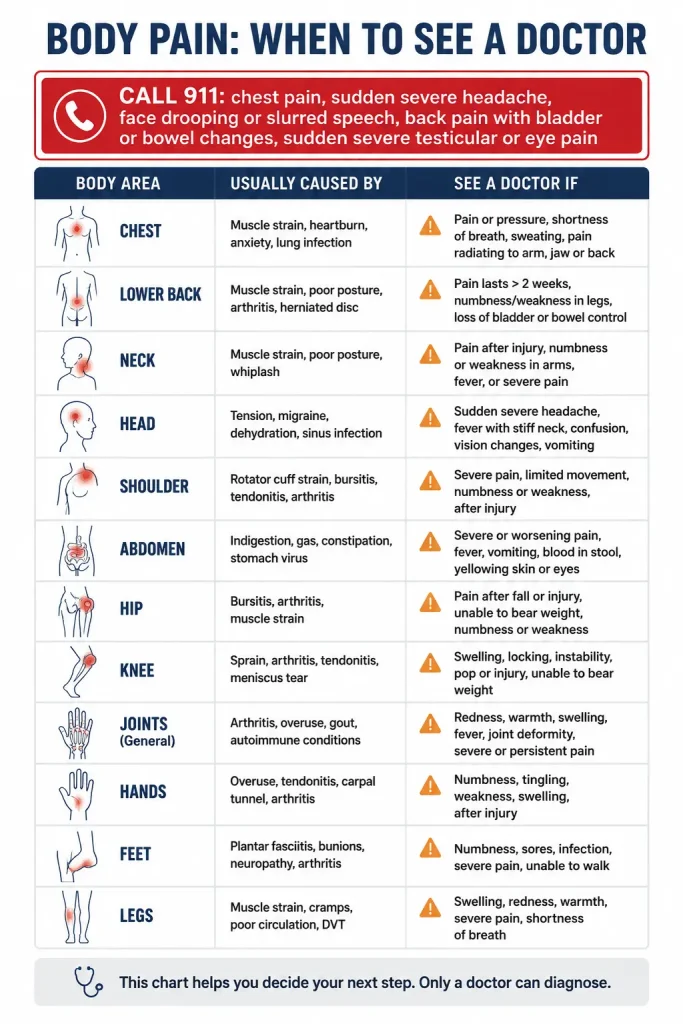
Call 911 Right Now For These
Start here. These signs need emergency care regardless of what else you read.
- Chest pain or pressure lasting more than a few minutes, or that comes and goes
- Chest discomfort with shortness of breath, cold sweat, nausea or lightheadedness
- Pain spreading to the arm, jaw, neck, back or stomach alongside chest discomfort
- Sudden severe headache described as the worst of your life
- Face drooping, arm weakness or slurred speech
- Back pain with loss of bladder or bowel control
- Numbness in the groin, buttocks or inner thighs
- Sudden weakness in one or both legs
- Severe abdominal pain with a rigid board like belly
- Sudden severe testicular pain, especially in a boy or young man
- Sudden severe eye pain with blurred vision, halos or a red eye
- Pain after a serious fall or car accident
- Any pain with confusion, fainting or trouble breathing
The CDC advises calling 911 immediately for heart attack symptoms, because faster treatment means less damage to the heart muscle.
Do not drive yourself. Ambulance crews start treatment on the way and hospitals often see arriving patients faster.
How to Think About Body Pain
Three questions sort most situations.
How did it start? Pain that builds slowly after activity usually points to muscle or joint strain. Pain that arrives suddenly and severely deserves more attention.
What comes with it? Pain alone is usually simple. Pain plus fever, numbness, weakness, weight loss or trouble with bladder and bowel function changes the picture entirely.
Is it getting better? Most musculoskeletal pain improves within a week or two. Pain that worsens over days, or wakes you at night, needs a doctor.
Common things are common. A sore lower back is far more likely to be a strained muscle than a kidney problem. Numb fingers are far more likely to be carpal tunnel than a vitamin deficiency. Start with the likely explanation and watch for the signs that suggest otherwise.
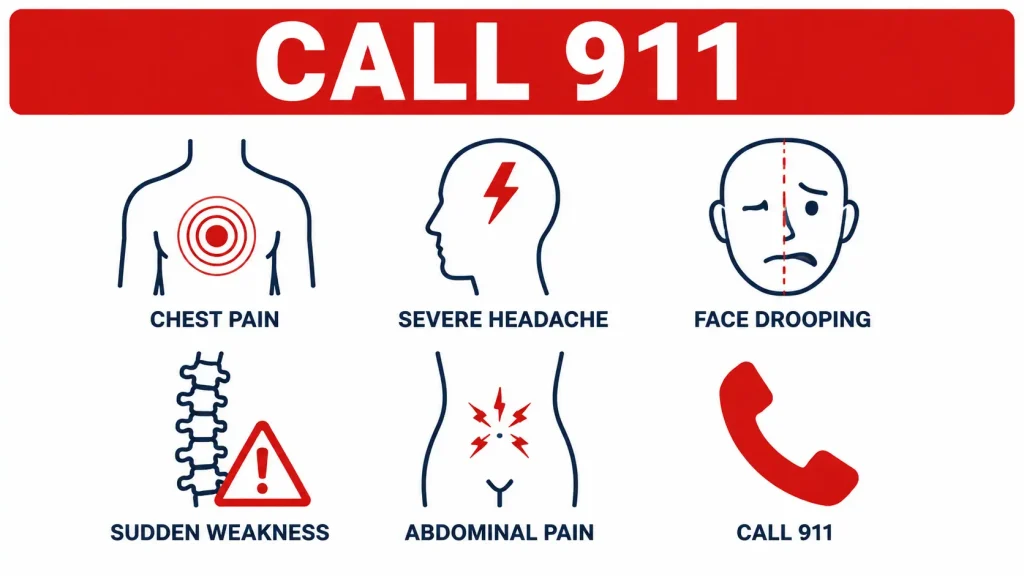
Body Pain by Area: Common Causes and Red Flags
| Body Area | Most Common Causes | See a Doctor If |
|---|---|---|
| Chest | Muscle strain, reflux, anxiety, costochondritis | Any chest pain lasting minutes, or with breathlessness. Call 911 |
| Lower back | Muscle strain, disc issues, poor posture | Bladder or bowel changes, groin numbness, fever, leg weakness |
| Mid back | Muscle strain, posture, spine issues | Severe pain boring through to the front, fever, cancer history |
| Neck | Muscle tension, posture, disc changes | Stiff neck with fever, arm weakness, after injury |
| Shoulder | Rotator cuff, tendinitis, frozen shoulder | Right shoulder pain with belly pain, fever or nausea |
| Head | Tension headache, migraine, dehydration | Sudden severe onset, fever with stiff neck, neurological changes |
| Abdomen | Gas, indigestion, constipation, gastritis | Severe or worsening pain, fever, vomiting, rigid belly |
| Hip | Osteoarthritis, bursitis, muscle strain | Unable to bear weight, after a fall, fever |
| Knee | Osteoarthritis, ligament or meniscus injury | Locking, giving way, hot and swollen joint |
| Joints generally | Osteoarthritis, overuse | Multiple joints, morning stiffness over an hour, swelling |
| Hands and fingers | Carpal tunnel, arthritis, overuse | Weakness, muscle wasting, symptoms in both hands |
| Feet | Plantar fasciitis, footwear, overuse | Burning both feet, numbness, non healing sores |
| Legs | Muscle cramps, strain, sciatica | One swollen warm calf, pain when walking that stops at rest |
Use this to decide your next step rather than to name a diagnosis. Only a doctor can do that part.
Chest Pain
Chest pain deserves its own section because the stakes differ from everywhere else.
Common harmless causes include muscle strain from lifting or coughing, acid reflux, anxiety and costochondritis, which is inflammation where ribs meet the breastbone.
Why you still cannot self diagnose it. Heart attack pain often feels like pressure, squeezing or fullness rather than sharp pain. Plenty of people describe it as indigestion. Nearly half of people having a heart attack do not recognize it at the time.
Higher risk groups. Women, people with diabetes and older adults often have less obvious symptoms. Women more commonly report shortness of breath, nausea, and back or jaw pain rather than classic chest pressure.
The rule. Chest pain gets treated as cardiac until a doctor rules that out. Getting checked and being sent home is a good outcome. Waiting is not.
Lower Back Pain
Roughly 90 percent of lower back pain comes from muscles, ligaments and discs. Most improves within a few weeks with movement and time.
Red flags that change the answer:
- New loss of bladder or bowel control
- Numbness in the saddle area, meaning groin, buttocks or inner thighs
- Weakness or numbness in one or both legs, especially if it worsens
- Fever alongside back pain
- Pain after significant trauma
- A history of cancer with new back pain
- Unplanned weight loss
- Night pain that wakes you and does not settle
The first three point toward cauda equina syndrome, a compression of nerve roots at the base of the spine. It is rare, and it is a surgical emergency where treatment within 24 to 48 hours changes the outcome. Go to an emergency room rather than waiting for an appointment.
Kidney problems can cause back pain, though usually higher and toward the side, often with fever, nausea or changes in urination. Kidney pain rarely presents as ordinary low back ache.
Headaches
Tension headaches and migraines account for the vast majority. Dehydration, poor sleep, screen time and caffeine withdrawal all contribute.
Red flags:
- Sudden severe headache reaching peak intensity within seconds
- Headache with fever and a stiff neck
- Headache with confusion, vision loss, weakness or slurred speech
- A headache pattern that changes noticeably
- Headache after a head injury
- New headaches starting after age 50
- Headache that worsens when lying down or with coughing
The first one matters most. A thunderclap headache can signal bleeding around the brain and needs emergency assessment.
A myth worth correcting. Ordinary high blood pressure does not cause headaches. Hypertension is asymptomatic, which is exactly why regular readings matter. Only a hypertensive crisis above roughly 180 over 120 causes symptoms, and that is a medical emergency in its own right. Never use headaches as a way to judge your blood pressure.
Abdominal Pain
Gas, indigestion and constipation cause most of it. Gastritis, food intolerance and menstrual cramps account for much of the rest.
Red flags:
- Severe pain that comes on suddenly
- A rigid board like abdomen
- Pain with fever and vomiting
- Pain that starts near the navel and moves to the lower right
- Blood in stool or vomit
- Black tarry stools
- Pain with jaundice, meaning yellow skin or eyes
- Inability to pass gas or stool with a swollen belly
That fourth point describes classic appendicitis. It needs same day assessment.
Gallbladder attacks typically bring pain in the upper right abdomen after fatty meals, sometimes radiating to the right shoulder blade. That connection is real and explained below.
Joint and Limb Pain
Osteoarthritis and overuse cause most joint pain. Wear on cartilage builds slowly and shows up as stiffness after rest that eases with movement.
Signs pointing to inflammatory arthritis rather than wear and tear:
- Multiple joints affected symmetrically
- Morning stiffness lasting more than an hour
- Visible swelling, warmth and redness
- Fatigue and general unwellness alongside joint pain
Those warrant a doctor rather than a supplement. Rheumatoid arthritis responds far better to early treatment.
One leg emergency worth knowing. A single calf that becomes swollen, warm, red and painful can indicate a blood clot. Risk rises after long travel, surgery or immobility. Clots can travel to the lungs, so this needs same day assessment.
Leg pain when walking that stops with rest may point to reduced blood flow. Worth a doctor visit rather than pushing through.
Three Pains With a Time Limit
Most pain gives you room to wait. These three do not, and general pain guides tend to skip them.
Testicular pain. Sudden severe pain in one testicle can mean testicular torsion, where the cord twists and cuts off blood supply. The window to save the testicle runs about six hours. It affects boys and young men most often and frequently starts at night or after activity. Pain with nausea, vomiting or a testicle sitting higher than usual makes it more likely. Go to an emergency room rather than waiting to see if it settles.
Eye pain. Sudden severe eye pain with blurred vision, halos around lights, a red eye and nausea can signal acute angle closure glaucoma. Pressure builds fast and can damage the optic nerve within hours. Ordinary eye strain does not cause this combination.
Jaw pain. Most jaw pain comes from teeth, grinding or the temporomandibular joint. Jaw pain arriving with chest discomfort, shortness of breath or a cold sweat is a heart attack symptom until proven otherwise, particularly in women. Jaw pain with facial swelling and fever points to a dental abscess, which also needs same day care.
None of these three are common. All three lose their window quickly, which is why they belong on a list like this.
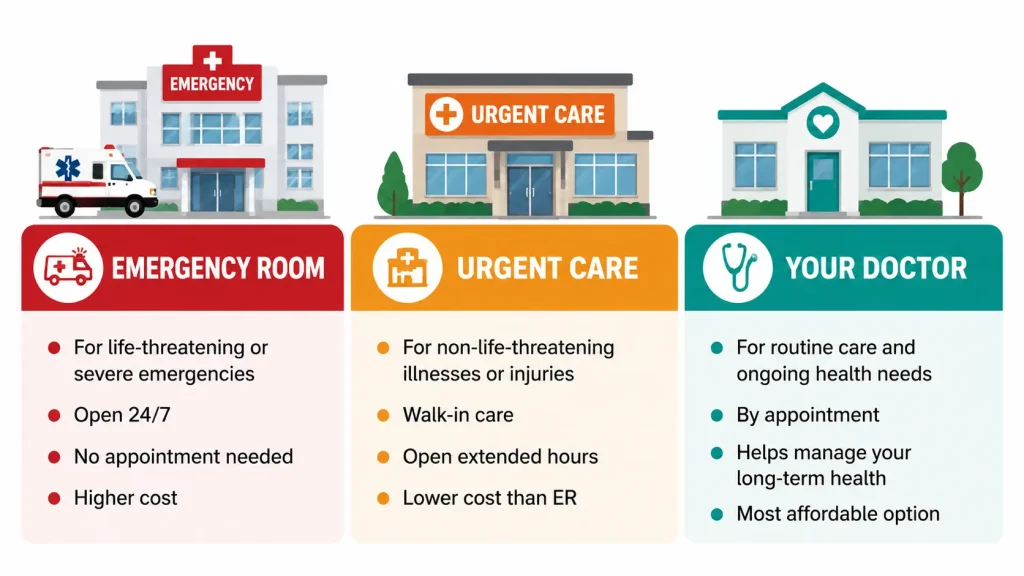
Where to Go: ER, Urgent Care or Your Doctor
Knowing you need care is half the decision. Picking the right place is the other half.
| Situation | Where to Go |
|---|---|
| Chest pain, stroke signs, severe head injury | Call 911 |
| Back pain with bladder or bowel changes | Emergency room now |
| Sudden severe testicular or eye pain | Emergency room now |
| Severe abdominal pain with fever or vomiting | Emergency room |
| Possible broken bone, deep cut, high fever | Urgent care or ER |
| Suspected sprain, minor burn, mild infection | Urgent care |
| Pain lasting over two weeks, slowly worsening | Your regular doctor |
| Joint stiffness, recurring headaches, chronic aches | Your regular doctor |
| Pain needing tests or referrals | Your regular doctor |
Urgent care handles things that cannot wait for an appointment but are not life threatening. It costs far less than an emergency room and usually moves faster.
Emergency rooms triage by severity rather than arrival time. Coming in with a genuine emergency means fast treatment. Coming in with a two week old backache means a long wait.
Call your doctor’s office first when unsure. Many have a nurse line that will tell you where to go.
Pain That Presents Differently in Some Groups
Standard symptom lists assume a healthy middle aged adult. Several groups do not fit that pattern.
Older adults. Heart attacks often skip chest pain entirely and show up as shortness of breath, confusion, weakness or fatigue. Infections may cause confusion rather than fever. Abdominal emergencies can produce surprisingly mild pain. A lower threshold for seeking care makes sense with age.
People with diabetes. Nerve damage blunts pain signals. Heart attacks can be silent. Foot injuries and infections may go unnoticed until they become serious, which is why daily foot checks matter.
Children. Young children cannot describe pain well. Watch behavior instead. Refusing to walk or bear weight, guarding one area, inconsolable crying, or a child who becomes unusually still and quiet all warrant a call. Any fever with a stiff neck in a child needs emergency assessment.
During pregnancy. Severe abdominal pain, vaginal bleeding, severe headache with vision changes, sudden swelling, or calf pain and swelling all need same day contact with your provider. Blood clot risk rises during and after pregnancy.
People taking blood thinners. Head injuries need assessment even when they seem minor, because bleeding can develop hours later.
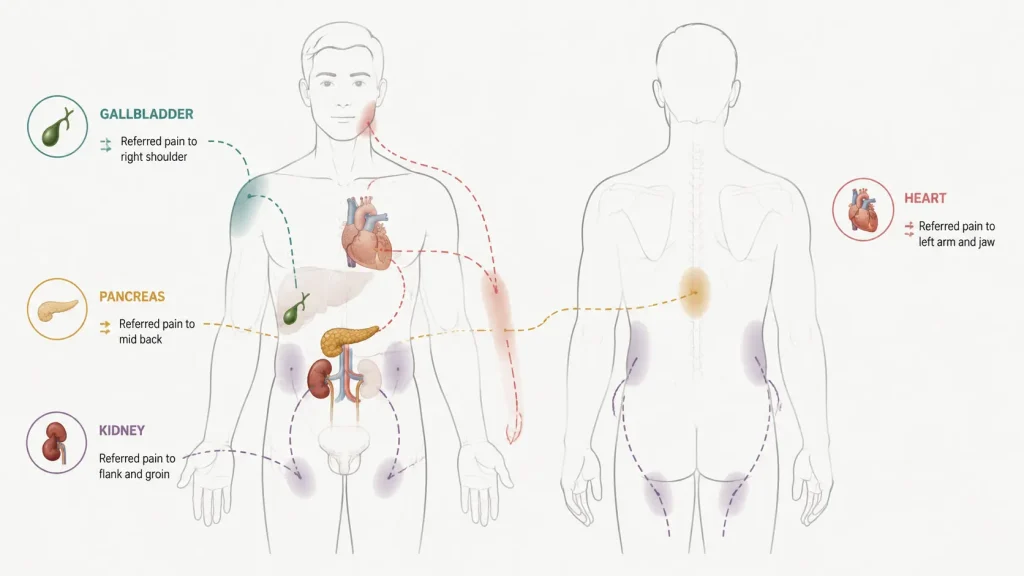
Referred Pain: Why Organ Problems Hurt Somewhere Else
This part surprises people and it is genuinely useful.
Nerves from your organs and nerves from your skin and muscles feed into the same segments of your spinal cord. Your brain receives the signal and misreads where it came from, mapping it to the skin area sharing that nerve pathway.
Gallbladder to right shoulder. The gallbladder sits under the diaphragm. The phrenic nerve serving the diaphragm originates at spinal levels C3 to C5, which also supply the shoulder. Irritation gets felt at the shoulder tip.
Heart to left arm and jaw. Cardiac nerves enter the spinal cord at levels that also serve the inner arm, neck and jaw. That is why heart attacks cause arm and jaw pain rather than only chest pain.
Pancreas to mid back. The pancreas sits deep against the back wall of the abdomen. Inflammation produces pain that bores straight through to the middle of the back, often worse lying flat.
Kidney to flank and groin. Kidney stones cause pain that travels from the flank down toward the groin as the stone moves.
Diaphragm irritation to the shoulder. Any irritation under the diaphragm, including from a ruptured spleen, can present as shoulder pain.
Understanding referred pain is not a diagnostic tool for you at home. It explains why doctors ask seemingly unrelated questions and why shoulder pain with nausea after a fatty meal means something different from shoulder pain after painting a ceiling.
Red Flags That Apply to Any Pain
These matter no matter where the pain sits.
- Fever alongside the pain
- Unplanned weight loss
- Night pain that wakes you from sleep
- Pain steadily worsening over days or weeks
- Numbness, weakness or tingling
- A history of cancer with new pain anywhere
- Pain after significant trauma
- Pain with changes in bladder or bowel function
- Anything that feels dramatically different from pain you have had before
That last one deserves weight. People know their own bodies. Pain that feels genuinely unfamiliar is worth a call.
Common Pain Myths
Several widespread claims send people to the wrong place.
Myth: Neck pain means high blood pressure. Hypertension causes no symptoms until it becomes a crisis. Neck pain is almost always muscular. Get a cuff reading instead of guessing.
Myth: Lower back pain usually means kidney trouble. Kidney pain sits higher and to the side, and typically brings fever or urinary changes. Ordinary low back ache is muscular.
Myth: Hip pain means calcium deficiency. Hip pain in adults is usually osteoarthritis, bursitis or muscle strain. Calcium deficiency does not present this way.
Myth: Joint stiffness means omega-3 deficiency. No such recognized deficiency state exists. Joint stiffness points to arthritis until a doctor says otherwise.
Myth: Numb fingers mean vitamin B12 deficiency. Carpal tunnel syndrome causes far more cases. B12 deficiency does cause numbness, though usually in both hands and feet together and with other symptoms.
Myth: Cracking knuckles causes arthritis. Studies have not found a link.
Vitamin deficiencies do cause real symptoms. They just sit much lower on the list than the ordinary explanations, and a blood test settles the question rather than a chart.
When Waiting Is Reasonable
Some pain genuinely does not need a doctor.
- Muscle soreness after unfamiliar exercise, easing within a few days
- A mild tension headache that responds to water, rest and a break from screens
- Low back stiffness after a long drive or a day of lifting
- Occasional joint aches that come and go with weather or activity
- Menstrual cramps matching your usual pattern
- Mild indigestion after a heavy meal
Give these a week of rest, gentle movement and over the counter pain relief if needed. Book an appointment when nothing improves after two weeks, or sooner if any red flag appears.
Movement usually beats bed rest for back and joint pain. Extended rest tends to stiffen things further.
How to Describe Pain to Your Doctor
Better description gets you better answers. Come prepared with these.
Location. Point to it. Note whether it stays put or travels.
Character. Sharp, dull, burning, throbbing, cramping or pressure. Doctors use this to narrow causes.
Timing. When it started, whether it comes and goes, and what time of day is worst.
Severity. Rate it from 0 to 10 at its best and worst.
What changes it. Movement, rest, food, position, heat or cold.
What comes with it. Fever, nausea, numbness, weakness, weight changes, sleep disruption.
What you have tried. Medications, doses and whether they helped.
Writing this down beforehand takes five minutes and makes a short appointment far more productive.
Frequently Asked Questions
When should I go to the ER for pain?
Chest pain, sudden severe headache, back pain with bladder or bowel changes, severe abdominal pain with a rigid belly, or any pain with confusion, fainting or breathing trouble. Also any pain after major trauma.
How long should I wait before seeing a doctor?
Two weeks for ordinary muscle or joint pain that is slowly improving. Sooner if it worsens, and immediately if any red flag appears.
Can pain in one place come from an organ somewhere else?
Yes. Doctors call it referred pain. Gallbladder problems can hurt in the right shoulder and heart problems can hurt in the arm or jaw, because those nerves share spinal pathways.
Does chest pain always mean a heart attack?
No. Muscle strain, reflux and anxiety cause many cases. Chest pain still needs assessment because heart attack symptoms are unreliable and many people mistake them for indigestion.
Can vitamin deficiencies cause body pain?
Some can. Vitamin D deficiency causes bone and muscle pain. B12 deficiency causes numbness and tingling. These are far less common than mechanical causes though, and a blood test identifies them rather than guesswork.
Is it safe to just take painkillers and wait?
For mild short term pain, usually yes. Painkillers that mask a worsening problem are a different matter. Stop the wait and see approach if the pain grows, spreads or brings new symptoms.
Why does my pain get worse at night?
Fewer distractions and different positioning explain most of it. Pain that consistently wakes you from sleep is a recognized red flag and deserves a doctor visit.
Should I see my regular doctor or a specialist first?
Start with your regular doctor unless you have a clear emergency. They can assess, order tests and refer you to the right specialist.
When should I use urgent care instead of the ER?
Urgent care suits problems that cannot wait for an appointment but are not life threatening, like a suspected sprain or a minor infection. Chest pain, stroke signs, severe abdominal pain and anything on the emergency list go to an ER.
Do older adults have different pain symptoms?
Often yes. Heart attacks in older adults may cause shortness of breath, confusion or weakness rather than chest pain. Infections can show as confusion instead of fever. Seeking care sooner makes sense.
What if I am not sure whether it is an emergency?
Call your doctor’s office nurse line or an emergency number and describe what is happening. Trained staff will tell you where to go. Being sent home after a check is a good outcome.
Related reading: some persistent aches trace back to nutrition, so see our 8 common signs of nutrient deficiencies, and the stair climb test for a simple fitness benchmark.
Two tools that help here. Poor sleep amplifies pain perception, so our sleep calculator gives you bedtime windows that fit your cycles, and the heart rate zone calculator keeps you training at an intensity you can recover from.
Final Thoughts on Body Pain
Most body pain resolves without anything more than time. The valuable skill is not naming a diagnosis from where it hurts. It is recognizing the small number of signs that mean stop waiting.
Learn the emergency list at the top of this article. Learn the general red flags of fever, weight loss, night pain, numbness, weakness and changes in bladder or bowel function. Everything else can reasonably wait a week or two.
No chart replaces an examination. Charts pairing a body area with a single cause tend to steer people away from likely explanations and toward alarming ones. Use this guide to decide your next step, then let a doctor do the diagnosing.
References
- Centers for Disease Control and Prevention. About Heart Attack Symptoms, Risk, and Recovery. cdc.gov
- American Heart Association. Warning Signs of a Heart Attack. heart.org
This article shares general health information. It does not replace advice from your doctor and it cannot diagnose any condition. Call emergency services for chest pain, sudden severe headache, weakness on one side, or any pain with confusion or breathing difficulty. Talk with a healthcare provider about any pain that persists, worsens or worries you. Read our full medical disclaimer and fact checking policy.
About the Author and Reviewer
Mezbaul Islam, MSc Nutrition owns and writes Simple Health Naturally. He researches each article from public health guidance, clinical guidelines and peer reviewed studies, and traces every figure back to a named source.
Dr. Obeydur Rahman, MBBS, MD in Medicine edits the articles, checks the sources cited and is responsible for the site’s editorial standards. MD in Medicine is the specialty for adult conditions such as liver disease, type 2 diabetes and high blood pressure.
Read more about our authors and reviewers or see our editorial policy.
Edited by Dr. Obeydur Rahman, MBBS, MD in Medicine.