Almost every food gets called anti-inflammatory these days. Very few have controlled trials behind them. These anti-inflammatory foods do, and this guide separates the ones with real research from the ones riding on lab studies and marketing.
You get ten foods rated by evidence strength, the doses used in actual trials and a clear statement of what food cannot do. That last part matters more than the list.
What Inflammation Actually Is
Two kinds exist and people mix them up constantly.
Acute inflammation is your immune system doing its job. A cut swells, turns red and hurts. That process fights infection and repairs tissue. You do not want to block it.
Chronic low grade inflammation runs quietly for years. It links with heart disease, type 2 diabetes, arthritis and several other conditions. This is the kind diet may influence.
Food works slowly on the second type. Nothing you eat produces the effect of an anti-inflammatory drug within an hour.
Researchers measure this with blood markers like C-reactive protein and interleukin 6. Most food studies show small reductions in those numbers. Small and real is the honest summary of this entire subject.
The 10 Foods Ranked by Evidence
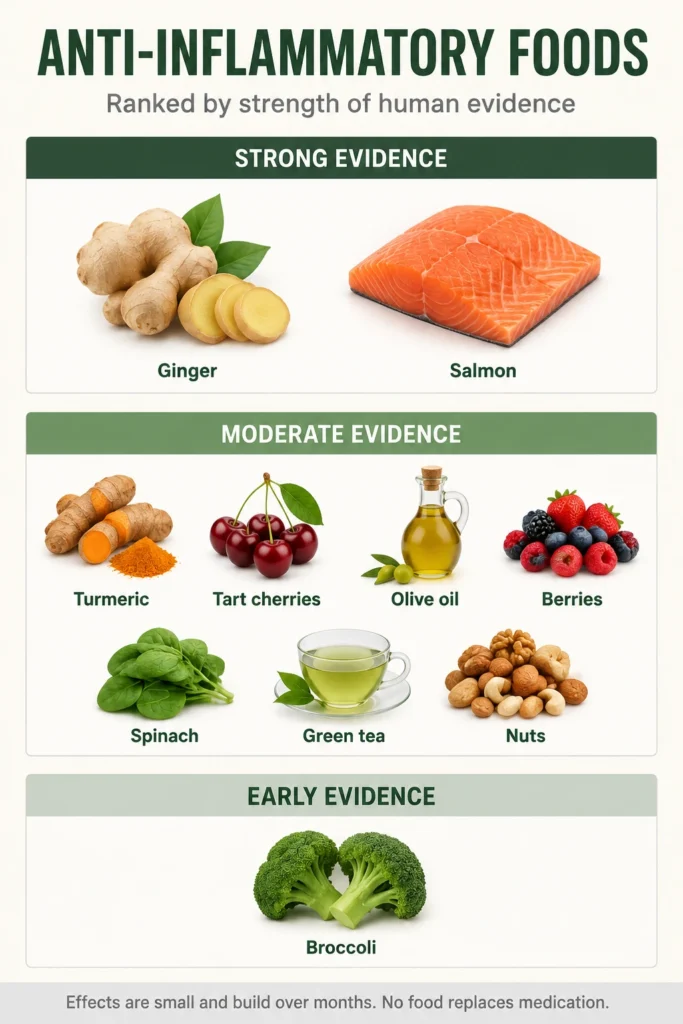
| Food | Best Evidence For | Strength | Trial Dose |
|---|---|---|---|
| Ginger | Menstrual pain, nausea | Strong | 750 to 2000 mg powder daily |
| Fatty fish | Inflammatory markers, joint pain | Strong | 2 servings weekly |
| Turmeric with pepper | Knee osteoarthritis | Moderate | 500 to 1000 mg curcumin |
| Tart cherries | Muscle soreness after exercise | Moderate | 480 ml juice daily |
| Olive oil | Inflammatory markers | Moderate | Extra virgin, daily |
| Berries | Inflammatory markers | Moderate | 1 to 2 cups daily |
| Leafy greens | General intake patterns | Moderate | Daily servings |
| Green tea | Inflammatory markers | Moderate | 2 to 3 cups daily |
| Nuts | Inflammatory markers | Moderate | 1 oz daily |
| Cruciferous vegetables | Lab and early human data | Weak to moderate | Regular servings |
Only two reach strong. That number tells you something about how loosely this term gets used.
1. Ginger
Evidence: strong.
Ginger has more human trial data than anything else on this list. A meta-analysis of randomized trials found ginger significantly reduced menstrual pain compared with placebo, and two trials comparing it directly with NSAIDs found similar pain relief for that specific condition.
Doses in those trials ran 750 to 2000 mg of ginger powder daily during the first three to four days of the cycle.
Ginger also has strong support for nausea from pregnancy, motion sickness and chemotherapy.
What it does not do. Menstrual cramp trials are specific. Nobody has shown ginger matches ibuprofen for a headache, a sprain or post surgical pain. Read the evidence narrowly.
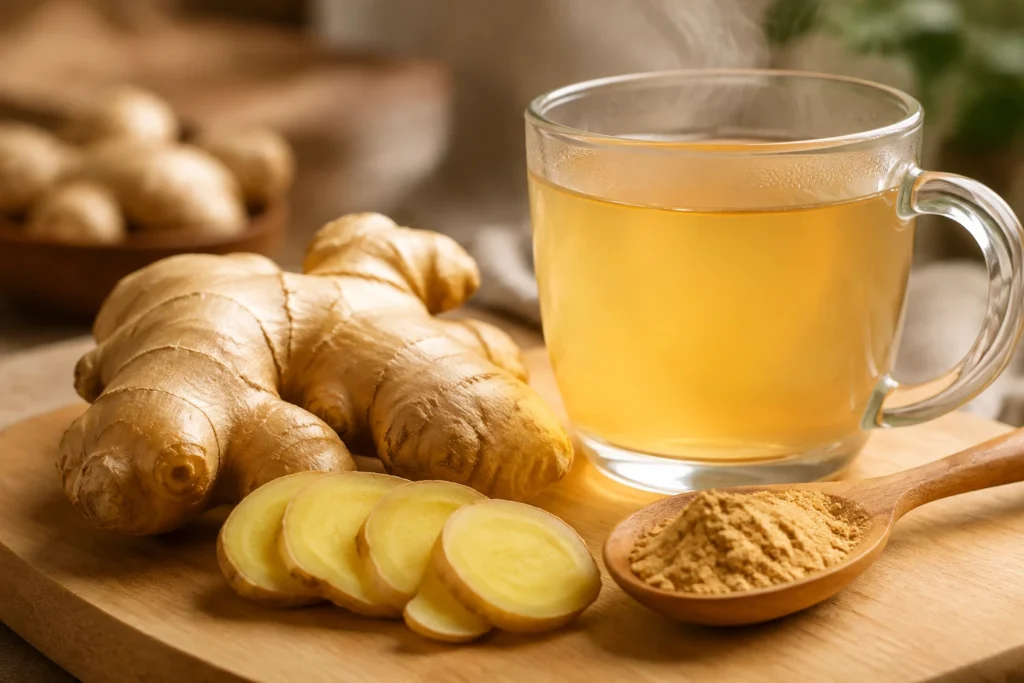
How to use it. Fresh grated ginger steeped 10 minutes in hot water, or ginger powder in cooking. Our guide to morning drinks and what they actually do covers the ginger tea version.
Caution. Ginger thins blood slightly. Ask your doctor before large amounts alongside anticoagulants.
2. Fatty Fish
Evidence: strong.
Salmon, mackerel, sardines and herring deliver EPA and DHA, two omega-3 fats with consistent effects on inflammatory markers across many trials.
Rheumatoid arthritis research is the most convincing. Omega-3 supplementation reduces morning stiffness and tender joint counts modestly in several trials, enough that some patients reduce NSAID use.
What it does not do. It will not replace disease modifying medication for rheumatoid arthritis. Effects are supportive rather than curative.
How to use it. Two servings weekly. Canned salmon and sardines cost far less than fresh and deliver the same omega-3s.
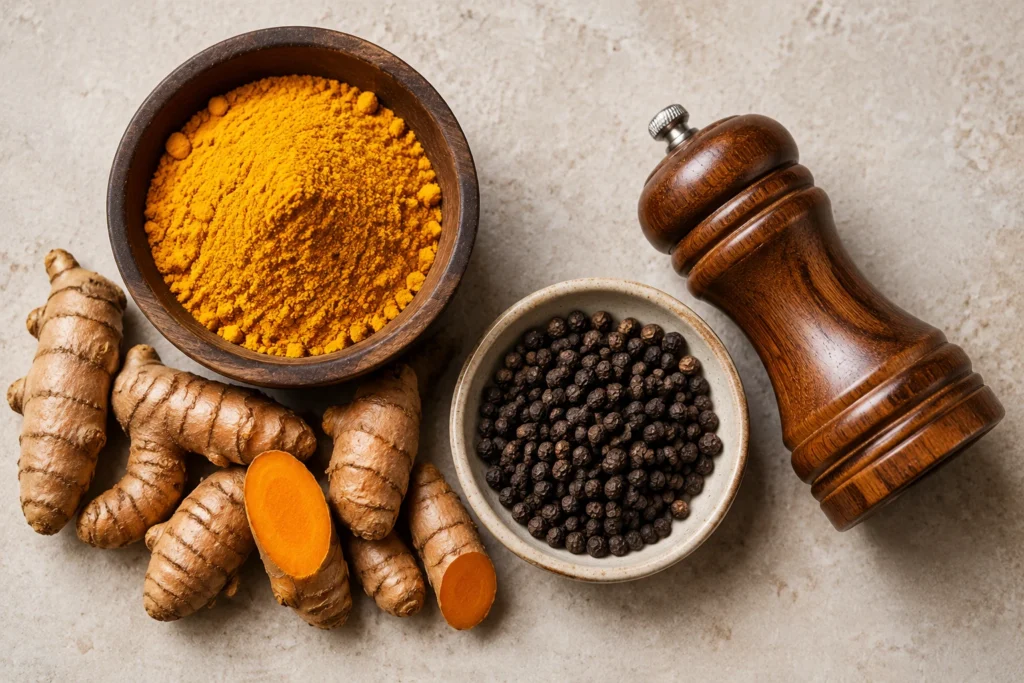
3. Turmeric With Black Pepper
Evidence: moderate.
Curcumin is the active compound and trials for knee osteoarthritis show modest pain improvement. Some studies found it comparable to low dose NSAIDs for that condition.
The catch matters. Trials use concentrated curcumin extracts at 500 to 1000 mg daily. Turmeric powder is only about 3 percent curcumin, so a teaspoon in your curry delivers a tiny fraction of the research dose.
Black pepper contains piperine, which increases curcumin absorption substantially. That pairing is genuinely useful.
What it does not do. Turmeric in food does not match the research doses. Anyone expecting trial level results from cooking will be disappointed.
Caution. High dose curcumin supplements interact with blood thinners and can irritate the stomach. Some products have been found adulterated. Choose tested brands.
4. Tart Cherries
Evidence: moderate.
Tart cherry juice has decent research for exercise recovery. Trials show reduced muscle soreness and faster strength recovery after hard training.
Gout research looks promising too, with some studies linking cherry intake to fewer flares.
Trial doses run about 480 ml of tart cherry juice daily, or the concentrate equivalent, usually for several days around the exercise.
What it does not do. Sweet cherries are not the same. The research uses tart Montmorency cherries specifically.
Caution. Cherry juice carries substantial sugar. Anyone managing blood sugar should account for it.
5. Extra Virgin Olive Oil
Evidence: moderate.
Olive oil contains oleocanthal, a compound that inhibits the same enzymes as ibuprofen in laboratory studies. That finding gets quoted constantly and needs context.
The lab effect is real. The amount in a daily serving of olive oil is far below an ibuprofen dose.
The stronger evidence comes from Mediterranean diet research, where olive oil rich eating patterns consistently associate with lower inflammatory markers.
What it does not do. A tablespoon of olive oil is not a painkiller.
How to use it. Extra virgin only. Refined olive oil loses the polyphenols. Use it raw as a finishing drizzle where possible.
6. Berries
Evidence: moderate.
Blueberries, strawberries and raspberries carry anthocyanins, the pigments behind their color. Trials show modest reductions in inflammatory markers with regular intake.
Doses in studies run one to two cups daily, often as freeze dried powder equivalent.
How to use it. Frozen berries hold nearly the same nutrition and cost far less than fresh.
7. Leafy Greens
Evidence: moderate.
Spinach, kale and collards deliver vitamin K, folate, magnesium and carotenoids. Population studies consistently link higher intake with lower inflammatory markers.
The evidence here is more about eating patterns than any single compound.
How to use it. Add fat, since the carotenoids need it for absorption. Olive oil on your greens does two jobs at once.
8. Green Tea
Evidence: moderate.
Catechins, particularly EGCG, show antioxidant activity and modest effects on inflammatory markers in several trials.
Two to three cups daily appears in most of the research.
Caution. Concentrated green tea extract supplements have been linked to liver injury in rare cases. Drinking the tea carries no such concern.
9. Nuts
Evidence: moderate.
Walnuts, almonds and pistachios all show associations with lower inflammatory markers in population studies and several controlled trials.
Walnuts stand out for their plant omega-3 content.
How to use it. About one ounce daily, roughly a small handful. Store them in the fridge since the oils spoil quickly.
10. Cruciferous Vegetables
Evidence: weak to moderate.
Broccoli, brussels sprouts and cabbage contain sulforaphane, which shows real promise in laboratory and animal work.
Human trials remain limited and small. The mechanism looks good and the clinical data has not caught up.
How to use it. Steam lightly. Long boiling destroys sulforaphane.
What These Foods Cannot Do
This section matters more than the list above.
No food works like a painkiller. Charts pairing foods with drug names circulate widely and they are wrong. Ginger is not ibuprofen. Cloves are not morphine. Turmeric is not hydrocodone. Those comparisons are not simplifications, they are false.
Never stop a prescribed medication for a food. Some drugs cause serious harm when stopped suddenly. Benzodiazepines can trigger seizures on abrupt withdrawal. Opioid discontinuation needs medical supervision. Talk to your doctor before changing anything.
Food will not treat acute pain. Post surgical pain, injuries, kidney stones and severe headaches all need proper treatment.
Effects take weeks. Inflammatory markers shift slowly. Give any dietary change two to three months.
Effect sizes are small. Trials show modest reductions in blood markers. That matters over years and does nothing over hours.
Supplements differ from food. Trials using concentrated extracts do not transfer to the vegetable on your plate.
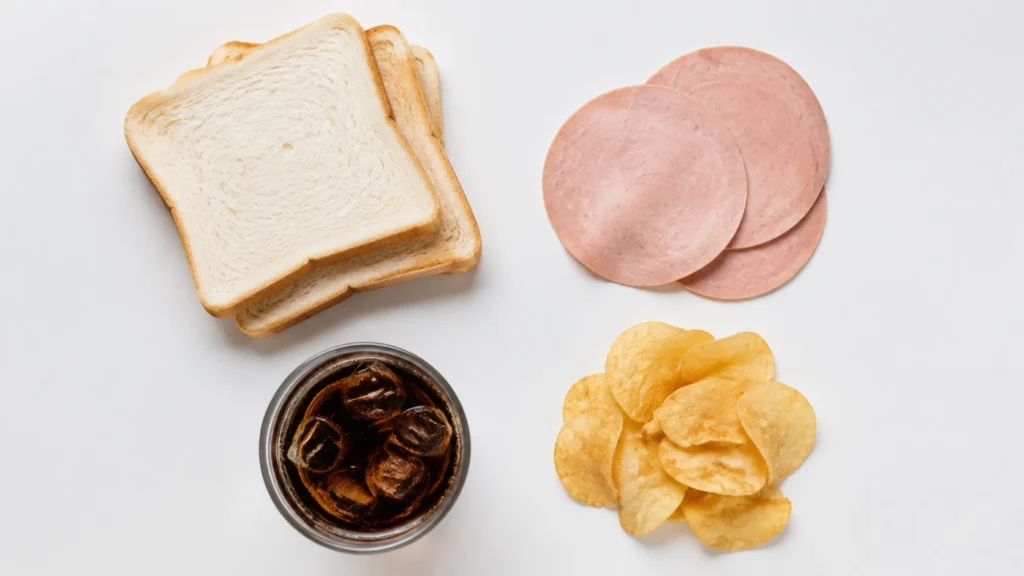
Foods That Increase Inflammation
Removing these often does more than adding anything.
- Ultra processed foods, which dominate the association research
- Added sugar and sweetened drinks
- Refined carbohydrates like white bread and pastries
- Processed meat
- Excess alcohol
- Fried foods, particularly with repeatedly reused oil
Whole eating patterns predict inflammatory markers far better than single foods do. The Mediterranean pattern has the strongest research behind it.
How You Cook Matters Too
This part gets left out of nearly every anti-inflammatory food article and it deserves attention.
High heat dry cooking creates compounds called advanced glycation end products. Researchers shorten that to AGEs. They form when protein and sugar react under dry heat, which is the same browning reaction that makes food taste good.
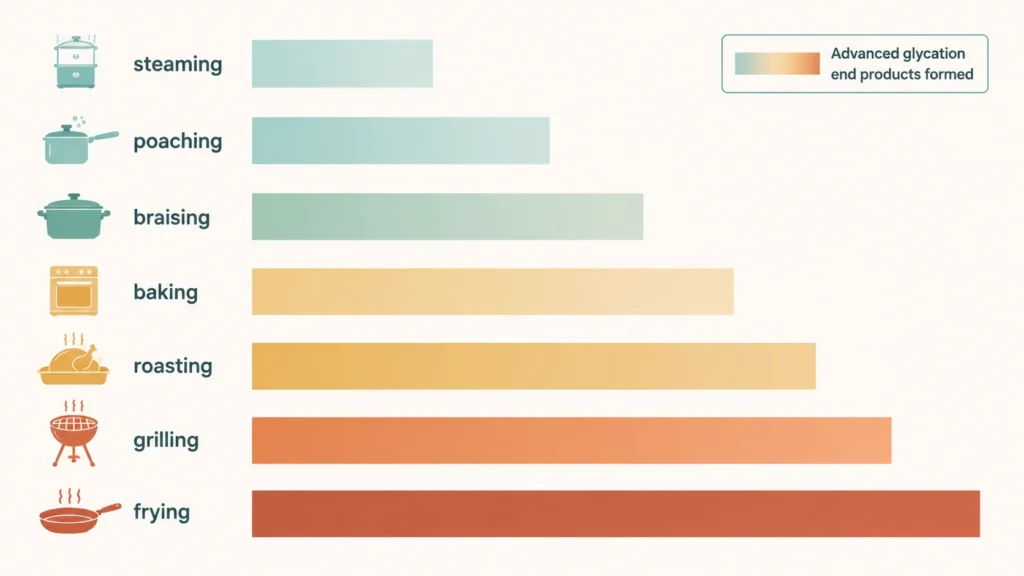
AGEs promote oxidative stress and inflammation. Diets high in them associate with higher inflammatory markers.
| Cooking Method | AGE Formation |
|---|---|
| Steaming | Lowest |
| Poaching and boiling | Very low |
| Braising and stewing | Low |
| Baking at moderate heat | Moderate |
| Roasting at high heat | High |
| Grilling and broiling | High |
| Frying | Highest |
Three practical points come out of this.
Wet heat beats dry heat. A braised chicken thigh carries far fewer AGEs than the same thigh grilled until charred.
Acidic marinades help. Lemon juice or vinegar before cooking reduces AGE formation substantially.
Lower and slower beats hot and fast. Temperature matters more than time.
None of this means you should never grill anything. Cooking method is a smaller lever than what you actually eat. It does mean that frying your salmon undercuts some of what the salmon gives you.
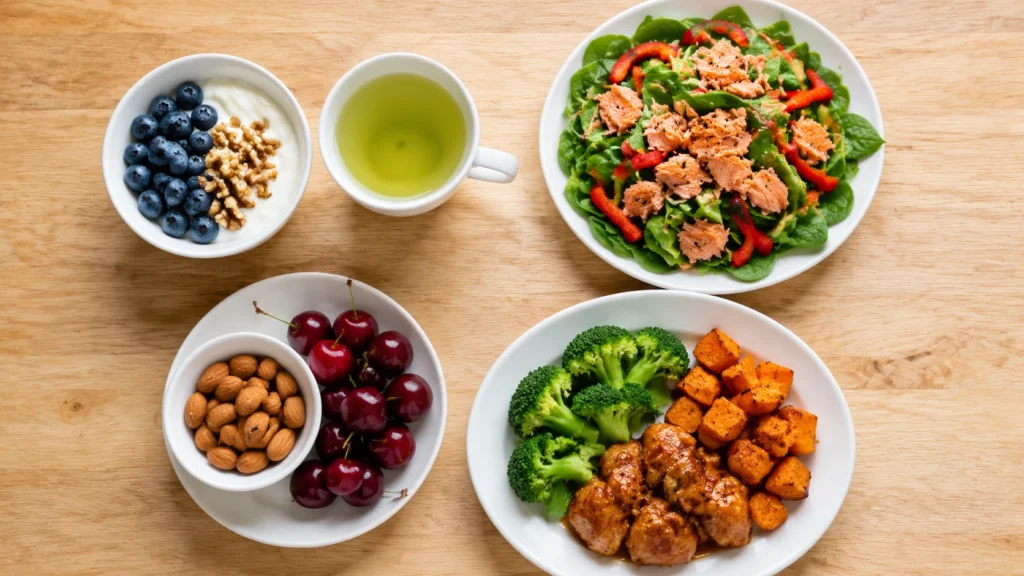
A Day of Anti-Inflammatory Eating
Lists become useful when they turn into meals.
Breakfast. Plain Greek yogurt with blueberries, walnuts and a sprinkle of ground ginger. Green tea alongside.
Lunch. Big spinach salad with canned salmon, red bell pepper, avocado and extra virgin olive oil with lemon.
Snack. A small handful of almonds and a few fresh cherries.
Dinner. Braised chicken or lentils with turmeric and black pepper, steamed broccoli and a side of roasted sweet potato.
Evening. Tart cherry juice if you trained hard, or a cup of ginger tea.
Notice what runs through it. Fish and greens most days, olive oil raw rather than heated, gentle cooking methods and no ultra processed food anywhere.
Notice also what it does not look like. Nobody eats turmeric by the spoonful or drinks a special elixir. The pattern does the work.
Should You Test Your Inflammation
Blood tests exist and they are less useful than people expect.
C-reactive protein, or CRP. Your liver makes it in response to inflammation. A standard CRP test picks up major inflammation from infection or injury. A high sensitivity version, hs-CRP, detects the low grade kind and gets used for cardiovascular risk assessment.
What the numbers mean. Under 1 mg/L suggests low risk, 1 to 3 suggests moderate and above 3 suggests higher risk. A single high reading means little though, since a cold or a recent injury sends it up temporarily.
Erythrocyte sedimentation rate, or ESR. An older and less specific test still used for conditions like rheumatoid arthritis and polymyalgia rheumatica.
When testing makes sense. Your doctor may order these for suspected inflammatory arthritis, unexplained symptoms or cardiovascular risk assessment. Testing yourself out of curiosity rarely changes anything useful.
What it will not tell you. No blood test identifies which food is causing a problem. Elimination and reintroduction under medical guidance does that.
Ask your doctor whether testing fits your situation rather than ordering it independently. An abnormal result without context causes more worry than clarity.
When to See a Doctor
Some signs need testing rather than a grocery list.
- Joint swelling with morning stiffness lasting over an hour
- Multiple joints affected symmetrically
- Fever alongside joint pain
- Unplanned weight loss
- Pain that wakes you at night
- Symptoms lasting more than six weeks
Rheumatoid arthritis and other inflammatory conditions respond far better to early treatment. Delaying while trying dietary changes costs real ground.
Our guide to body pain and when to see a doctor covers the red flags in detail.
Frequently Asked Questions
Which food has the strongest anti-inflammatory evidence?
Ginger, with more randomized trial data than anything else on this list. Fatty fish comes close, particularly for rheumatoid arthritis.
Does turmeric really work for joint pain?
Trials show modest improvement in knee osteoarthritis, using concentrated curcumin extracts at 500 to 1000 mg daily. Turmeric powder in cooking delivers far less than that.
Can food replace anti-inflammatory medication?
No. Food supports treatment. Never stop a prescription based on dietary changes, and speak to your doctor before adjusting anything.
How long until anti-inflammatory foods work?
Two to three months for measurable changes in inflammatory markers. Nothing here works within hours.
Is ginger as good as ibuprofen?
For menstrual cramps specifically, two trials found similar pain relief. That finding does not extend to other kinds of pain.
Do I need supplements or is food enough?
Food first for most people. Some trial doses, particularly curcumin, exceed what food realistically provides. Supplements also carry interaction risks food does not.
What foods cause inflammation?
Ultra processed foods, added sugar, refined carbohydrates, processed meat and excess alcohol show the strongest associations.
Does an anti-inflammatory diet help arthritis?
It may reduce symptoms modestly. It does not replace disease modifying treatment for rheumatoid arthritis, and early medical treatment matters a great deal.
Does cooking method affect inflammation?
Yes. High heat dry cooking like frying and grilling creates advanced glycation end products, which promote inflammation. Steaming, poaching and braising produce far fewer. An acidic marinade before cooking reduces them too.
Should I get my CRP tested?
Only if your doctor suggests it. A high sensitivity CRP test can help assess cardiovascular risk, though a single reading rises temporarily with any infection or injury. Testing out of curiosity rarely changes anything.
What is the best anti-inflammatory diet?
The Mediterranean pattern has the strongest research behind it. Fish, olive oil, vegetables, legumes, nuts and whole grains, with little ultra processed food.
Can I take turmeric and fish oil together?
Both can thin the blood slightly and the effects add together. Ask your doctor first, particularly if you take anticoagulants or have surgery scheduled.
Final Thoughts on Anti-Inflammatory Foods
Honest expectations make this list useful. The best anti-inflammatory foods produce small measurable changes over months. Ginger and fatty fish have the strongest human evidence. Turmeric, tart cherries, olive oil, berries, greens, green tea and nuts all show moderate support.
Nothing here works like a drug. Any chart pairing a food with a painkiller name is making a claim the research does not support, and following that advice with a serious condition can cause real harm.
Build the pattern rather than chasing one ingredient. Add fish twice a week, cook with olive oil and ginger, eat berries and greens most days, and cut back on ultra processed food. Then see your doctor about anything that persists.
References
- Daily JW, et al. Efficacy of ginger for alleviating the symptoms of primary dysmenorrhea: a systematic review and meta-analysis of randomized clinical trials. Pain Medicine. PubMed
- Negi R, et al. Efficacy of ginger in the treatment of primary dysmenorrhea: a systematic review and meta-analysis. Cureus. PubMed Central
- Ozgoli G, Goli M, Moattar F. Comparison of effects of ginger, mefenamic acid, and ibuprofen on pain in women with primary dysmenorrhea. Journal of Alternative and Complementary Medicine. PubMed
This article shares general nutrition information. It does not replace advice from your doctor. Never stop or reduce prescribed medication based on dietary changes, since some drugs cause serious harm when discontinued suddenly. Talk with a healthcare provider about persistent pain, joint swelling or any diagnosed condition. Read our full medical disclaimer and fact checking policy.
About the Author and Reviewer
Mezbaul Islam, MSc Nutrition owns and writes Simple Health Naturally. He researches each article from public health guidance, clinical guidelines and peer reviewed studies, and traces every figure back to a named source.
Dr. Obeydur Rahman, MBBS, MD in Medicine edits the articles, checks the sources cited and is responsible for the site’s editorial standards. MD in Medicine is the specialty for adult conditions such as liver disease, type 2 diabetes and high blood pressure.
Read more about our authors and reviewers or see our editorial policy.
Edited by Dr. Obeydur Rahman, MBBS, MD in Medicine.