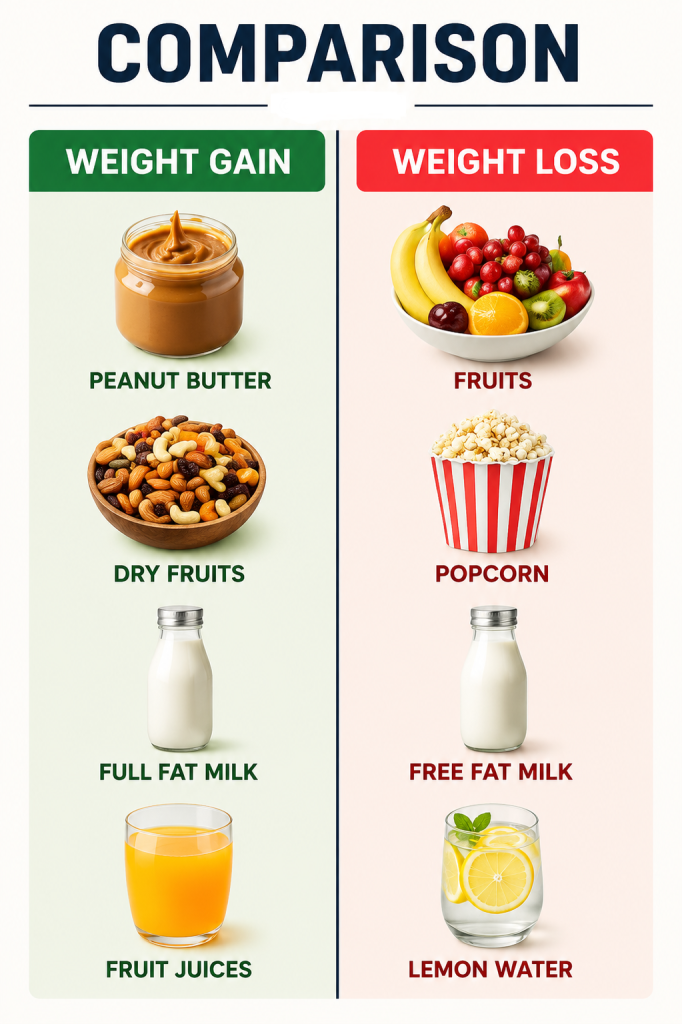
Every weight gain vs weight loss foods chart has the same flaw: it sorts food into two columns when the real difference is a number none of them print. That number is energy density, measured in calories per gram, and once you have it the two columns stop making sense. Whole milk comes in at 0.61 kcal/g. Air popped popcorn comes in at 3.87 kcal/g. Yet almost every chart puts milk in the gain column and popcorn in the loss column.
Below are the actual figures for both columns, what a tightly controlled NIH trial found when it held calories equal and changed only how the food was made, and what the new 2025 to 2030 Dietary Guidelines say about whole milk now that the old advice has been reversed.
Medical Disclaimer: This is educational and is not medical advice. Speak to a doctor or a registered dietitian before deliberately changing your weight, especially with a medical condition, during pregnancy, or with any history of disordered eating. Read our medical disclaimer, editorial policy and fact checking policy.
Why the Weight Gain vs Weight Loss Foods Split Is Misleading
The strongest evidence on this question comes from a study that removed food choice as a variable entirely.
Researchers at the NIH Clinical Center admitted 20 adults for one continuous month. Each person spent two weeks on an ultra processed diet and two weeks on a minimally processed diet, in random order. The two diets were matched for calories offered, sugar, fat, carbohydrate and fibre. Participants could eat as much or as little as they liked.
- On the ultra processed diet, people ate 508 more calories a day
- They gained 0.9 kg in two weeks
- On the minimally processed diet, the same people lost 0.9 kg
- They also ate faster on the ultra processed diet
Nobody was told to eat more. The calories on the table were the same. What changed was how quickly and easily those calories went down. That is the finding a two column chart cannot express, and it is why the honest answer to what really matters is form, not food.
The One Number That Actually Sorts Food
Energy density is calories divided by weight in grams. Water contributes 0 kcal/g and fat contributes 9, so anything watery lands low and anything oily or dry lands high. Research by Barbara Rolls established the working bands used below.
| Band | kcal per gram | What sits here |
|---|---|---|
| Very low | Under 0.6 | Most fruit, vegetables, skim milk, broth soups |
| Low | 0.6 to 1.5 | Whole milk, cooked beans, plain yogurt, oatmeal |
| Medium | 1.5 to 4 | Dried fruit, bread, popcorn, cheese |
| High | Over 4 | Nuts, nut butter, crisps, oils, chocolate |
Rolls’ feeding studies showed how much this moves intake without anyone noticing. Serving a higher energy density pasta raised what people ate at that meal by 153 calories. Eating a low energy density salad first lowered it by 123 calories. Same person, same appetite, different density.
Weight Gain vs Weight Loss Foods, With the Real Numbers
Here is every food from the usual chart, measured. Sorted by energy density, not by which column it is normally printed in.
| Food | kcal/g | Typical serving | Calories |
|---|---|---|---|
| Olive oil | 8.84 | 1 tbsp | 124 |
| Walnuts | 6.54 | 28 g | 183 |
| Peanut butter | 5.88 | 2 tbsp | 188 |
| Almonds | 5.79 | 28 g | 162 |
| Popcorn, air popped | 3.87 | 1 cup | 31 |
| Raisins | 2.99 | 40 g | 120 |
| Medjool dates | 2.77 | 2 dates | 133 |
| Whole milk | 0.61 | 1 cup | 149 |
| Greek yogurt, plain nonfat | 0.59 | 170 g | 100 |
| Apple | 0.52 | 1 medium | 95 |
| Orange | 0.47 | 1 medium | 62 |
| Broccoli, cooked | 0.35 | 1 cup | 55 |
| Skim milk | 0.34 | 1 cup | 83 |
| Strawberries | 0.32 | 1 cup | 49 |
| Watermelon | 0.30 | 1 cup | 46 |
| Water | 0 | 1 cup | 0 |
Two things fall out of this table immediately.
Whole milk is not a calorie dense food. At 0.61 kcal/g it sits in the low band, closer to broccoli than to peanut butter. The gap between whole and skim milk over one cup is 66 calories, which is real but small. Whole milk earned its place in the gain column by reputation, not arithmetic.
Popcorn is the exception that proves the rule. Per gram it is 6 times denser than whole milk. It works as a lower calorie snack only because it is mostly air, so a normal portion weighs almost nothing. That protection disappears the moment fat or sugar is added:
- Air popped, plain: 31 calories per cup
- Oil popped: 64 calories per cup
- Caramel coated: 140 calories per cup
Same grain, four and a half times the calories. The preparation did that, not the food.
The Whole Milk Advice Has Changed
If you read anywhere that federal guidance recommends fat free or low fat milk for everyone over age two, that advice is now out of date. The 2025 to 2030 Dietary Guidelines for Americans, released in January 2026 under the tagline eat real food, reversed it. The text now reads: when consuming dairy, include full fat dairy with no added sugars.
Other changes that matter for weight:
- Protein target raised to 1.2 to 1.6 g per kg of body weight a day, roughly 50 to 100 percent above the old minimum
- Dairy: 3 servings a day on a 2,000 calorie pattern
- Added sugars: no more than 10 g in any one meal, and no amount is described as part of a healthy diet
- First edition to name highly processed foods as a category to significantly reduce
- Saturated fat cap unchanged at 10 percent of daily calories
Those last two points sit awkwardly together, and it is worth knowing why before you act on the dairy change. Harvard’s Nutrition Source did the arithmetic: on a 2,000 calorie diet the 10 percent cap works out to about 22 g of saturated fat. Take the three recommended dairy servings as full fat, meaning a cup of whole milk at 5 g, three quarters of a cup of full fat Greek yogurt at 6 g, and an ounce of cheddar at 6 g, and you are at 17 g before anything else in the day. Add a tablespoon of butter and you are over.
Frank Hu, who chairs nutrition at Harvard, called the messaging around saturated fat rich foods contradictory. The practical reading is that full fat dairy is now permitted rather than mandated, and if you choose it you have less saturated fat budget left for butter, cheese and red meat.
Setting Up Either Goal
If the goal is gaining weight
Aim for a surplus of roughly 300 to 500 calories a day, which supports about 0.25 to 0.5 kg a week. Use high energy density foods deliberately, because their whole advantage is fitting calories into a small volume when appetite is the limiting factor.
| Add to a meal you already eat | Extra calories |
|---|---|
| 2 tbsp peanut butter | 188 |
| 28 g walnuts | 183 |
| 1 tbsp olive oil on vegetables | 124 |
| 40 g raisins | 120 |
| Swap skim milk for whole milk | 66 |
Two of those additions cover the whole surplus without adding a meal. Keep protein at 1.2 to 1.6 g per kg so the gain includes muscle rather than fat alone, and pair it with resistance training.
If the goal is losing weight
Lower the average energy density of what you eat rather than removing foods. Adding volume works as well as subtracting calories, and it is easier to keep up.
- Water before meals. In a 12 week trial of 48 adults aged 55 to 75 on a reduced calorie diet, those who drank 500 ml of water before each meal lost about 2 kg more than those who did not. They ate 75 to 90 fewer calories at those meals
- Vegetables first. The salad preload effect above was worth 123 calories at a single meal
- Protein at 1.2 to 1.6 g per kg, with roughly 25 to 30 g per meal, which preserves lean mass during a deficit better than the old 0.8 g minimum
- Cook more of your own food. This is the single change the NIH trial supports most directly
One correction on the arithmetic you may have seen. The old rule that 3,500 calories equals one pound is a poor predictor over time, because metabolism adjusts as body size changes. Kevin Hall’s dynamic model gives a better rule of thumb: a sustained change of about 10 calories a day leads to roughly 1 kg of eventual weight change, with half of it reached in about a year and 95 percent within three. Progress is slower and more gradual than the old rule promises.
For practical food lists built on these principles, see our guides to foods that may support healthy weight loss, high protein breakfasts and the most hydrating foods.
The Same Food Serves Both Goals
Once you work in calories per gram, the columns collapse.
- Peanut butter is a weight loss food at 1 tsp on an apple and a weight gain food at 3 tbsp in a shake
- Whole milk is 149 calories a cup, which fits a deficit easily
- Popcorn is 31 calories a cup plain and 140 caramel coated
- Lemon water burns no fat. It helps only by replacing a drink that had calories in it. Our guide to drinks and weight covers why
- Fruit juice is not a weight gain food, though the Guidelines do advise limited portions or diluting it with water
When to Get Professional Input
Talk to a doctor or a registered dietitian before setting a weight target if any of the following apply.
- Weight changed without you trying, in either direction
- Your BMI is under 18.5
- You have diabetes, kidney, liver or heart disease
- You are pregnant or breastfeeding
- You take medicines that affect appetite or weight
If food or your body feels like something you are fighting, if you find yourself counting compulsively, or if eating is followed by guilt, that is worth raising with a professional too. Eating disorders affect people at every body size, and support is available through your doctor or through the National Alliance for Eating Disorders helpline. Weight is also shaped by sleep, medication, genetics, thyroid function and stress, so a plateau is rarely a failure of willpower.
Our guide to common weight loss mistakes covers the practical traps in more detail.
Frequently Asked Questions
Do certain foods cause weight gain by themselves?
No single food does it on its own, but how food is made matters more than most charts admit. In an NIH inpatient trial, 20 adults ate an ultra processed diet and a minimally processed diet for two weeks each, matched for calories, sugar, fat, carbohydrate and fibre. On the ultra processed diet they ate 508 more calories a day and gained 0.9 kg, and on the minimally processed diet they lost 0.9 kg. Nobody was told to eat differently.
What is energy density and why does it matter for weight?
Energy density is calories per gram. Under 0.6 kcal/g is very low, 0.6 to 1.5 is low, 1.5 to 4 is medium and over 4 is high. It matters because people tend to eat a fairly consistent weight of food rather than a consistent number of calories. Feeding studies found that serving a higher energy density pasta raised intake at that meal by 153 calories, while eating a salad first lowered it by 123.
Does whole milk make you gain weight?
Not by itself. Whole milk is 0.61 kcal/g, which puts it in the low energy density band, closer to broccoli than to peanut butter. A cup is 149 calories against 83 for skim, a difference of 66 calories. It carries about 4.5 to 5 g of saturated fat per cup, which is the figure to watch rather than the calorie count.
Do the new Dietary Guidelines recommend whole milk?
Yes, and this reverses the previous advice. The 2025 to 2030 Dietary Guidelines for Americans, released January 2026, state that when consuming dairy you should include full fat dairy with no added sugars, and recommend 3 servings a day. The saturated fat cap stays at 10 percent of daily calories, so choosing full fat dairy uses more of that budget. On 2,000 calories, three full fat dairy servings come to about 17 g of a roughly 22 g allowance.
Is air popped popcorn actually low in calories?
By volume, yes. By weight it is 3.87 kcal/g, which is medium to high, but a cup weighs only 8 g so it comes to 31 calories. That advantage vanishes with additions: oil popped is 64 calories per cup and caramel coated is 140, about four and a half times plain. The grain did not change, the preparation did.
How much protein should I eat when losing or gaining weight?
Current guidance is 1.2 to 1.6 g per kilogram of body weight per day, with roughly 25 to 30 g per meal. That range preserves lean mass during a calorie deficit better than the older 0.8 g per kg minimum, and trials found no clear additional benefit from going as high as 2.4 g per kg. Individual needs vary, so check with a dietitian if you have kidney disease.
Does lemon water burn fat?
No. Lemon water contains no fat burning compound. Any effect on weight comes from replacing a drink that contained calories. Plain water does have a measurable effect through a different route: in a 12 week trial of 48 adults aged 55 to 75, drinking 500 ml before each meal produced about 2 kg more weight loss, with participants eating 75 to 90 fewer calories per meal.
Is the 3,500 calories equals one pound rule accurate?
It is a rough approximation that becomes increasingly wrong over time, because energy expenditure falls as body size falls. The rule predicts a straight line that never levels off, and the error can reach several kilograms within the first year. A better rule of thumb from dynamic modelling is that a sustained change of about 10 calories a day leads to roughly 1 kg of eventual weight change, half of it within a year.
Can the same food work for both weight gain and weight loss?
Yes, and most foods do. A teaspoon of peanut butter on an apple suits a deficit, while three tablespoons in a shake suits a surplus. What decides the outcome is the portion, how often you eat it, how it is prepared, and your total intake across the day. The chart label on the food tells you very little.
How fast is a safe rate of weight change?
For gaining, a surplus of roughly 300 to 500 calories a day supports about 0.25 to 0.5 kg a week alongside resistance training. For losing, a similar sized deficit is the usual starting point. Faster than that generally means losing more lean tissue and is harder to sustain. Anyone with unexplained weight change in either direction should see a doctor before adjusting their diet.
Find your own maintenance level first. Neither a surplus nor a deficit means anything until you know what you are working from. Our daily calorie calculator gives TDEE, BMR and a macro split in one place.
Final Thoughts
The weight gain vs weight loss foods chart is not wrong so much as incomplete. Sort the same foods by calories per gram and the columns rearrange themselves: whole milk drops to 0.61 and lands beside broccoli, popcorn climbs to 3.87 and lands nearer the nuts. The label was never the useful information.
What the evidence supports is narrower and more useful than a list. Cook more of your own food, since that alone moved intake by 508 calories a day in a controlled trial. Add volume before you subtract foods, because water and vegetables do more work than restriction. Keep protein at 1.2 to 1.6 g per kg in either direction. And expect change to be gradual, because a sustained 10 calorie a day shift takes about a year to deliver half its effect. No food on either side of that chart can move faster than that.
Edited by Dr. Obeydur Rahman, MBBS, MD in Medicine.