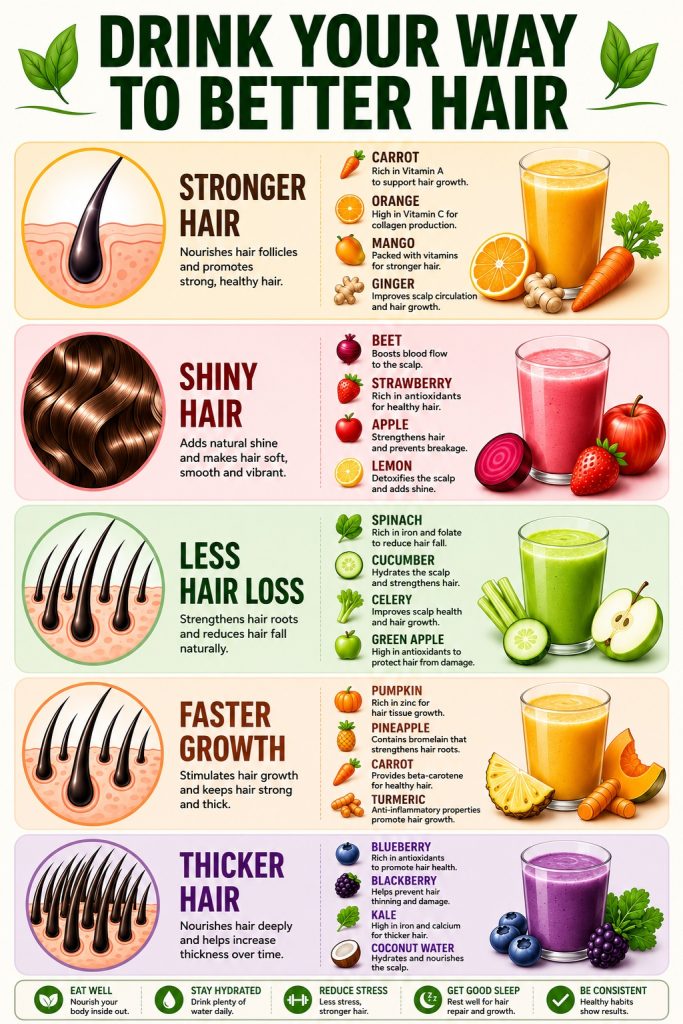
Most smoothies for hair health are just smoothies with a hopeful headline. These five are built around one mechanism that genuinely works: vitamin C taken alongside plant iron increases how much of that iron you absorb, by roughly three and a half fold in controlled studies. Since low iron stores are the nutritional deficiency most consistently linked to hair shedding in women, a blender is actually a sensible tool for the job. Every recipe below clears 78 mg of vitamin C.
Short answer: Ferritin below 30 ng/mL is the level linked to shedding, and standard lab ranges will not flag it. Pair plant iron with 50 mg or more of vitamin C in the same glass to absorb several times more of it. Also expect nothing quickly: shedding starts two to three months after its trigger and full recovery takes 12 to 18 months.
What Nutrition Can and Cannot Do for Hair
Three facts change how you should read every recipe below.
The number that matters is ferritin, not iron. Research links ferritin below 30 ng/mL with telogen effluvium, the diffuse shedding that alarms people most. The catch is that most laboratories only flag ferritin as low around 10 to 15 ng/mL, which is anaemia territory. You can sit at 20 ng/mL, be told your bloods are normal, and still be in the range associated with hair shedding. If you are losing hair, ask for the actual number rather than accepting normal.
But iron is not most people’s answer. Honesty matters here: in one analysis, 61.9 percent of women with female pattern hair loss or chronic telogen effluvium had ferritin above 30. So low iron is worth ruling out, and it will not be the explanation for the majority.
The timeline is slower than anyone wants. Shedding typically begins two to three months after the trigger, whether that was illness, surgery, childbirth, crash dieting or acute stress. It then runs for three to six months, and full density takes 12 to 18 months to return. Around 95 percent of acute cases resolve within six months of the trigger being dealt with.
Two implications follow. What is happening to your hair today reflects something from around three months ago, not this morning’s breakfast. And no smoothie will show a result in weeks, because the follicle cycle does not move that fast.
The American Academy of Dermatology notes that inadequate protein, iron, zinc or biotin can contribute to hair loss, and that correcting a genuine deficiency may allow regrowth. Taking extra when no deficiency exists does not.
The One Thing a Smoothie Does Better Than a Plate
Plant iron, called non heme iron, is poorly absorbed on its own. Vitamin C changes that by reducing ferric iron to the ferrous form the small intestine takes up much more readily.
The effect size is large. Ascorbic acid at a 4:1 molar ratio to iron increased absorption roughly 3.5 fold. The practical target is about 50 mg of vitamin C in the same sitting as the iron.
A blender is unusually good at this, because it puts spinach, seeds or tofu in the same glass as strawberries, kiwi or orange, consumed together within a few minutes. That is exactly the condition the research describes.
The dairy question, answered properly
Calcium does inhibit iron absorption. Around 100 mg of calcium reduces it by roughly 18 percent, and 200 mg by about 27 percent. Three quarters of a cup of Greek yogurt carries roughly 200 mg.
Before you drop the yogurt, note the rest of the finding: adding ascorbic acid overcame the calcium effect entirely, raising iron absorption two to three fold at a 2:1 molar ratio and three to four fold at 4:1. In other words, enough vitamin C more than compensates.
So the rule is not avoid dairy. It is: if the smoothie contains yogurt, make sure it also contains plenty of vitamin C. Recipe four below does exactly that, at 173 mg.
5 Smoothies for Hair Health
All five clear the 50 mg vitamin C threshold. Figures are approximate. For reference, the iron RDA is 18 mg a day for women aged 19 to 50 and 8 mg for men and postmenopausal women.
1. Spinach, strawberry and orange (152 cal, 5 g protein, 3.1 mg iron, 140 mg vitamin C)
Two cups of spinach, one cup of strawberries, half an orange, a tablespoon of chia, water and ice.
The purest expression of the principle, with 45 times more vitamin C than iron by weight. Lightest here at 152 calories, and lowest in protein, so treat it as a snack or pair it with something else. Two cups of spinach sounds like a lot and blends down to almost nothing.
2. Pumpkin seed, blackberry and orange (323 cal, 18 g protein, 4.4 mg iron, 84 mg vitamin C)
One ounce of pumpkin seeds, one cup of blackberries, a cup of kale, half an orange, three quarters of a cup of unsweetened soy milk.
Pumpkin seeds are the quiet star, bringing 2.3 mg of iron in an ounce along with zinc, the other mineral linked to hair. Highest calorie entry here because seeds are dense, so this one is a meal rather than a drink alongside one.
3. Tofu, mango and lime (205 cal, 12 g protein, 4.5 mg iron, 78 mg vitamin C)
Half a cup of firm tofu, one cup of mango, a cup of spinach, a squeeze of lime, water and ice.
Firm tofu alone provides 3.4 mg of iron, and it blends to a texture most people assume came from banana. Dairy free, and the best iron per calorie on the list.
4. Greek yogurt, kiwi and strawberry (264 cal, 21 g protein, 1.4 mg iron, 173 mg vitamin C)
Three quarters of a cup of plain Greek yogurt, two kiwi, half a cup of strawberries, a tablespoon of ground flaxseed.
Highest protein at 21 g and highest vitamin C at 173 mg, which is deliberate: the vitamin C is there to offset the yogurt’s calcium. Lowest iron of the five, so this is the protein option rather than the iron one. Protein deficiency is itself a recognised contributor to hair loss, and this covers that base.
5. Oat, cocoa and berry (316 cal, 14 g protein, 5.1 mg iron, 119 mg vitamin C)
A quarter cup of oats, a tablespoon of unsweetened cocoa, one cup of blackberries, one cup of strawberries, three quarters of a cup of fortified soy milk, a tablespoon of chia.
Most iron here at 5.1 mg, roughly 28 percent of the RDA for a premenopausal woman, assembled from four modest sources rather than one. Cocoa is an underrated iron contributor. Unsweetened cocoa, not drinking chocolate.
Note what is absent throughout: no fruit juice, no honey, no syrup, no sweetened yogurt. Those turn any of these into a dessert, as our guide to healthy smoothies explains.
When More Nutrients Cause Hair Loss
This is the part worth reading twice, because supplements taken for hair can cause the problem they were bought to fix.
- Selenium. Excess selenium is a recognised cause of hair loss. Brazil nuts are extraordinarily concentrated, and a daily handful is a genuine way to overshoot.
- Vitamin A. Too much preformed vitamin A also causes hair loss, and it accumulates rather than being excreted. High doses carry serious risk in pregnancy. Beta carotene from vegetables does not behave this way.
- Vitamin E. Also linked to hair loss at excessive intakes.
- Biotin. The most marketed and the least justified. Deficiency does cause thinning, but there is little evidence that high doses help anyone who already gets enough. Worse, high dose biotin interferes with laboratory assays, including thyroid and some cardiac tests, which can produce results that look like a thyroid disorder or mask a real one. If you take biotin, tell whoever orders your bloods.
The pattern is consistent: correcting a deficiency helps, exceeding sufficiency does not, and substantially exceeding it can harm. Food first, and test before supplementing.
See a Dermatologist For Any of These
- Sudden or patchy loss, or smooth bald patches
- A rapidly widening part or receding hairline
- Hair loss with itching, burning, pain or scaling
- Loss of eyebrows or eyelashes
- Heavy shedding continuing beyond six months
- Hair loss alongside fatigue, weight change or menstrual changes, which may point to thyroid disease or another cause
Nutrition is one cause among many. Genetics, hormones, thyroid disease, autoimmune conditions, medicines, illness, childbirth, scalp disorders and tight hairstyles all produce hair loss, and each has a different treatment. Diagnosis is what makes treatment work.
Diet cannot compensate for mechanical damage either. Use conditioner, detangle wet hair gently, limit high heat styling, and avoid styles that pull repeatedly at the hairline.
Frequently Asked Questions
Can smoothies really help with hair loss?
Only in one specific way, and only if a nutrient deficiency is the cause. Blending puts plant iron and vitamin C in the same glass at the same time, and vitamin C increases non heme iron absorption by roughly 3.5 fold at the right ratio. That is a real mechanism. But if your hair loss comes from genetics, thyroid disease, hormones, medicines or an autoimmune condition, no smoothie will change it, which is why diagnosis comes first.
What ferritin level causes hair loss?
Research links ferritin below 30 ng/mL with telogen effluvium. The important practical detail is that most laboratories only flag ferritin as low around 10 to 15 ng/mL, which is close to anaemia. You can be told your results are normal while sitting at 20 ng/mL, inside the range associated with shedding. Ask for the actual number rather than accepting normal. That said, in one analysis 61.9 percent of women with hair loss had ferritin above 30, so it is worth ruling out rather than assuming.
How much vitamin C do I need with iron?
About 50 mg in the same sitting is the practical target for optimum non heme iron absorption. All five smoothies here clear 78 mg, and the highest reaches 173 mg. Vitamin C works by reducing ferric iron to the ferrous form the small intestine absorbs far more readily, and at a 4:1 molar ratio to iron it increased absorption roughly 3.5 fold in controlled studies.
Does dairy block iron absorption in a smoothie?
Calcium does inhibit it, by roughly 18 percent at 100 mg and 27 percent at 200 mg, and three quarters of a cup of Greek yogurt carries about 200 mg. But the same research found that adding ascorbic acid overcame the effect, raising iron absorption two to three fold at a 2:1 molar ratio and three to four fold at 4:1. So you do not need to drop the yogurt. You need enough vitamin C alongside it.
How long before I see results?
Longer than most people expect, and this is worth knowing before you start. Shedding typically begins two to three months after its trigger, continues for three to six months, and full density takes 12 to 18 months to return. Around 95 percent of acute cases resolve within six months of the trigger resolving. What is happening to your hair now reflects something from roughly three months ago, so judging a dietary change after a few weeks tells you nothing.
Should I take biotin for hair growth?
Probably not. Biotin deficiency does cause thinning, but there is little evidence that high doses help anyone who already gets enough, and most people do. There is also a specific hazard: high dose biotin interferes with laboratory assays including thyroid and some cardiac tests, which can produce misleading results or mask a genuine problem. If you take it, tell whoever orders your blood tests.
Can taking too many vitamins cause hair loss?
Yes, and this catches people out. Excess selenium, excess preformed vitamin A and excess vitamin E have all been linked to hair loss. Brazil nuts are so concentrated in selenium that a daily handful can overshoot. Vitamin A accumulates rather than being excreted, and high doses are particularly risky in pregnancy. The pattern is consistent: correcting a deficiency helps, exceeding sufficiency does not, and greatly exceeding it can harm.
Which smoothie has the most iron?
The oat, cocoa and berry smoothie at 5.1 mg, which is roughly 28 percent of the 18 mg daily requirement for a woman aged 19 to 50. It gets there from four modest sources rather than one: oats, unsweetened cocoa, blackberries and fortified soy milk. The tofu, mango and lime version is close behind at 4.5 mg and has the best iron per calorie, since firm tofu alone provides 3.4 mg.
Is protein important for hair?
Yes. Inadequate protein is a recognised contributor to hair loss, since hair is largely keratin, a protein. But adequate is the operative word: extra protein beyond your needs does not accelerate growth. The Greek yogurt, kiwi and strawberry smoothie leads here at 21 g. Anyone with kidney disease, liver disease or a prescribed protein restriction should get individual advice before adding high protein smoothies regularly.
When should I see a dermatologist instead of changing my diet?
Straight away for sudden or patchy loss, smooth bald patches, a rapidly widening part, a receding hairline, hair loss with itching, burning, pain or scaling, or loss of eyebrows or eyelashes. Also if heavy shedding continues beyond six months, or comes with fatigue, weight change or menstrual changes, which can point to thyroid disease. These patterns have specific causes and specific treatments, and diet is not one of them.
Final Thoughts on Smoothies for Hair Health
Useful smoothies for hair health earn the label through one mechanism rather than a long ingredient list. Plant iron plus 50 mg of vitamin C in the same glass, which multiplies absorption several fold. Everything else on these recipes is ordinary good nutrition.
Before you blend anything, get your ferritin number. Below 30 ng/mL is the range linked to shedding, and your lab will probably not flag it. Also accept that most hair loss is not nutritional, and that the timeline runs in months rather than weeks.
Then skip the supplement aisle. Excess selenium, vitamin A and vitamin E all cause hair loss, and high dose biotin distorts your thyroid results while doing nothing for your hair. Food first, testing before supplements, and a dermatologist for anything sudden, patchy or persistent.
Related reading: foods that support immune function | healthy smoothies | best vegetables to eat regularly | high protein breakfasts
Medical Disclaimer
This article is for general education and does not diagnose, prevent or treat hair loss. Nutrient figures are estimates that vary with variety, brand and portion. Sudden, patchy, severe or persistent hair loss should be evaluated by a qualified healthcare professional, and blood testing should guide any supplementation rather than guesswork. Seek individual advice if you are pregnant or breastfeeding, have kidney or liver disease, take regular medicines, or follow a prescribed protein or mineral restriction. Do not begin iron supplements without testing, since excess iron is harmful. See our medical disclaimer, editorial policy and fact checking policy.
Cross checked against American Academy of Dermatology guidance on diet and hair loss, published research on serum ferritin and alopecia in women, a systematic review and meta analysis of vitamin C and dietary iron bioavailability, research on calcium and iron absorption, clinical descriptions of the telogen effluvium timeline, and USDA FoodData Central. Last updated July 2026.
About the Author and Reviewer
Mezbaul Islam, MSc Nutrition owns and writes Simple Health Naturally. He researches each article from public health guidance, clinical guidelines and peer reviewed studies, and traces every figure back to a named source.
Dr. Obeydur Rahman, MBBS, MD in Medicine edits the articles, checks the sources cited and is responsible for the site’s editorial standards. MD in Medicine is the specialty for adult conditions such as liver disease, type 2 diabetes and high blood pressure.
Read more about our authors and reviewers or see our editorial policy.
Edited by Dr. Obeydur Rahman, MBBS, MD in Medicine.