Climb four flights of stairs fast and the internet says your heart is fine. That claim spread across social media for years and it still shows up in headlines. The stair climb test does measure something real and useful. It just does not measure what most of those headlines promise.
This guide covers where the test came from, how to do it safely, what your time means, how it compares to other simple fitness checks and the important things it cannot detect. Every claim links back to a source at the bottom.
What the Stair Climb Test Actually Is
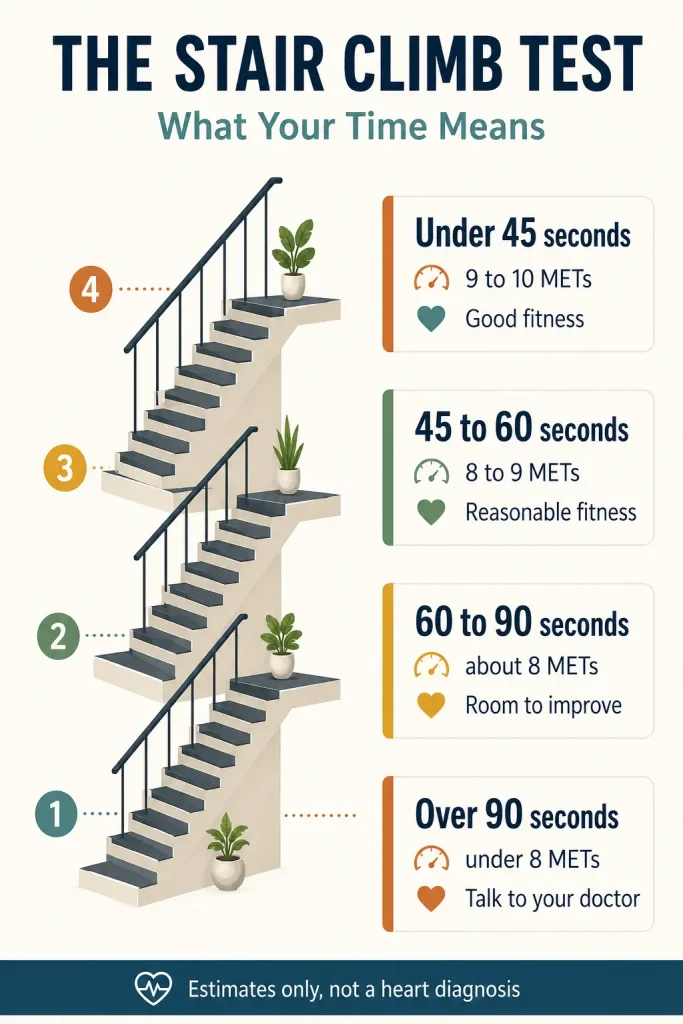
The test asks one thing of you. Climb 60 stairs, which is four typical flights, at a fast pace without running or stopping. Time yourself.
Spanish researchers led by Dr. Jesús Peteiro at University Hospital A Coruña presented the work at a European Society of Cardiology meeting in December 2020. Their goal was practical rather than dramatic.
Formal exercise testing works well. It also requires a treadmill, an ECG, trained staff and an appointment. A stairwell requires none of that.
Peteiro framed the purpose clearly in the ESC announcement. He described it as a way to help doctors decide which patients need fuller examination.
Read the test as a rough fitness estimate rather than a heart scan. That single distinction shapes everything else in this article.
How to Do the Stair Climb Test Safely
Follow these steps in order.
- Find a stairwell with four flights, or count out about 60 steps. Buildings vary so count steps rather than flights.
- Warm up for five minutes with easy walking. Going straight from sitting to hard effort raises your injury risk.
- Start at the bottom and climb at a fast pace. Do not run and do not stop partway.
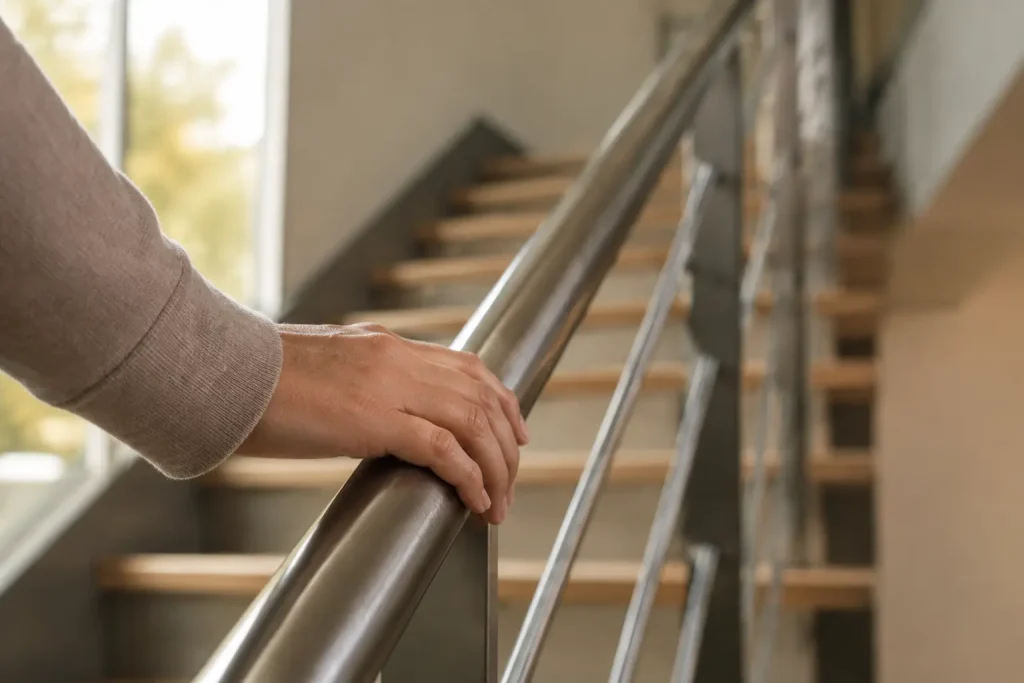
- Hold the handrail whenever you need it. A safe climb beats a fast one.
- Stop the clock at the top step and write your time down.
- Walk slowly for two or three minutes afterward rather than sitting down right away.
Stop immediately for chest pain or pressure, dizziness, severe breathlessness, a racing or irregular heartbeat, or pain radiating into your arm or jaw. Those symptoms need medical attention, not a finish line.
Wear proper shoes. Test in daylight or good lighting. Have someone nearby the first time if you feel unsure.
Skip the test entirely if you fall into any group listed further down.
What Your Time Actually Means
Numbers below come from the original research. Read them as broad categories rather than a grade.
| Your Time | Estimated Exercise Capacity | What That Suggests |
|---|---|---|
| Under 45 seconds | About 9 to 10 METs | Good fitness for most adults |
| 45 to 60 seconds | Roughly 8 to 9 METs | Reasonable fitness |
| 60 to 90 seconds | Around 8 METs | Room to improve |
| Over 90 seconds | Under 8 METs | Worth raising with your doctor |
The European Society of Cardiology reported that patients finishing in under 40 to 45 seconds reached more than 9 to 10 METs on formal treadmill testing. Patients taking 90 seconds or longer came in under 8 METs.
One finding from that study rarely makes the headlines. Among patients who took longer than 90 seconds, 58 percent showed abnormal heart function during their treadmill test. Among those finishing in under a minute, 32 percent showed the same abnormalities.
Look at that second number again. Roughly one in three fast climbers still had abnormal results on proper imaging. A good time did not mean a clean heart.
What METs Mean in Plain English
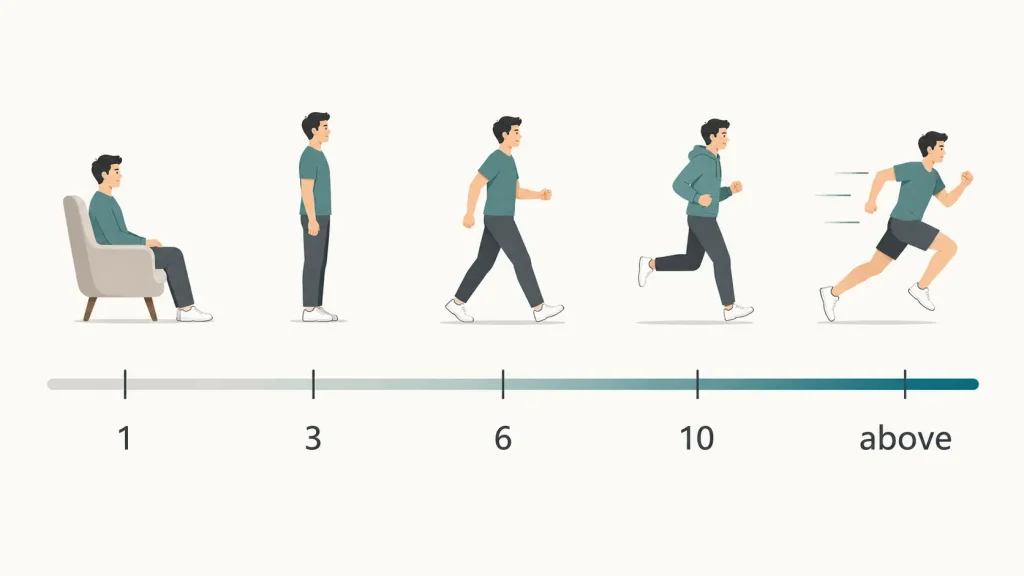
MET stands for metabolic equivalent. One MET equals the energy your body burns sitting quietly, about 3.5 milliliters of oxygen per kilogram of body weight per minute.
Everything else scales from that baseline.
| Activity | Approximate METs |
|---|---|
| Sitting quietly | 1 |
| Standing, slow walking | Under 3 |
| Brisk walking, light cycling | 3 to 6 |
| Jogging, swimming laps, soccer | 6 to 10 |
| Running hard, competitive sport | Over 10 |
Higher exercise capacity tracks with living longer. That relationship holds across decades of research and it holds strongly.
A landmark study in the New England Journal of Medicine followed 6,213 men referred for treadmill testing over an average of six years. Men in the lowest exercise capacity group were more than four times as likely to die as men in the highest group. Exercise capacity beat smoking, diabetes and other established risk factors as a predictor of death.
That study explains why a quick estimate of exercise capacity interests cardiologists at all. Fitness genuinely matters.

What the Research Really Found
The details matter and most coverage skips them.
The study was small. 165 people took part.
Participants were cardiac patients, not healthy adults. Every one had known or suspected coronary artery disease. Their symptoms included chest pain or shortness of breath during exertion.
Nobody peer reviewed it. The team presented the work as a conference abstract in December 2020. It has still not appeared in a peer reviewed journal.
The test estimated fitness, not heart structure. METs describe how much work your body performs. They say nothing about your arteries, your valves or your rhythm.
Peteiro himself hedged the general population claim. He noted the correlation between stair time and exercise capacity would likely look similar in healthy people, while the mortality figures and imaging results would look more favorable than in his patient group.
None of that makes the test useless. The same research group presented earlier work on more than 12,000 patients undergoing exercise echocardiography, and each additional MET achieved was associated with roughly 9 percent lower risk of cardiovascular death over about five years.
Read the stair test as a useful rough signal. Do not read it as a diagnosis.
What the Stair Climb Test Cannot Tell You
This section matters far more than your time does.
A fast climb tells you your fitness holds up. It rules out none of the following.
Blocked arteries. Plaque builds silently for decades. Many people with significant coronary blockages climb stairs without trouble. Detection needs imaging or a formal stress test.
High blood pressure. Hypertension causes no symptoms until it causes damage. Only a cuff measures it.
High cholesterol. Only a blood panel finds it.
Irregular heart rhythms. Atrial fibrillation often comes and goes. A 60 second climb will miss an arrhythmia that appears twice a month.
Valve problems. These need an echocardiogram to see.
Early heart failure. Symptoms can stay subtle for a long time.
Diabetes and metabolic problems. Both raise cardiac risk and neither shows up in a stair time.
Family history. Genetics load the dice regardless of your fitness.
The gap between fitness and cardiac health is real and it catches people out. Fit adults have heart attacks. Marathon runners get diagnosed with coronary disease. Your stair time and your cardiac risk relate to each other without being the same thing.
Chest pain, shortness of breath, palpitations, leg swelling or unusual fatigue all warrant a doctor visit. That holds no matter how fast you climb.
Who Should Skip This Test
Do not attempt it in any of these situations.
- Chest pain now or in recent weeks
- Known heart disease without clearance from your doctor for vigorous activity
- Recent heart attack, stroke or cardiac surgery
- Uncontrolled high blood pressure
- Balance problems or a history of falls
- Joint pain or injury in your knees, hips or ankles
- Later stages of pregnancy
- Severe lung disease
- A long stretch with no regular exercise and no medical check first
The test asks for vigorous effort. CDC guidance recommends talking with your doctor before vigorous activity when you have been inactive, live with a chronic condition or have a disability.
A stairwell also presents a genuine fall hazard. Rushing up stairs against a clock causes real injuries every year, especially among older adults.
Age and Your Expected Time
Exercise capacity declines with age. Most estimates put the drop at roughly 8 to 10 percent per decade after your twenties, with the rate depending heavily on activity level.
The original study set no age adjusted cutoffs. Treat the times below as loose context rather than official standards.
A 30 year old and a 70 year old climbing in the same time are not equally fit. The older climber is doing considerably better relative to their age group.
Your own trend beats any comparison. Test yourself, train for two months, test again. Improvement in your own time tells you more than measuring yourself against a stranger.
How to Improve Your Time
Slow times respond well to training. Exercise capacity ranks among the most trainable things about your body, and improvement shows up in weeks.
Walk more and walk faster sometimes. Brisk walking sits at 3 to 6 METs and builds your aerobic base.
Take real stairs during your week. Skip the elevator for two or three floors. Small doses add up.
Add short hard bursts. Walk at your normal pace, then push hard for 30 seconds, then recover. Repeat six to eight times. Interval work raises capacity faster than steady pace alone.
Build leg strength. Squats, step ups, lunges and calf raises make each stair cost less effort. Two sessions a week is enough.
Hit the weekly target. Federal guidelines call for 150 to 300 minutes of moderate activity or 75 to 150 minutes of vigorous activity per week, plus muscle strengthening on two or more days.
A simple eight week plan looks like this.
- Weeks 1 and 2: Walk 30 minutes five days a week. Take stairs when you see them.
- Weeks 3 and 4: Add two strength sessions. Keep walking.
- Weeks 5 and 6: Add one interval session per week. Six rounds of 30 seconds hard.
- Weeks 7 and 8: Add a second interval session. Retest at the end of week 8.
Start lower than that if you have been inactive. Talk to your doctor first if anything on the skip list applies to you.
Other Simple Fitness Checks
The stair test is one rough measure among several. None replaces medical testing.
Resting heart rate. Count your pulse for a full 60 seconds before you get out of bed. Most adults fall between 60 and 100 beats per minute. Trained people often sit well below that. A resting rate that climbs over months without explanation deserves a mention to your doctor.
The talk test. Walk briskly and check your breathing. Able to talk but not sing means moderate intensity. Unable to say more than a few words means vigorous. This helps you gauge effort without any equipment.
30 second chair stand. Sit in a straight backed chair with arms crossed over your chest. Count how many times you can stand fully and sit back down in 30 seconds without using your hands. This measures leg strength and balance rather than heart fitness, and clinicians use it in fall risk screening.
Grip strength. A large international study of nearly 140,000 adults across 17 countries found that every 5 kilogram drop in grip strength linked with a 16 percent higher risk of death from any cause and a 17 percent higher risk of cardiovascular death. Grip strength predicted mortality more strongly than systolic blood pressure in that data. A basic hand dynamometer costs very little.
Track all of these over time rather than against other people. Your own trend carries the information.
What Actually Screens Your Heart
Ask your doctor which of these fit your age, symptoms and family history.
Blood pressure check. Simple, cheap and the single most useful routine measurement for cardiac risk.
Lipid panel. Measures total cholesterol, LDL, HDL and triglycerides from a blood draw.
Blood glucose or A1C. Diabetes substantially raises cardiac risk.
ECG. Records electrical activity and catches many rhythm and conduction problems.
Exercise stress test. Treadmill work with monitoring. This is the formal version of what the stair test roughly estimates.
Echocardiogram. Ultrasound imaging of heart structure, valves and pumping function.
Coronary calcium scan. A CT scan that measures calcified plaque in your arteries. Useful for risk assessment in some middle aged adults.
Your doctor decides which apply to you. A stairwell decides nothing.
Frequently Asked Questions
Is the stair climb test accurate?
It gives a rough estimate of exercise capacity. The research behind it came from a small unpublished study of 165 cardiac patients. Treat your time as a general signal rather than a measurement.
Does a fast time mean my heart is healthy?
No. It suggests decent fitness. In the original study, 32 percent of people who climbed in under a minute still showed abnormal heart function on formal testing.
How many stairs equal four flights?
About 60 steps. Flight lengths vary between buildings so count the steps.
What if I take longer than 90 seconds?
Bring it up at your next doctor visit. A slow time suggests lower exercise capacity, which links with higher risk across the research. It also improves with training in most people.
Can I do this test if I am over 60?
Many older adults can. Talk to your doctor first, especially with any heart condition, balance concern or joint problem. Safety on stairs matters far more than your time.
How often should I retest?
Every two or three months at most. Fitness changes slowly and frequent testing tells you nothing new.
Does the stair test work for women?
The original study included both men and women without reporting separate cutoffs. Exercise capacity does differ by sex on average, so treat the published times as general rather than precise for anyone.
Can I use a treadmill on an incline instead?
Not for a comparable number. The published times come from actual stairs. A treadmill measures something related but not identical.
What is a good MET score?
Reaching 10 METs on formal testing associates with low mortality across multiple studies. Under 5 METs generally signals poor exercise capacity and warrants medical attention.
Should I test after eating or in the morning?
Wait at least an hour after a meal. Time of day matters less than being consistent, so test under similar conditions each time.
Related reading: our 5 daily wellness habits covers the step and activity targets behind this test, and body pain: when to see a doctor explains which symptoms mean stop rather than push on.
Train to the right intensity. The 220 minus age formula is a poor estimate for most people. Our heart rate zone calculator gives you a better set of zones to work from.
Final Thoughts on the Stair Climb Test
The stair climb test earned attention because it costs nothing and takes a minute. Your time gives a rough read on exercise capacity, and exercise capacity genuinely predicts long term health outcomes across large studies.
The headlines went well past what the research supports though. A fast climb means your fitness holds up. It does not mean your arteries are clear, your blood pressure is fine or your rhythm is normal. Those need real tests and a real doctor.
Use your time as a starting point rather than a verdict. Improve it with regular walking, stairs and a bit of strength work. Book the actual screenings on schedule. Speak up about symptoms even when you feel strong, because feeling strong and being safe are not the same thing.
References
- European Society of Cardiology. Test your heart health by climbing stairs. Press release, 11 December 2020. Abstract by Peteiro J et al, University Hospital A Coruña, Spain. escardio.org
- Myers J, Prakash M, Froelicher V, Do D, Partington S, Atwood JE. Exercise capacity and mortality among men referred for exercise testing. New England Journal of Medicine. 2002;346(11):793-801. PubMed
- Leong DP, Teo KK, Rangarajan S, et al. Prognostic value of grip strength: findings from the Prospective Urban Rural Epidemiology (PURE) study. The Lancet. 2015;386(9990):266-273. The Lancet
- Centers for Disease Control and Prevention. Physical Activity Guidelines and Recommendations. cdc.gov
- US Department of Health and Human Services. Physical Activity Guidelines for Americans, 2nd edition. 2018. odphp.health.gov
This article shares general health information. It does not replace advice from your doctor. Talk with a healthcare provider before starting vigorous activity or about any symptoms including chest pain, shortness of breath or palpitations. Call emergency services for chest pain lasting more than a few minutes. Read our full medical disclaimer and fact checking policy.
Edited by Dr. Obeydur Rahman, MBBS, MD in Medicine.