A fatty liver diet is not a cleanse, a detox, or a list of magic foods. It is a Mediterranean style eating pattern with a modest calorie reduction, and it is the treatment that current international guidelines put at the centre of managing metabolic dysfunction associated steatotic liver disease, or MASLD. What makes it worth doing is that liver fat responds. Lose enough weight and the changes show up on a biopsy, not just on a scale.
This guide covers what to eat, what to cut, how much weight loss actually changes the liver, and which popular advice is wrong.
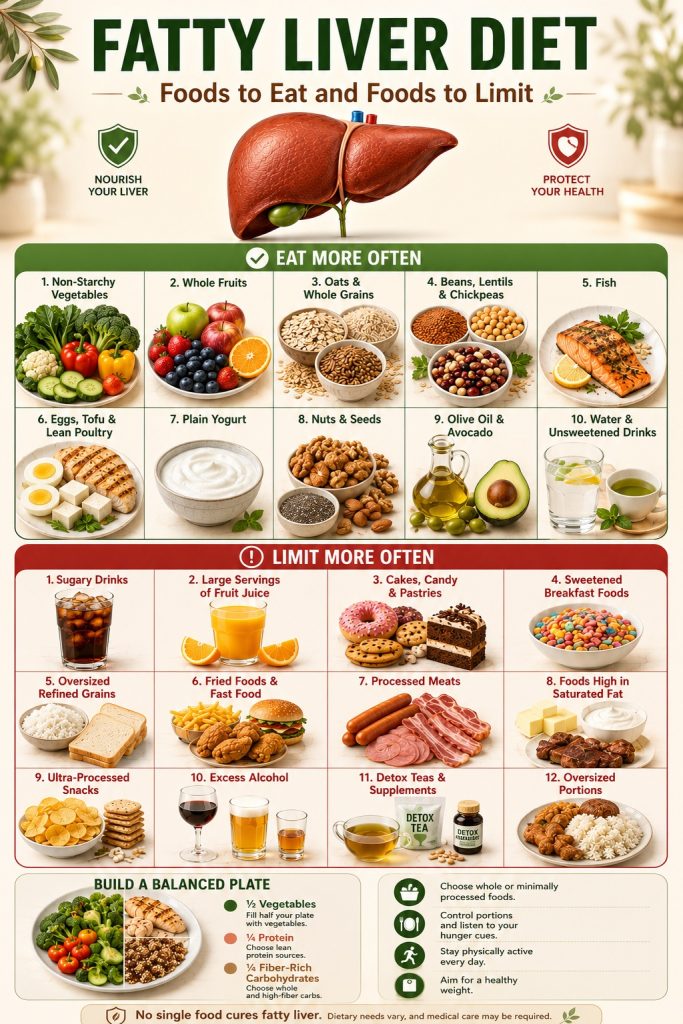
Short answer: Build meals from vegetables, whole fruit, legumes, whole grains, fish, nuts and olive oil. Cut sugary drinks first, then fried food, processed meat and ultra processed snacks. Aim for gradual weight loss of 7 to 10 percent if you carry excess weight. Skip detox teas and liver cleanse supplements entirely.
What the Best Fatty Liver Diet Looks Like
The 2024 EASL, EASD and EASO clinical practice guidelines name the Mediterranean diet as the preferred pattern for MASLD, combined with a calorie deficit and regular activity. The credited components are the polyphenols, fibre, carotenoids and omega 3 fats that come with eating this way, rather than any single ingredient.
In practice that means a daily deficit of roughly 500 to 750 calories, achieved by changing what fills the plate rather than by cutting out entire food groups. NIDDK gives the same core advice: limit added sugars and refined carbohydrate, cut sugary drinks and juice, and build meals from whole foods.
How much weight loss actually changes the liver
This is where the numbers get useful. A prospective study of 293 people with biopsy proven steatohepatitis, who made lifestyle changes over 52 weeks with repeat biopsies at the end, produced a clear dose response (Vilar-Gomez et al., Gastroenterology):
- 3 to 5 percent body weight loss begins to reduce liver fat
- 5 percent or more: 58 percent had resolution of steatohepatitis and 82 percent had a meaningful drop in disease activity score
- 7 to 10 percent: reliably improves inflammation
- 10 percent or more: every participant reduced their activity score, 90 percent had steatohepatitis resolve, and 45 percent had fibrosis regress
Two honest caveats. Scarring reversal really does require the larger loss, so the 10 percent figure is not arbitrary. And only 30 percent of participants managed to lose 5 percent or more in a year, which tells you this is hard and that a slower approach you can sustain beats an aggressive one you abandon.
If your weight is already in a healthy range, you do not need to lose any. The food quality changes below still apply. Rapid weight loss and very low calorie plans can make liver disease worse, and anyone with cirrhosis or low muscle mass should only change intake under supervision.
Foods to Eat on a Fatty Liver Diet
- Non starchy vegetables. Spinach, broccoli, peppers, courgette, cauliflower, tomatoes, salad leaves. Fill half the plate. They add volume and fibre for very few calories, which is the mechanism that makes a deficit tolerable.
- Whole fruit. Berries, apples, pears, citrus, kiwi. Two to three servings daily is fine. Fruit fibre slows sugar absorption, which is precisely why juice behaves differently from the fruit it came from.
- Legumes. Lentils, chickpeas, black beans, kidney beans. Protein plus fibre plus slow carbohydrate in one ingredient, and among the cheapest items on this list.
- Whole grains. Oats, barley, quinoa, brown rice, whole grain bread. Keep to roughly a quarter of the plate. The instruction is to swap refined for whole, not to eliminate carbohydrate.
- Fish, especially oily fish. Salmon, sardines, mackerel, trout, twice a week. Supplies the long chain omega 3 fats that most low fat diets miss.
- Other lean protein. Eggs, skinless poultry, tofu, plain Greek yogurt, cottage cheese. Eggs are fine for most people; the old cholesterol panic has not held up.
- Nuts, seeds and olive oil. Walnuts, almonds, chia, flax, extra virgin olive oil. Measure these, since a handful of nuts is 160 calories and four handfuls is a meal.
- Water, unsweetened tea and coffee. Coffee has the best observational data of any drink here, associated with lower odds of fibrosis and cirrhosis. Details in our review of coffee and liver health.
For a deeper look at individual foods, see our roundup of foods that may support liver health.
Foods and Drinks to Limit
Sugary drinks come first, and here is why
Sugary drinks are not just empty calories. Fructose is processed largely by the liver and drives de novo lipogenesis, the process by which the liver manufactures fat from sugar.
A randomised controlled trial in 94 healthy men tested this directly. Beverages sweetened with fructose or sucrose at 80 g daily for seven weeks roughly doubled the liver’s fatty acid synthesis compared with baseline. Glucose sweetened drinks did not. Crucially, total calorie intake stayed stable, so this was not a calorie effect. The type of sugar mattered independently.
That is why soda, sweetened tea and coffee, energy drinks, fruit drinks and large servings of juice sit at the top of the limit list. Replacing them is the highest return single change most people can make. Our guide to snacks that will not spike blood sugar covers the same principle for food.
The rest of the limit list
- Ultra processed foods. Packaged snacks, sweetened cereals, instant noodles, most convenience meals. Cohort research links higher ultra processed intake with greater risk of developing MASLD, and separately with higher all cause mortality. These foods also displace the fibre and protein that make a deficit bearable.
- Cakes, biscuits, pastries and confectionery. Occasional is fine. Daily is the problem.
- Fried food and fast food. Deep frying adds substantial calories and often damaged fats. Bake, roast, grill or air fry instead.
- Processed meat. Bacon, sausages, salami, deli meats. The WHO cancer agency classifies processed meat as a Group 1 carcinogen for colorectal cancer, so this is worth limiting for reasons beyond the liver.
- Excess saturated fat. Fatty cuts, butter heavy cooking, cream, full fat cheese in quantity. Swapping toward olive oil, nuts and fish is the specific change guidelines recommend.
- Refined grains in large portions. White bread, white rice, standard pasta. Portion and swap rather than banish.
- Alcohol. Less is better. For some people the right amount is none, particularly with significant fibrosis, cirrhosis or abnormal liver tests.
- Oversized portions of healthy food. Olive oil, nuts, nut butter, avocado and cheese are all nutritious and all calorie dense. A deficit built from good ingredients is still a deficit you can eat past.
The Plate Method and a Sample Day
For most lunches and dinners: half the plate non starchy vegetables, one quarter protein, one quarter whole grains or legumes, a measured amount of healthy fat, and water or an unsweetened drink.
- Breakfast: oats with berries, plain yogurt and a spoon of walnuts. Or two eggs with spinach and whole grain toast.
- Lunch: lentil and vegetable salad with olive oil and lemon, plus a piece of fruit.
- Snack, if needed: a small handful of almonds, or plain yogurt, or vegetables with hummus.
- Dinner: baked salmon, roasted broccoli and peppers, a small serving of quinoa.
- Drinks: water, unsweetened tea, black coffee or coffee with milk.
Nobody eats like this every day. Consistency across the week matters more than perfection on any single day.
Supplements: What Actually Has Evidence
Vitamin E is the one supplement with a real guideline position. AASLD guidance notes that 800 IU daily improved liver histology in adults with biopsy proven steatohepatitis who do not have diabetes, and may be considered for that specific group after discussing risks. That is a narrow population, it requires a biopsy diagnosis, and long term high dose vitamin E has been associated with increased prostate cancer risk in at least one large trial. This is a prescribing conversation, not a self starting one.
Omega 3 may help triglycerides but has not been shown to resolve steatohepatitis. Eating oily fish twice weekly is the sensible default.
Detox teas, liver cleanse formulas and fat burners have no evidence of benefit and carry genuine risk. Green tea extract, turmeric, ashwagandha, garcinia and red yeast rice are all recognised causes of drug induced liver injury. Our article on green tea and liver health explains why the brewed drink and the capsule behave very differently.
Myths Worth Dropping
- “All carbohydrates are bad.” Refined carbohydrate in large portions is the issue. Vegetables, fruit, legumes and whole grains are carbohydrate foods that belong in this diet.
- “Fruit causes fatty liver.” Whole fruit comes packaged with fibre and water. The fructose research that worries people used concentrated sweetened beverages, not apples.
- “You need a fat free diet.” The guideline recommendation is to change fat quality, not eliminate fat. Olive oil, nuts and oily fish are actively encouraged.
- “A detox drink cleans the liver.” The liver is the detox organ. Nothing you drink cleans it.
- “You have to be perfect.” The study above found that most participants did not hit a 5 percent loss in a year, and plenty still improved. Directional beats flawless.
Frequently Asked Questions
What is the best diet for fatty liver?
A Mediterranean style pattern with a modest calorie deficit. The 2024 EASL, EASD and EASO guidelines name it as the preferred approach for MASLD, built on vegetables, whole fruit, legumes, whole grains, fish, nuts and olive oil, with reduced added sugar, refined carbohydrate and ultra processed food. Combined with activity and gradual weight loss, this is currently the central treatment rather than one option among many.
How much weight do I need to lose to reverse fatty liver?
It depends what you want to reverse. Around 3 to 5 percent of body weight starts reducing liver fat, 7 to 10 percent improves inflammation, and 10 percent or more is where scarring can regress. In a study of 293 people with biopsy proven steatohepatitis, those losing 10 percent or more saw 90 percent resolution of steatohepatitis and 45 percent fibrosis regression. Lose it gradually, since rapid loss can worsen liver disease.
What foods should I avoid with fatty liver?
Sugary drinks first, since fructose drives the liver to manufacture fat. Then fried food and fast food, processed meats such as bacon and salami, ultra processed snacks and cereals, large portions of refined grains, excess saturated fat, and alcohol. Detox teas and liver cleanse supplements should be avoided entirely, as several are known causes of liver injury.
Can I eat rice and bread with fatty liver?
Yes, in sensible portions. The recommendation is to swap refined for whole rather than cut carbohydrate out. Brown rice, barley, quinoa and whole grain bread at roughly a quarter of the plate work well. White rice and white bread are not forbidden, but large daily portions of refined grain make the pattern harder to sustain.
Is fruit bad for fatty liver?
No. Whole fruit is recommended, generally two to three servings a day. The fructose concern comes from research on sweetened beverages, where 80 g daily of fructose or sucrose sweetened drinks raised liver fat production in a controlled trial. Whole fruit delivers fructose alongside fibre and water in far smaller amounts. Large glasses of juice are a different matter and are best limited.
Is coffee good for fatty liver?
The observational evidence is favourable and unusually consistent. Pooled analyses link coffee drinking with roughly 40 percent lower odds of cirrhosis and around 27 to 35 percent lower odds of advanced fibrosis compared with none. These are associations rather than proof, and the benefit applies to ordinary coffee rather than sweetened blended drinks. Two to three cups daily is a reasonable amount for most adults.
Are eggs allowed on a fatty liver diet?
Yes for most people. Eggs supply protein, choline and other nutrients, and the older concern about dietary cholesterol has not held up well. They fit comfortably into a Mediterranean pattern. If you have been given specific cholesterol or dietary advice by your clinician, follow that instead.
Do I need to fast or follow keto for fatty liver?
No. Neither intermittent fasting nor a ketogenic diet is required, and guidelines do not recommend them over a Mediterranean pattern. What matters is a sustained calorie deficit and better food quality. If a particular eating window helps you eat less without misery, it is a reasonable tool, but it is not the mechanism.
How quickly can a fatty liver diet work?
Liver fat can start falling within weeks of consistent change, and liver enzymes often improve within a few months. Inflammation and scarring take considerably longer, which is why the biopsy study above ran for 52 weeks. Do not judge progress by how you feel, since fatty liver is usually symptomless. Follow up testing is how you know.
Should I take a supplement for fatty liver?
Usually not. Vitamin E at 800 IU daily has a guideline position, but only for adults with biopsy proven steatohepatitis who do not have diabetes, and it carries its own risks that need discussing with a clinician. Detox teas, liver cleanse blends and fat burners have no proven benefit and several contain botanicals linked to liver injury.
Final Thoughts on the Fatty Liver Diet
A fatty liver diet that works is unglamorous and specific: a Mediterranean pattern, a modest calorie deficit, sugary drinks gone, and gradual weight loss if you carry excess weight. The evidence for it is stronger than for anything sold in a bottle, and the biopsy data show the liver genuinely responds when the weight comes off.
Start with one change rather than twelve. Replace sweetened drinks with water, tea or coffee, then work on getting vegetables and a protein onto most plates. Pair the diet with activity, since movement helps liver fat even when weight barely shifts, and keep up with your medical follow up. Our guide to lifestyle habits that support liver health covers the rest of the picture, including the fibrosis risk score worth asking your clinician about.
The diet works through weight, so the numbers are worth knowing. A loss of 3 to 5 percent of body weight lowers liver fat, and 7 to 10 percent may improve inflammation and scarring. Our weight loss percentage calculator shows what those milestones weigh for you, and our waist to height ratio calculator tracks the central fat that drives liver fat in the first place. Related reading:
Medical Disclaimer
This article is for general education and does not diagnose or treat liver disease. Dietary needs differ for people with cirrhosis, diabetes, kidney disease, pregnancy, malnutrition or prescribed dietary restrictions, and rapid weight loss can worsen some liver conditions. Consult a qualified healthcare professional or registered dietitian before making significant changes to your diet or supplements. See our medical disclaimer, editorial policy and fact checking policy.
Cross checked against the 2024 EASL, EASD and EASO clinical practice guidelines, NIDDK, AASLD and peer reviewed research in Gastroenterology and the Journal of Hepatology. Last updated July 2026.
About the Author and Reviewer
Mezbaul Islam, MSc Nutrition owns and writes Simple Health Naturally. He researches each article from public health guidance, clinical guidelines and peer reviewed studies, and traces every figure back to a named source.
Dr. Obeydur Rahman, MBBS, MD in Medicine edits the articles, checks the sources cited and is responsible for the site’s editorial standards. MD in Medicine is the specialty for adult conditions such as liver disease, type 2 diabetes and high blood pressure.
Read more about our authors and reviewers or see our editorial policy.
Edited by Dr. Obeydur Rahman, MBBS, MD in Medicine.