The research on coffee and liver health is unusually consistent for a drink people enjoy anyway. Large cohort studies repeatedly link regular coffee drinking with lower rates of cirrhosis, liver cancer and death from liver disease, and a 2026 study added imaging and blood protein evidence to the picture. What coffee is not is a detox, a cure, or a substitute for treatment, and the evidence has a specific weak spot worth knowing about.
Short answer: In a 2026 UK Biobank analysis, people drinking five or more cups a day had 32 percent lower cirrhosis risk, 47 percent lower liver cancer risk and 42 percent lower liver related death than non drinkers. Earlier work found benefit peaking at 3 to 4 cups. All of it is observational, so association rather than proof.
What the Latest Research on Coffee and Liver Health Shows
The 2026 imaging and proteomics study
The most substantial recent work, published in Clinical Gastroenterology and Hepatology, followed 354,957 UK Biobank participants who had no cirrhosis or liver cancer at enrolment for a median of 13 years. What makes it notable is that it did not stop at diagnoses. It also examined MRI liver measurements in 28,961 people and blood protein profiles in 44,633.
Compared with non drinkers, people drinking five or more cups daily had:
- 32 percent lower risk of cirrhosis
- 47 percent lower risk of liver cancer
- 42 percent lower risk of liver related death
The MRI results matter as much as the outcome figures. Higher coffee intake tracked with lower liver fat, lower liver iron, less fibrosis and less inflammation on imaging. That is a physical signal in the organ itself, not just a difference in who ends up with a diagnosis.
All coffee types, including decaf
An earlier UK Biobank analysis in BMC Public Health followed 494,585 people for a median of 10.7 years and compared 384,818 coffee drinkers with 109,767 non drinkers. Coffee drinkers were 21 percent less likely to develop chronic liver disease, 20 percent less likely to develop chronic liver disease or steatosis, and 49 percent less likely to die from chronic liver disease.
Two details from that study are worth carrying forward. Benefit peaked at 3 to 4 cups per day rather than rising indefinitely. And the association held for ground, instant and decaffeinated coffee, which is the strongest hint that caffeine is not the only active ingredient.
Coffee contains chlorogenic acids and other polyphenols, cafestol and kahweol, and melanoidins formed during roasting. Researchers have proposed effects on oxidative stress, inflammation and fibrotic signalling. Those mechanisms are plausible and not proven in humans.
Where the evidence is genuinely weaker
Two claims you will see online do not hold up as well.
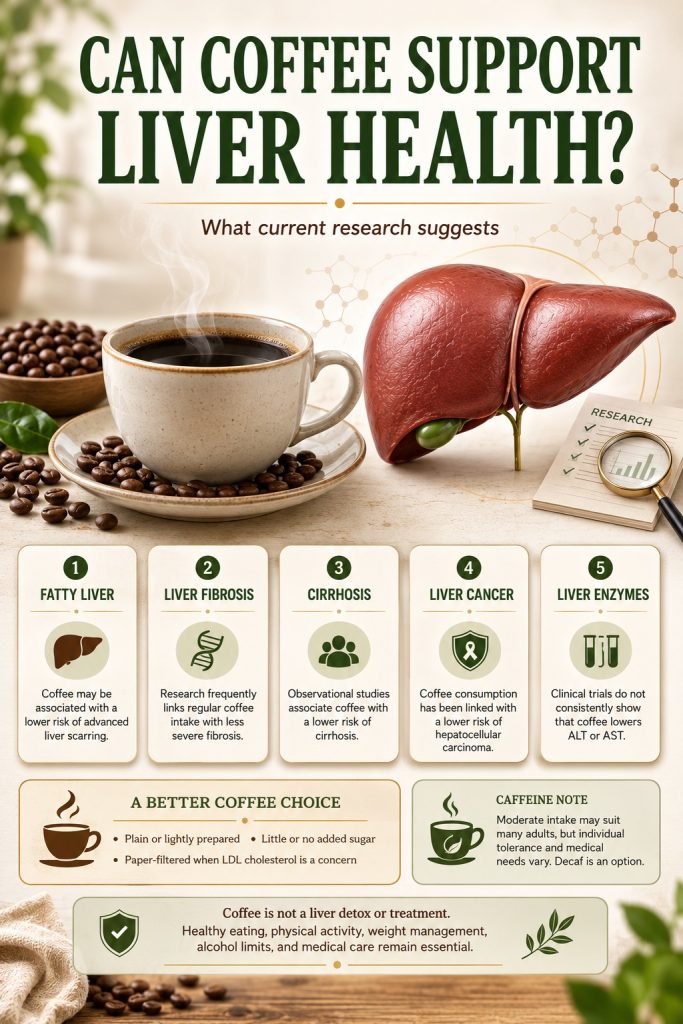
- Coffee does not reliably lower ALT or AST. Observational studies often show lower enzymes in coffee drinkers, but systematic reviews of randomised controlled trials have not found a consistent effect on liver function markers. Do not drink coffee to move a blood test number instead of investigating why it is abnormal.
- Coffee does not appear to prevent fatty liver from developing. A systematic review found no significant association between coffee and the incidence or prevalence of fatty liver. Among people who already had it, however, coffee drinkers had roughly 35 percent lower odds of significant fibrosis. The pattern suggests coffee is linked to slower progression rather than to preventing fat accumulation in the first place.
That distinction is the single most useful thing in this article. Coffee looks better at the scarring end of the disease than at the beginning of it.
Why These Numbers Need a Caveat
Every figure above comes from observational research, which shows association and cannot establish cause. Two specific problems apply here.
Confounding. Coffee drinkers differ from non drinkers in diet, activity, smoking, alcohol, income and healthcare access. Statistical adjustment helps but never fully removes this.
Reverse causation. This one is easy to miss and matters a lot. People who already feel unwell, or who have early liver disease, often go off coffee. That pushes sicker people into the non drinker group and makes coffee look more protective than it is. Studies try to handle it by excluding early cases, but it cannot be eliminated.
There has never been a large randomised trial assigning people to drink coffee for a decade, and there probably never will be. So the honest position is that the association is strong, consistent and biologically plausible, and still not proof.
Does the Brewing Method Matter?
Yes, and this is where a genuine tradeoff appears.
Unfiltered coffee, meaning French press, boiled coffee, espresso and some traditional preparations, retains more of the oils cafestol and kahweol. Meta analyses of controlled trials show these raise total and LDL cholesterol. Paper filtering removes most of them.
That matters more than it sounds, because most people with metabolic liver disease also carry cardiovascular risk, and heart disease kills more of them than liver disease does. If you drink several cups a day and have raised LDL, diabetes or existing cardiovascular disease, paper filtered coffee is the sensible default. Instant coffee is generally low in these compounds too.
What goes in the cup matters more than the brewing method for most people. A few teaspoons of sugar, syrup, sweetened condensed milk, whipped cream or a sweetened creamer turns coffee into a dessert, and added sugar works directly against the metabolic goals that drive liver disease. A splash of milk is fine.
How Much, and Who Should Be Careful
There is no prescribed dose of coffee for liver disease, and there is an awkward tension in the data. The 2026 study found the strongest associations at five or more cups daily, while the earlier one found benefit peaking at 3 to 4. Meanwhile the FDA cites 400 mg of caffeine daily as the amount not generally associated with negative effects in healthy adults, which is roughly four to five 8 ounce cups or two to three larger ones.
In other words, the intake linked to the biggest liver signal sits at or above the general caffeine ceiling for many people. That is a reason to keep your current habit rather than to escalate it.
- Caffeine sensitivity. Palpitations, raised blood pressure, insomnia, anxiety, jitters, nausea and headache are all dose related. Switch to decaf or cut back.
- Pregnancy. ACOG advises staying under 200 mg of caffeine daily, counting coffee, tea, cola, chocolate and energy drinks together.
- Sleep problems. Move coffee earlier in the day or switch to decaf after midday. Decaf is not caffeine free, at roughly 2 to 15 mg per 8 ounce cup.
- Reflux and digestive symptoms. There is no liver related reason to keep drinking something that causes persistent symptoms.
- Advanced liver disease. With cirrhosis, liver cancer, malnutrition, arrhythmia, kidney disease or complex medication, ask your team before changing intake.
- Medication. Several drugs affect caffeine metabolism or interact with it. Check with a pharmacist.
Should non drinkers start?
No. The evidence does not support telling people to take up a habit they do not have, particularly when it is observational. If you dislike coffee, or caffeine causes problems, there are habits with far stronger evidence: gradual weight loss where appropriate, regular activity, cutting sugary drinks, limiting alcohol, and treating diabetes, cholesterol and blood pressure. Our guide to lifestyle habits that support liver health covers the full list.
What Coffee Cannot Do
Coffee does not flush toxins, remove liver fat on its own, or reverse established scarring. The liver is itself the detoxification organ and does not need help from a drink.
It also cannot offset excess calories, sugary drinks, heavy alcohol use or inactivity, and it does not replace hepatitis B vaccination, hepatitis treatment, alcohol reduction, metabolic management or the ultrasound surveillance recommended for people with cirrhosis.
Be particularly wary of anything sold as liver detox coffee, fatty liver cleansing blends, mushroom coffee that claims to cure liver disease, or green coffee extract for fat removal. Concentrated extracts are not the same as brewed coffee, and several botanical supplements are recognised causes of liver injury. Our article on green tea and liver health explains why the drink and the capsule behave very differently, and the same logic applies here.
Frequently Asked Questions
Is coffee good for your liver?
The association is one of the most consistent in liver research. A 2026 UK Biobank study of 354,957 people followed for a median of 13 years found that drinking five or more cups daily was linked with 32 percent lower cirrhosis risk, 47 percent lower liver cancer risk and 42 percent lower liver related death compared with non drinkers, alongside less liver fat and fibrosis on MRI. All of this is observational, so it shows association rather than proof of cause.
How many cups of coffee are good for the liver?
There is no prescribed dose. One large study found benefit peaking at 3 to 4 cups daily, while a 2026 analysis found the strongest associations at five or more. The FDA cites 400 mg of caffeine daily as generally without negative effects for healthy adults, roughly four to five 8 ounce cups. Since the highest intakes in the research sit at or above that ceiling, the sensible reading is to keep your current habit rather than increase it.
Is coffee good for fatty liver?
Partly. A systematic review found no significant association between coffee and whether people develop fatty liver in the first place. Among those who already had it, coffee drinkers had roughly 35 percent lower odds of significant fibrosis. So the link appears stronger for slowing progression to scarring than for preventing fat accumulation. Coffee cannot remove liver fat on its own.
Does decaf coffee help the liver too?
The evidence suggests yes. A UK Biobank study of 494,585 people found favourable associations for ground, instant and decaffeinated coffee alike, which is the strongest indication that caffeine is not the only active component. Chlorogenic acids, other polyphenols and roasting compounds may contribute. Decaf is a reasonable choice if caffeine causes insomnia, palpitations or anxiety, though it still contains roughly 2 to 15 mg per cup.
Does coffee lower liver enzymes like ALT and AST?
Not reliably. Observational studies often show lower enzymes among coffee drinkers, but systematic reviews of randomised controlled trials have not found a consistent effect on liver function markers. Normal enzymes also do not rule out fatty liver or fibrosis. Abnormal results need proper investigation rather than an attempt to move the number with a drink.
Does the brewing method matter for liver health?
It matters for cholesterol rather than for the liver directly. Unfiltered coffee such as French press, boiled coffee and espresso retains cafestol and kahweol, oils shown in controlled trials to raise total and LDL cholesterol. Paper filtering removes most of them. Since most people with metabolic liver disease also carry cardiovascular risk, paper filtered coffee is the more sensible everyday choice if you drink several cups.
Should I start drinking coffee for my liver?
No. The evidence is observational and does not justify starting a habit you do not already have, especially if you dislike coffee or caffeine causes problems. Weight management, physical activity, cutting sugary drinks, limiting alcohol and treating diabetes and cholesterol all have stronger evidence behind them for liver and metabolic health.
Can coffee prevent liver cancer?
It cannot guarantee prevention, though the association is notable. Systematic reviews have linked each additional two cups per day with roughly 35 percent lower risk of hepatocellular carcinoma, and the 2026 UK Biobank analysis found 47 percent lower risk at five or more cups. Hepatitis B vaccination, hepatitis treatment, alcohol reduction, metabolic management and ultrasound surveillance for people with cirrhosis remain far more important.
Is coffee with milk and sugar still beneficial?
A splash of milk is unlikely to matter. Sugar is the problem. Several teaspoons of sugar, flavoured syrup, sweetened condensed milk, whipped cream or sweetened creamer turns coffee into a dessert, and added sugar works directly against the metabolic factors that drive liver disease. If you take sugar, reducing it gradually is worth more than switching brewing methods.
Can I drink coffee if I have cirrhosis?
Ask your healthcare team rather than deciding from research summaries. Advanced liver disease often involves sleep disturbance, malnutrition, fluid retention, arrhythmia, kidney problems or complex medication regimens, any of which can change whether caffeine is appropriate. Coffee also does nothing to treat the underlying cause of cirrhosis, which needs cause specific management.
Check your own timing. Caffeine has a half life of about five hours, so an afternoon coffee can still be working at bedtime. Our caffeine calculator shows how much is still in you when you go to sleep.
Final Thoughts on Coffee and Liver Health
On the balance of evidence, coffee and liver health is one of the few popular health claims that mostly survives scrutiny. Two large UK Biobank analyses, one adding MRI and blood protein data, point the same direction across cirrhosis, liver cancer and liver related death, and the association holds for decaf as well as caffeinated.
Keep three caveats in mind. It is observational, so it is association rather than proof. It looks better at slowing progression to fibrosis than at preventing fatty liver in the first place. And it does not reliably move liver enzymes, so it is no substitute for finding out why a blood test is abnormal.
Practically: if you already drink coffee and tolerate it, carry on, keep it plain, use a paper filter if you drink several cups or have raised cholesterol, and stay inside a caffeine intake that suits you. If you do not drink it, there is no good reason to start. Put that effort into the things with stronger evidence behind them, starting with what you eat and how much you move. Our fatty liver diet guide is a better place to begin than the coffee aisle.
Related reading: Lifestyle habits that support liver health | Fatty liver diet: foods to eat and limit | Green tea and liver health | 10 best foods that may support liver health
Medical Disclaimer
This article is for general education and does not diagnose, prevent or treat liver disease. Coffee does not replace medical testing, prescribed treatment, healthy eating, physical activity or recommended liver surveillance. Consult a qualified healthcare professional about caffeine intake if you are pregnant, have advanced liver disease, take regular medicines, or experience palpitations, anxiety, sleep problems or digestive symptoms. See our medical disclaimer, editorial policy and fact checking policy.
Cross checked against Clinical Gastroenterology and Hepatology, BMC Public Health, FDA caffeine guidance and peer reviewed systematic reviews. Last updated July 2026.
Edited by Dr. Obeydur Rahman, MBBS, MD in Medicine.