Most lists of foods to avoid if you have fatty liver are just lists of unhealthy food, which tells you nothing you did not already know. This one is ordered by evidence. Three things have been tested in controlled human trials and shown to increase liver fat directly, sometimes without any weight gain at all. Everything else is a reasonable precaution. Knowing which is which is the difference between changing three habits and trying to change twenty.
Short answer: Sweetened drinks raised liver fat by 132 to 143 percent in a six month randomised trial. Saturated fat raised it 50 percent in an overfeeding trial where the comparison group gained identical weight and had no increase at all. Ultra processed food drove 508 extra calories a day when everything else was matched. Alcohol now has a specific numeric threshold attached to your diagnosis. Start there.
The Three With Real Causal Evidence
Nearly all diet advice for fatty liver rests on observational data, which shows what people who get the disease tend to eat. These three are different. They come from randomised trials where researchers fed people something and measured what happened to their liver.
1. Sweetened drinks
The single clearest finding in this whole area. In a six month randomised study, people drinking one litre of regular cola daily showed relative increases in liver fat of 132 to 143 percent compared with groups drinking isocaloric milk, diet cola or water. Visceral fat rose 24 to 31 percent and triglycerides 32 percent.
Note that milk comparison. Same calories, very different liver. This is not simply a calorie story.
The mechanism appears to be fructose. A separate randomised trial found that fructose and sucrose sweetened drinks increased the liver’s own fat production, called de novo lipogenesis, while glucose sweetened drinks did not. Table sugar is half fructose, and so is high fructose corn syrup, which is why regular soda, sweetened tea, energy drinks, sports drinks, sweetened coffee, bubble tea and fruit flavoured drinks all belong in the same category.
Fruit juice counts here, including juice with nothing added. A glass delivers the sugar of several pieces of fruit in seconds without the fibre. Whole fruit does not behave the same way and does not need avoiding.
Instead: water, sparkling water, unsweetened tea, plain coffee. If you drink one sweetened drink a day, this is the highest value change on the page.
2. Saturated fat, specifically
The LIPOGAIN 2 trial is the one worth knowing about. Sixty one overweight adults were overfed muffins for eight weeks, identical in every respect except the oil: palm oil for the saturated fat group, sunflower oil for the polyunsaturated group.
Both groups gained about the same weight, roughly 2 kg. The saturated fat group’s liver fat rose about 50 percent, with worsened liver enzymes and blood lipids. The polyunsaturated group showed no increase in liver fat, no enzyme change and no adverse lipid effects.
Same calories. Same weight gain. Completely different liver. That is about as clean a demonstration as human nutrition research produces, and it is why “eat less fat” is the wrong instruction and “swap the type of fat” is the right one.
Limit: fatty cuts of meat, poultry skin, butter, ghee, cream, cream sauces, large amounts of cheese, palm oil and coconut oil. Coconut oil in particular is marketed as a health food and is roughly 80 percent saturated fat.
Instead: olive oil, rapeseed oil, nuts, seeds, avocado, oily fish. Measured, since these are still calorie dense.
3. Ultra processed food
In a tightly controlled inpatient crossover trial, 20 adults ate ultra processed and unprocessed diets for two weeks each. The menus were matched for calories presented, energy density, macronutrients, sugar, sodium and fibre, so the only real difference was processing.
People ate 508 more calories a day on the ultra processed diet and gained 0.9 kg in two weeks, losing the same on the unprocessed one. They also ate about 17 calories a minute faster, which is the likely explanation: the plate empties before fullness signals arrive.
This one matters because it explains why willpower feels insufficient. The food is engineered to be eaten quickly, and eating quickly defeats satiety.
Limit: crisps, cheese flavoured snacks, sweetened snack bars, packaged cakes, instant noodles, sweetened crackers, frozen fried foods and most ready meals. Fried and fast food sits here too, combining refined starch, saturated fat, sodium and speed in one package.
Instead: keep genuinely convenient whole foods to hand. Fruit, plain yogurt, unsalted nuts, boiled eggs, hummus, tinned beans, oats. Convenience is the reason ultra processed food wins, so the replacement has to be convenient too.
Alcohol Now Has a Number Attached
This changed in 2023 and most articles have not caught up. Under the current steatotic liver disease nomenclature, alcohol intake does not just affect your liver, it determines which diagnosis you have.
- MASLD requires liver fat, a cardiometabolic risk factor, and alcohol below 20 g a day for women and 30 g for men.
- MetALD is the overlap category: 20 to 50 g a day for women, 30 to 60 g for men. Both metabolic and alcohol factors are contributing.
- Above roughly 50 g for women and 60 g for men, it is classified as alcohol related liver disease.
In practical terms, a US standard drink contains 14 g of alcohol, meaning a 12 oz regular beer, a 5 oz glass of wine or a 1.5 oz measure of spirits. So the MASLD ceiling is roughly one and a half drinks a day for women and two for men, and the MetALD band runs from there to about three and a half or four and a half.
Two things follow. First, a habit that feels moderate can move you into a different diagnostic category, and that changes what your care should look like. Second, mild to moderate drinking has been associated with fibrosis in people with biopsy confirmed MASLD, so the threshold is not a safe zone so much as a classification boundary.
Many people with fatty liver are advised to avoid alcohol entirely, particularly with inflammation, fibrosis, cirrhosis, abnormal liver tests or interacting medicines. Be straightforward with your clinician about how much you actually drink, since the number changes the plan rather than the judgement. And red wine is not protective for the liver, whatever it is marketed as.
Foods to Avoid If You Have Fatty Liver: The Rest of the List
These are sensible to limit. The evidence is observational or indirect, so treat them as second tier rather than emergencies.
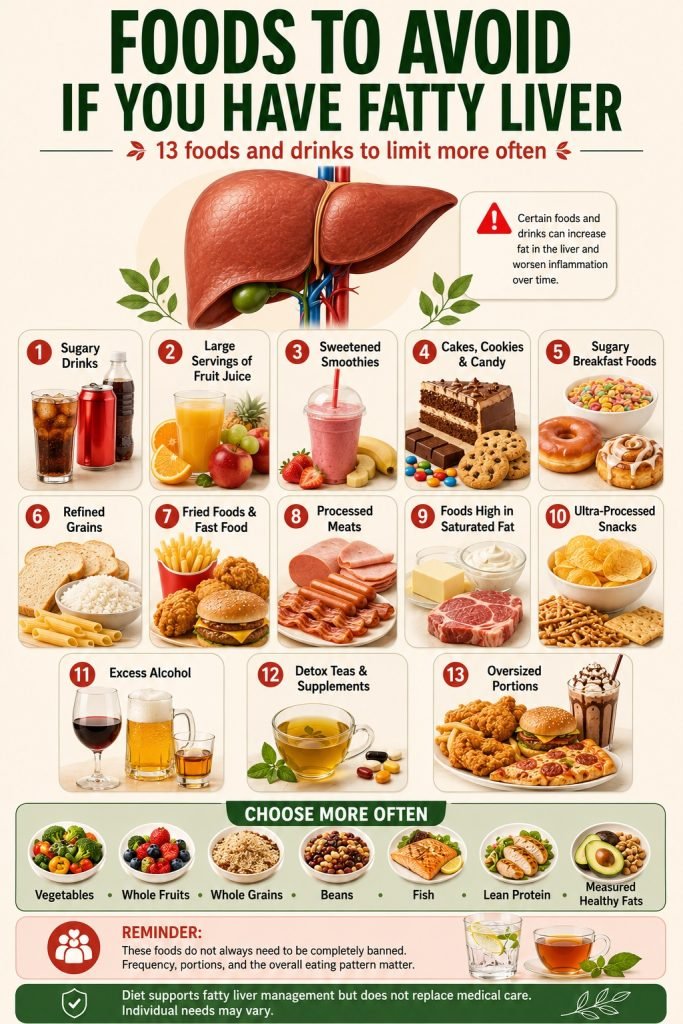
- Sweetened breakfast foods. Frosted cereal, sweetened instant oatmeal, most granola, flavoured yogurt, breakfast bars, pancakes with syrup. These are desserts with breakfast branding, and flavoured yogurt often carries two to three times the sugar of plain for the same protein.
- Desserts and sweets. Cakes, biscuits, doughnuts, pastries, ice cream, chocolate bars. Added sugar and saturated fat in the same bite. Frequency and portion matter more than a permanent ban.
- Oversized refined grain portions. White bread, white rice and refined pasta are not poison. The problem is a plate that is three quarters rice with no vegetables or protein. Swap half for beans, lentils, whole grains or vegetables rather than eliminating the category.
- Processed meat. Bacon, sausages, salami, hot dogs, pepperoni, deli meats. Diets high in processed meat and low in fibre are consistently associated with more fatty liver. Fish, poultry, eggs, tofu and legumes do the same job.
- Detox teas, cleanse juices and liver supplements. These do not remove liver fat, and some cause actual harm. NIDDK warns that certain herbal remedies can damage the liver, and high dose green tea extract is a documented cause of liver injury, as we cover in green tea and liver health. This is the only category on the page that can make things worse rather than merely failing to help.
- Oversized portions of good food. Nuts, nut butter, olive oil, avocado, cheese, granola, dried fruit and large smoothies are all nutritious and all calorie dense. Healthy does not mean unlimited, and a home smoothie with juice, honey, two bananas and nut butter can beat a milkshake.
For the constructive side of this, what to build meals from rather than what to cut, see our fatty liver diet guide and the best vegetables for liver health.
What You Do Not Need to Avoid
Fatty liver advice online bans far more than the evidence supports, and unnecessary restriction makes the diet harder to sustain without making the liver any better.
- Whole fruit. Repeatedly confused with fruit juice. The fibre and the chewing change everything. Sensible portions are fine.
- Eggs. Protein, cheap, quick. What accompanies them is usually the issue.
- Carbohydrates as a category. Oats, beans, lentils, whole grains, vegetables and fruit all contain carbohydrate and all belong. Quality and portion, not elimination.
- Dietary fat. A fat free diet is neither necessary nor helpful. LIPOGAIN 2 showed the type matters, not the presence.
- Plain coffee. Genuinely associated with better liver outcomes, covered in coffee and liver health. Just do not turn it into a dessert.
- Potatoes and rice in normal portions. Treat them as the carbohydrate quarter of the plate rather than as forbidden.
Worth keeping in proportion: losing 3 to 5 percent of body weight reduces liver fat, and 7 to 10 percent may be needed to improve inflammation and fibrosis, according to NIDDK. Gradual matters, because rapid weight loss and malnutrition make liver disease worse. Our guide to foods that support weight loss covers the practical side.
Frequently Asked Questions
What is the worst food for fatty liver?
Sweetened drinks, by a clear margin, because they have the strongest causal evidence. In a six month randomised study, one litre of regular cola daily raised liver fat by 132 to 143 percent compared with isocaloric milk, diet cola and water. The milk comparison matters: same calories, very different liver, so this is not only about total energy. Fructose appears to be the mechanism, since fructose and sucrose sweetened drinks increase the liver’s own fat production while glucose sweetened drinks do not.
Does saturated fat cause fatty liver?
It contributes directly. In the LIPOGAIN 2 trial, 61 adults were overfed muffins made with either palm oil or sunflower oil for eight weeks. Both groups gained about 2 kg. The saturated fat group’s liver fat rose roughly 50 percent with worsened liver enzymes and blood lipids, while the polyunsaturated group showed no increase at all. Identical calories and identical weight gain produced completely different livers, which is why swapping the type of fat beats simply eating less fat.
How much alcohol can I drink with fatty liver?
Under the current nomenclature, alcohol determines your diagnosis. MASLD requires intake below 20 g a day for women and 30 g for men, roughly one and a half to two US standard drinks. Between 20 and 50 g for women or 30 and 60 g for men the diagnosis becomes MetALD, meaning both metabolic and alcohol factors contribute. Above that it is classified as alcohol related liver disease. Many people are advised to avoid alcohol entirely, particularly with inflammation, fibrosis, cirrhosis or abnormal liver tests, so discuss your actual intake with your clinician.
Is fruit bad for fatty liver?
Whole fruit is not, and it is routinely confused with fruit juice. The fibre and the time it takes to eat change how the sugar is handled. Juice is the problem: a glass delivers the sugar of several pieces of fruit in seconds without the fibre, and it belongs in the same category as soda. Limit juice, syrup packed fruit and sweetened dried fruit. Eat whole fruit in sensible portions without concern.
Why is ultra processed food a problem if the nutrients are the same?
Because people eat more of it without noticing. In an inpatient crossover trial, 20 adults ate ultra processed and unprocessed diets matched for calories presented, energy density, macronutrients, sugar, sodium and fibre. They consumed 508 more calories a day on the ultra processed diet and gained 0.9 kg in two weeks. They also ate about 17 calories a minute faster, which appears to be the explanation: the plate empties before fullness signals arrive.
Do I have to give up rice and bread?
No. Refined grains are worth limiting rather than eliminating, and the usual problem is proportion rather than presence. A plate that is three quarters white rice with no vegetables or protein is the issue, not rice itself. Swap half the portion for beans, lentils, whole grains or vegetables. Choose whole grain versions more often, and remember that whole grain bread, pasta and especially granola are still calorie dense.
Is coconut oil good for fatty liver?
No, and it is frequently marketed as though it were. Coconut oil is roughly 80 percent saturated fat, the type shown in randomised overfeeding to raise liver fat by about 50 percent while polyunsaturated fat did not. It is not a liver treatment. Olive oil, rapeseed oil, nuts, seeds, avocado and oily fish are better everyday choices, used in measured amounts since they are still calorie dense.
Can detox teas or liver supplements remove liver fat?
No, and this is the one category that can actively harm you. Lemon water, celery juice, apple cider vinegar drinks and herbal cleanse products do not remove liver fat. NIDDK warns that certain herbal remedies can damage the liver, and high dose green tea extract is a documented cause of drug induced liver injury. Supplements can also interact with prescribed medicines, so tell your clinician about anything you take.
Can fatty liver be reversed by changing what I eat?
Liver fat can improve substantially. NIDDK puts the thresholds at 3 to 5 percent of body weight lost to reduce liver fat and 7 to 10 percent to improve inflammation and fibrosis. Crucially it should be gradual, because rapid weight loss and malnutrition make liver disease worse. Established fibrosis is harder to reverse than fat, which is the argument for acting earlier rather than waiting.
Do I need to fast or follow a very restrictive diet?
No. Fasting is not required for fatty liver, and severe restriction tends to backfire through fatigue, nutrient gaps, muscle loss and rebound eating, while rapid weight loss specifically worsens liver disease. The eating pattern that works is the one you can maintain with adequate nutrition. Anyone with diabetes, cirrhosis, pregnancy or a history of disordered eating should get individual advice before fasting.
Final Thoughts on Foods to Avoid If You Have Fatty Liver
If you take one thing from this list of foods to avoid if you have fatty liver, make it the ordering. Sweetened drinks, saturated fat and ultra processed food are the three with controlled trial evidence behind them, and alcohol now carries a threshold that decides your diagnosis. Those four are worth real effort. The rest is sensible tidying.
Notice what the trials keep showing. In two of the three, calories were held constant and the liver still responded differently. That is unusual and it is the reason these specific swaps are worth making even before any weight changes.
Then resist the urge to overcorrect. Whole fruit, eggs, carbohydrates, dietary fat and plain coffee do not need avoiding, and banning them makes the whole plan harder to keep without helping your liver. Gradual beats aggressive here, because rapid weight loss actively worsens liver disease. Three changes you sustain will beat twenty you abandon by March.
Related reading: fatty liver diet: foods to eat and limit | best vegetables for liver health | lifestyle habits that support liver health | coffee and liver health
Medical Disclaimer
This article is for general education and is not a personalised treatment plan. Dietary needs differ substantially for people with cirrhosis, diabetes, kidney disease, pregnancy, food allergies, or prescribed sodium, protein or carbohydrate limits. Alcohol guidance in particular should come from your own clinician, who knows your liver tests and medicines. Consult a qualified healthcare professional or registered dietitian before making major dietary changes, and never start a restrictive diet with cirrhosis without supervision. See our medical disclaimer, editorial policy and fact checking policy.
Cross checked against NIDDK guidance on MASLD nutrition and treatment, the LIPOGAIN 2 randomised overfeeding trial, a six month randomised trial of sucrose sweetened beverages and ectopic fat, an inpatient randomised crossover trial of ultra processed diets, randomised data on hepatic de novo lipogenesis by sugar type, and the 2023 multisociety steatotic liver disease nomenclature. Last updated July 2026.
About the Author and Reviewer
Mezbaul Islam, MSc Nutrition owns and writes Simple Health Naturally. He researches each article from public health guidance, clinical guidelines and peer reviewed studies, and traces every figure back to a named source.
Dr. Obeydur Rahman, MBBS, MD in Medicine edits the articles, checks the sources cited and is responsible for the site’s editorial standards. MD in Medicine is the specialty for adult conditions such as liver disease, type 2 diabetes and high blood pressure.
Read more about our authors and reviewers or see our editorial policy.
Edited by Dr. Obeydur Rahman, MBBS, MD in Medicine.