Breakfast is the highest leverage meal to fix for your liver, and not because mornings are metabolically special. It is because the two things with the strongest evidence for raising liver fat, added sugar and saturated fat, cluster more densely at breakfast than at any other meal. Cereal, flavoured yogurt, granola, juice, sweetened coffee, pastries, bacon, sausage and butter are all breakfast foods. A sensible breakfast for fatty liver mostly just removes them. Here are seven that do, with the numbers.
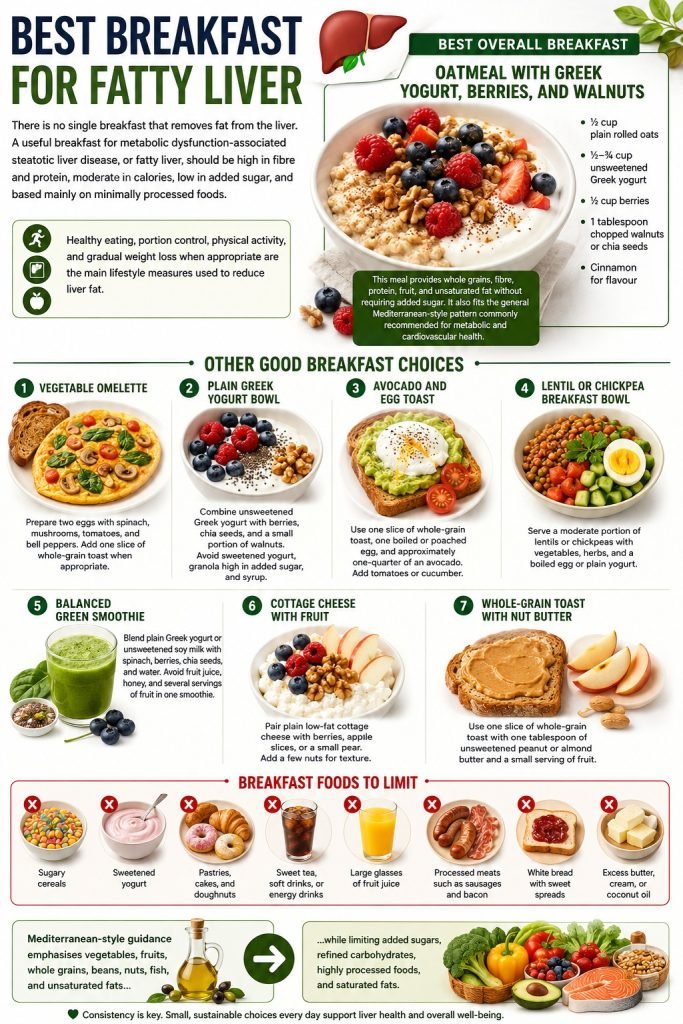
At a glance: All seven land between 240 and 340 calories, with 12 to 24 g of protein, 6 to 16 g of fibre and zero added sugar. That last figure is the point. A bowl of flavoured yogurt with granola can carry 20 to 30 g of added sugar before you add anything else.
Why a Breakfast for Fatty Liver Is Worth Fixing First
Three reasons, and the third one surprises people.
It is where the sugar is. Fructose is metabolised mainly in the liver and drives fat production there. Breakfast is the meal built around sweetened cereal, flavoured yogurt, granola, fruit juice, jam, syrup and sweetened coffee. No other meal concentrates added sugar so reliably.
It is also where the saturated fat is. Bacon, sausage, butter, pastries and creamy coffee drinks. This matters because randomised overfeeding research found saturated fat raised liver fat by about 50 percent while polyunsaturated fat produced no increase at all, at identical calories and identical weight gain. Fat type has an independent effect, and the traditional cooked breakfast sits on the wrong side of it.
Skipping it is not the fix. This is the counterintuitive part. In an analysis of NHANES data following 3,004 people with fatty liver disease over a median of 23 years, those who never ate breakfast had 2.9 times the cardiovascular mortality of daily breakfast eaters. Irregular breakfast and late night eating both tracked with worse outcomes.
That cardiovascular framing deserves a moment. Cardiovascular disease is the leading cause of death in people with MASLD, accounting for roughly a third of all deaths, ahead of liver related causes. So a breakfast built for your liver should also be built for your heart. Conveniently, the same one does both.
Worth noting the evidence here is observational, and at least one cohort found no link between skipping breakfast and fatty liver. Total intake and diet quality still matter more than timing. If you genuinely are not hungry in the morning, forcing food is not the lesson.
7 Best Breakfasts for Fatty Liver
Figures are approximate and vary with brand and portion. Every one contains no added sugar, and each follows the pattern NIDDK recommends for fatty liver: lower glycaemic foods, controlled portions, unsaturated rather than saturated fat, and very little simple sugar.
1. Oats with Greek yogurt, berries and walnuts (340 calories, 24 g protein, 6 g fibre)
Half a cup of plain rolled oats, three quarters of a cup of plain Greek yogurt, half a cup of berries, a tablespoon of walnuts, cinnamon.
The best all rounder, and the yogurt is what makes it work. Oats made with water alone give you about 5 g of protein, which is not a breakfast. Note that plain oats are not the same food as sweetened instant oatmeal, and cinnamon does the job people think honey is doing.
2. Lentil breakfast bowl with an egg (330 calories, 22 g protein, 16 g fibre)
Three quarters of a cup of cooked lentils, spinach, tomato, mushrooms, topped with a poached egg, lemon and herbs.
Nearly triple the fibre of anything else here, and legumes carry the strongest controlled trial evidence of any food group for weight and waist. Unfamiliar as breakfast in some places, entirely normal in others. Cook the lentils in advance and reheat.
3. Vegetable omelette with toast (310 calories, 20 g protein, 6 g fibre)
Two eggs with spinach, mushrooms, tomato and peppers, one slice of whole grain toast, cooked in olive oil rather than butter.
The oil choice is not fussiness. It is the saturated versus unsaturated point applied to the pan. Skip the bacon and sausage on the side, which is what usually turns this breakfast from good to counterproductive.
4. Greek yogurt, chia and berry bowl (250 calories, 20 g protein, 7 g fibre)
Three quarters of a cup of plain Greek yogurt, half a cup of berries, a tablespoon of chia, a tablespoon of walnuts, cinnamon.
No cooking, ninety seconds. The word carrying all the weight is plain. This exact bowl made with flavoured yogurt and shop granola becomes a dessert, which is covered below.
5. Green smoothie (240 calories, 24 g protein, 7 g fibre)
Three quarters of a cup of plain Greek yogurt, a cup of spinach, half a cup of berries, a tablespoon of chia, half a cup of unsweetened soy milk, water and ice.
Useful when your morning appetite is low. The rules are strict though: no fruit juice, no honey, no second banana, no sweetened protein powder. Those four additions are how a 240 calorie smoothie becomes a 600 calorie one.
6. Cottage cheese with fruit and nuts (270 calories, 22 g protein, 6 g fibre)
Three quarters of a cup of plain cottage cheese, a small pear or berries, a few chopped nuts, cinnamon.
Cheapest protein per calorie on the list. Works savoury too with tomato, cucumber and black pepper. Check the sodium if you have been advised to.
7. Avocado and egg toast (250 calories, 12 g protein, 6 g fibre)
One slice of whole grain toast, one poached egg, a quarter of an avocado, tomato and cucumber.
Lowest protein here at 12 g, so add a second egg if this is your default. Avocado earns its place as monounsaturated fat replacing the butter that would otherwise be on that toast.
For more options built around protein specifically, see our guide to high protein breakfasts.
The Breakfast That Looks Healthy and Is Not
Flavoured yogurt with granola and a glass of orange juice. It photographs well and it is the single most common mistake in this whole category.
- Flavoured yogurt commonly exceeds 10 g of sugar per 100 g, with median figures above 13 g per 100 g in some categories. A single pot can carry two to three times the sugar of plain yogurt for identical protein.
- Shop granola typically holds 9 to 12 g of added sugar per serving, and almost nobody measures a serving.
- Together that is roughly 20 to 30 g of added sugar before you pour the juice.
For scale, breakfast cereal sugar content has risen 150 to 200 percent over fifty years, while plain or unsweetened cereals sit at 0 to 2 g per serving. The category has drifted and the packaging has not admitted it.
The fix is small: plain yogurt instead of flavoured, whole fruit instead of juice, nuts and seeds instead of granola. Same bowl, same time, roughly 25 g less sugar. Our guide to foods to avoid if you have fatty liver covers the rest.
What to drink
Water, unsweetened tea, or plain coffee. Coffee is worth singling out, since large cohort studies consistently link regular coffee drinking with lower rates of cirrhosis and liver cancer, and the association holds for decaf. That is association rather than proof, and it stops applying the moment you add syrup and whipped cream. We cover the detail in coffee and liver health.
Not juice. Even with nothing added, it delivers several fruits worth of sugar in seconds with the fibre removed, which is precisely the delivery method the fructose research is about. Whole fruit behaves completely differently, as we explain in fruits that support a healthy liver.
Frequently Asked Questions
What is the best breakfast for fatty liver?
Plain oats with Greek yogurt, berries and walnuts, at roughly 340 calories with 24 g of protein, 6 g of fibre and no added sugar. The yogurt is what makes it work, since oats made with water alone provide only about 5 g of protein. That said, no single breakfast removes liver fat. What matters is the pattern: minimally processed food, protein and fibre at each meal, and very little added sugar.
Why does breakfast matter more than other meals for the liver?
Because the two things with the strongest evidence for raising liver fat cluster there. Added sugar arrives as sweetened cereal, flavoured yogurt, granola, juice, jam and sweetened coffee. Saturated fat arrives as bacon, sausage, butter and pastries, and randomised overfeeding research found saturated fat raised liver fat about 50 percent while polyunsaturated fat did not, at identical calories. No other meal concentrates both so reliably, which makes breakfast the easiest one to improve.
Should I skip breakfast to lose weight and reduce liver fat?
The evidence points the other way. In an NHANES analysis following 3,004 people with fatty liver disease for a median of 23 years, those who never ate breakfast had 2.9 times the cardiovascular mortality of daily breakfast eaters. That matters because cardiovascular disease, not liver disease, is the leading cause of death in MASLD. The evidence is observational and one cohort found no link, so if you genuinely are not hungry in the morning this is not a reason to force food.
Is yogurt with granola a healthy breakfast?
Usually not, and it is the most common mistake in this category. Flavoured yogurt commonly exceeds 10 g of sugar per 100 g, with median values above 13 g per 100 g in some categories, and shop granola typically carries 9 to 12 g of added sugar per serving. Together that is roughly 20 to 30 g of added sugar before you add juice. Plain yogurt with berries, nuts and seeds gives you the same bowl with essentially none.
Is oatmeal good for fatty liver?
Plain rolled oats are a good base but a poor breakfast alone, providing around 5 g of protein and roughly 4 g of fibre per half cup dry. Add plain Greek yogurt, milk or fortified soy milk plus nuts or seeds to make it a complete meal. What to avoid is sweetened instant oatmeal, syrup, brown sugar and large amounts of dried fruit, which turn a sensible breakfast into a dessert.
Are eggs safe to eat with fatty liver?
Yes. A 2023 meta analysis of 32 controlled trials found whole egg consumption had no significant effect on body weight, BMI, waist circumference or fat free mass. Eggs are a useful protein base at 72 calories and 6.3 g of protein each. What matters is the company they keep: two eggs with vegetables and whole grain toast is a very different meal from two eggs with bacon, sausage, fried bread and butter.
Can I drink coffee with fatty liver?
Plain coffee, yes, and it may be actively helpful. Large cohort studies consistently associate regular coffee drinking with lower rates of cirrhosis and liver cancer, and the association holds for decaffeinated coffee too, which suggests caffeine is not the only active component. This is observational evidence rather than proof. The benefit does not survive several teaspoons of sugar, syrup or whipped cream.
Is fruit juice acceptable at breakfast?
No, and this includes juice with nothing added. A glass carries the sugar of several pieces of fruit with the fibre removed and is finished in seconds. That is the exact delivery method that raised liver fat in feeding trials. Whole fruit behaves completely differently because the fibre and the chewing slow everything down, so eat the orange rather than drinking it.
How many calories should a fatty liver breakfast have?
The seven here run from 240 to 340 calories, which suits someone eating in a moderate deficit. Scale up if you are larger, active or not trying to lose weight, by adding an extra egg, a slice of whole grain toast, or a larger portion of grain. Clinical guidance uses a deficit of 500 to 1,000 calories a day overall rather than a target for any single meal.
Will changing breakfast alone reverse fatty liver?
No. One meal does not remove liver fat. What does is sustained change: losing 3 to 5 percent of body weight reduces liver fat and 7 to 10 percent may improve inflammation and fibrosis, alongside around 150 minutes of weekly activity which helps even without weight loss. Breakfast is simply the easiest place to start, because the swaps are small and you make the decision once rather than negotiating it all day.
Final Thoughts on the Best Breakfast for Fatty Liver
A good breakfast for fatty liver is mostly a subtraction. Take out the added sugar and the saturated fat, keep protein and fibre, and you have arrived. All seven above land between 240 and 340 calories with 12 to 24 g of protein and no added sugar, which is not a coincidence so much as what is left once you remove the cereal, the flavoured yogurt, the granola and the juice.
Do not skip it either. Never eating breakfast tracked with 2.9 times the cardiovascular mortality in people with fatty liver, and cardiovascular disease kills more people with this condition than the liver does. The morning meal is doing two jobs.
Then pick two and repeat them. A 250 calorie yogurt bowl you eat five mornings a week beats a perfect lentil bowl you make once. Breakfast is the easiest meal to make automatic, which is exactly why it is the one worth fixing first. Build the rest of the day around it with our 7 day fatty liver meal plan.
Weight is the lever that moves liver fat most reliably. A loss of 3 to 5 percent of body weight lowers it, and 7 to 10 percent may improve inflammation and scarring. Our weight loss percentage calculator turns those figures into pounds for your own starting weight, and our calorie deficit calculator sets the daily target to get there. Waist size tracks liver fat more closely than the scale does, so our waist to height ratio calculator is worth two minutes with a tape measure. Related reading:
Medical Disclaimer
This article is for general education and is not a personalised nutrition or medical plan. Calorie, protein and fibre figures are estimates that vary with brand and portion. Carbohydrate portions and meal timing may need adjusting for people using insulin or other glucose lowering medicines, and anyone with cirrhosis, chronic kidney disease, pregnancy, food allergies or a history of disordered eating should get individual advice. People with cirrhosis in particular are often advised to avoid long fasting periods. See our medical disclaimer, editorial policy and fact checking policy.
Cross checked against NIDDK guidance on MASLD nutrition, NHANES analyses of breakfast patterns and mortality in fatty liver disease, published data on cardiovascular mortality in MASLD, randomised overfeeding data on saturated versus polyunsaturated fat, and USDA FoodData Central. Last updated July 2026.
About the Author and Reviewer
Mezbaul Islam, MSc Nutrition owns and writes Simple Health Naturally. He researches each article from public health guidance, clinical guidelines and peer reviewed studies, and traces every figure back to a named source.
Dr. Obeydur Rahman, MBBS, MD in Medicine edits the articles, checks the sources cited and is responsible for the site’s editorial standards. MD in Medicine is the specialty for adult conditions such as liver disease, type 2 diabetes and high blood pressure.
Read more about our authors and reviewers or see our editorial policy.
Edited by Dr. Obeydur Rahman, MBBS, MD in Medicine.