Most meal plans for fatty liver list meals without telling you what is in them, which makes them impossible to actually use. This fatty liver meal plan gives you calories, protein and fibre for all seven days, plus instructions for scaling it to your own size. It follows a Mediterranean pattern, and there is a specific reason for that: in a randomised crossover trial, that pattern cut liver fat by 39 percent while participants stayed weight stable.
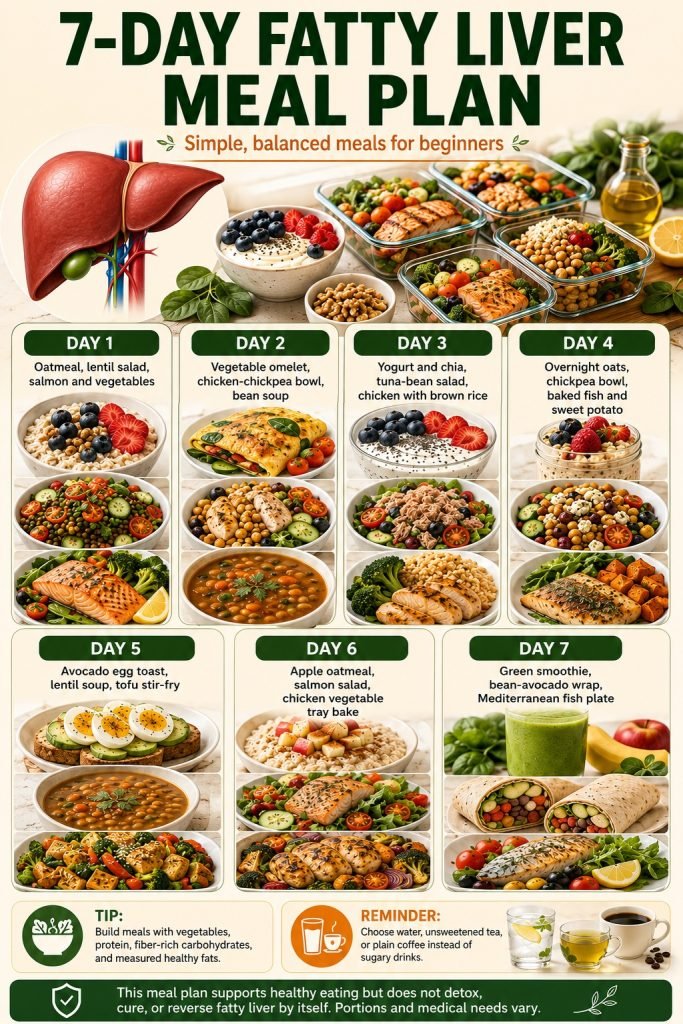
At a glance: Seven days averaging about 1,380 calories, 95 g of protein and 39 g of fibre. That is a deliberate starting point on the low side, so read the sizing section before you begin. No week reverses fatty liver, but this is the pattern with the best trial evidence behind it, and it is meant to be repeated rather than completed.
Why This Pattern and Not Another
The Mediterranean pattern is not on this page because it is fashionable. It is here because of one particularly clean piece of evidence.
In a randomised crossover trial, adults with biopsy confirmed fatty liver followed a Mediterranean diet and a low fat, high carbohydrate diet for six weeks each, with MRI spectroscopy measuring liver fat. The Mediterranean phase produced a 39 percent relative reduction in liver fat against 7 percent on the low fat diet, along with better insulin sensitivity, and it did so while participants remained weight stable.
That last detail is the whole point. The composition of the food changed the liver without weight change doing the work. It was a small study, only 12 people, so treat it as a strong signal rather than proof. But it is why AASLD practice guidance recommends a Mediterranean pattern for people with MASLD regardless of whether weight loss is part of the plan.
Three numbers frame everything below:
- 3 to 5 percent of body weight lost reduces liver fat. 7 to 10 percent may be needed to improve inflammation and fibrosis, per NIDDK. Our weight loss percentage calculator shows what those two thresholds weigh for you.
- 500 to 1,000 calories a day below your maintenance intake is the deficit range clinical guidance uses. Not more. Our calorie deficit calculator works out your own maintenance figure first.
- 150 minutes a week of moderate activity benefits the liver even with no weight loss at all. This is not optional garnish, it is a separate lever.
And the warning that matters most: rapid weight loss and malnutrition make liver disease worse. Slow is not just safer here, it works better.
Size It Before You Start
The plan below averages about 1,380 calories a day. For many adults that is more of a deficit than the 500 to 1,000 range advises, and for some it is too little food outright. Do not simply follow it as written.
To add roughly 300 calories a day, pick two: an extra slice of whole grain bread with lunch, a second egg at breakfast, a small handful of nuts, half an avocado, an extra half cup of cooked grain at dinner, or an extra 100 g of fish or chicken.
To add roughly 600, do all of the above plus a second optional snack.
To reduce, drop the optional snack and halve the added oil. Going below about 1,200 calories a day should involve a dietitian rather than guesswork.
One more practical warning. At around 39 g of fibre a day this plan sits well above the usual 25 to 38 g targets, and average intake is closer to 16 g. If your current diet is low in fibre, that jump will cause bloating and wind. Ramp up over a week or two and drink more water rather than pushing through it.
Anyone with diabetes, cirrhosis, chronic kidney disease, pregnancy, food allergies, prescribed fluid or sodium limits, or a history of disordered eating should have this adapted by a professional rather than following it as printed.
The 7 Day Fatty Liver Meal Plan
Figures are approximate and vary with brand and portion. Drinks throughout: water, unsweetened tea, plain coffee.
Day 1 (about 1,400 calories, 82 g protein, 38 g fibre)
- Breakfast: ½ cup rolled oats, ¾ cup plain Greek yogurt, ½ cup berries, 1 tbsp walnuts, cinnamon.
- Lunch: ¾ cup cooked lentils with cucumber, tomato, spinach, peppers and red onion, 1 tbsp olive oil, lemon. One slice whole grain bread.
- Snack: An apple with 1 tbsp peanut butter.
- Dinner: 4 oz baked salmon, ½ cup quinoa, broccoli and courgette, lemon and garlic.
Vegetarian: swap salmon for tempeh or a lentil patty.
Day 2 (about 1,360 calories, 103 g protein, 37 g fibre)
- Breakfast: Two egg omelette with spinach, mushrooms, tomato and peppers. One slice whole grain toast, ¼ avocado. Cook in olive oil, not butter.
- Lunch: 4 oz grilled skinless chicken, ½ cup chickpeas, lettuce, cucumber, tomato, carrot and cabbage, lemon and olive oil dressing.
- Snack: Plain Greek yogurt with berries.
- Dinner: White bean and vegetable soup with tomato, carrot, celery, spinach and garlic in low sodium stock. One slice whole grain bread.
Day 3 (about 1,370 calories, 116 g protein, 37 g fibre)
- Breakfast: ¾ cup plain Greek yogurt, ½ cup berries, 1 tbsp chia, 2 tbsp rolled oats, cinnamon.
- Lunch: Tuna packed in water with ¾ cup cannellini beans, spinach, tomato, cucumber, onion and parsley, lemon and olive oil.
- Snack: Carrot and cucumber sticks with 2 tbsp hummus.
- Dinner: 4 oz skinless chicken, ½ cup brown rice, roasted cauliflower, peppers and courgette.
The highest protein day of the week at 116 g, useful if you are also strength training.
Day 4 (about 1,410 calories, 84 g protein, 44 g fibre)
- Breakfast: Overnight oats made the night before with ½ cup oats, ½ cup unsweetened soy milk, ¾ cup plain yogurt, 1 tbsp ground flaxseed and ½ cup berries. No honey, no syrup, no sweetened granola.
- Lunch: ¾ cup chickpeas with tomato, cucumber, peppers, spinach and parsley, ¼ avocado, lemon. ½ cup quinoa.
- Snack: A pear with a small handful of walnuts.
- Dinner: 4 oz baked cod, half a medium sweet potato, green beans and broccoli, olive oil and lemon.
Highest fibre day at 44 g. If you are new to this, do not make Day 4 your first day.
Day 5 (about 1,310 calories, 80 g protein, 44 g fibre)
- Breakfast: One slice whole grain toast, one poached egg, ¼ avocado, tomato and cucumber.
- Lunch: Lentil soup with tomato, carrot, celery, onion and greens, seasoned with cumin and turmeric. Large side salad with olive oil. One slice whole grain bread.
- Snack: Plain cottage cheese with berries.
- Dinner: Tofu stir fry with broccoli, mushrooms, peppers, cabbage and courgette, garlic and ginger, low sodium soy sauce, ½ cup brown rice. Do not deep fry the tofu or use a bottled sweet sauce.
Day 6 (about 1,430 calories, 98 g protein, 34 g fibre)
- Breakfast: ½ cup cooked oats with a chopped apple, 1 tbsp walnuts, cinnamon and plain Greek yogurt.
- Lunch: Sardines or cooked salmon over mixed greens with cucumber, tomato, carrot and peppers, ½ cup chickpeas, lemon and olive oil.
- Snack: An orange with a small handful of unsalted nuts.
- Dinner: Tray bake of skinless chicken with broccoli, cauliflower, peppers, onion and courgette, olive oil and herbs, ½ cup barley.
Day 7 (about 1,410 calories, 100 g protein, 40 g fibre)
- Breakfast: Smoothie with ¾ cup plain Greek yogurt, a cup of spinach, ½ cup berries, 1 tbsp chia, ½ cup unsweetened soy milk, water and ice. No juice, no honey, no second banana.
- Lunch: Small whole grain wrap with ½ cup black beans, spinach, tomato, cucumber, cabbage, peppers and ¼ avocado, lime and coriander. ½ cup quinoa on the side.
- Snack: A kiwi with plain yogurt and a few nuts.
- Dinner: 4 oz grilled cod or ¾ cup beans, roasted aubergine, tomato, courgette and peppers, ½ cup quinoa, olive oil and lemon.
Finish with whole fruit rather than a sweetened dessert.
Two Hours of Prep Makes This Work
The plan fails on Wednesday if you cook every meal from scratch. One session at the start of the week covers most of it.
- Cook a big pot of lentils and one of chickpeas or white beans. These cover five lunches.
- Cook a batch each of quinoa, brown rice and barley. Refrigerated cooked grains also form resistant starch, which is a small bonus.
- Roast two trays of mixed vegetables. They reheat across three dinners.
- Boil six eggs.
- Wash and chop salad vegetables into containers.
- Make one jar of dressing: lemon juice, olive oil, garlic, herbs, black pepper.
- Portion nuts and seeds into small bags. This is the step people skip and then eat four servings.
- Freeze fish and chicken portions individually.
Tinned and frozen count throughout. Tinned beans, tinned tomatoes, tinned fish and frozen vegetables are cheaper, keep longer and are nutritionally fine. Rinse tinned beans to cut sodium by roughly 40 percent. For what to put in the trolley more broadly, see our best vegetables for liver health and the full fatty liver diet guide.
Refrigerate cooked food promptly and reheat thoroughly. Cooked grains and beans keep about four days in the fridge.
Notice what is not in this plan: no sweetened drinks, no fruit juice, no processed meat, no fried food, no detox tea. Those exclusions are deliberate and the reasoning is in our guide to foods to avoid if you have fatty liver.
Frequently Asked Questions
How many calories should a fatty liver meal plan have?
There is no fixed number, because needs vary with body size, age, sex and activity. Clinical guidance uses a deficit of 500 to 1,000 calories a day below your maintenance intake rather than a target figure. This plan averages about 1,380 calories, which is a deliberately low starting point that many people should scale up. Going below roughly 1,200 calories a day should involve a dietitian, since rapid weight loss and malnutrition make liver disease worse.
Why is this plan Mediterranean rather than low fat?
Because of a direct comparison. In a randomised crossover trial, adults with biopsy confirmed fatty liver followed both a Mediterranean diet and a low fat, high carbohydrate diet for six weeks each. Liver fat fell 39 percent on the Mediterranean phase versus 7 percent on the low fat one, measured by MRI spectroscopy, and participants stayed weight stable throughout. The food composition changed the liver without weight loss doing the work. It was a small trial of 12 people, so treat it as a strong signal rather than settled proof.
Can a 7 day meal plan reverse fatty liver?
No, and any plan claiming otherwise is not being straight with you. One week establishes a pattern. What changes liver fat is sustained: NIDDK puts the thresholds at 3 to 5 percent of body weight lost to reduce liver fat and 7 to 10 percent to improve inflammation and fibrosis. Physical activity helps even without weight loss. Think of this week as a template to repeat, not a course to complete.
How much protein does this plan provide?
About 95 g a day on average, ranging from 80 g on Day 5 to 116 g on Day 3. That is generous by design, since higher protein intakes of roughly 1.2 to 1.6 g per kg of body weight help preserve muscle during a deficit, and muscle loss makes weight regain more likely. Anyone with chronic kidney disease should have protein individually set rather than following these figures.
Is 39 g of fibre a day too much?
It is above the usual targets of about 25 g for women and 38 g for men, and well above the average intake of roughly 16 g. That is intentional, but the jump is the problem rather than the amount. Going from 16 g to 39 g overnight causes bloating and wind. Increase gradually across a week or two, drink more water, and start with the lower fibre days rather than Day 4, which is the highest at 44 g.
Do I need to exercise as well?
It is a separate lever, not an optional extra. Guidance points to about 150 minutes a week of moderate activity, and the important finding is that exercise benefits the liver independently of weight loss. Even increasing your activity by 60 minutes a week appears to help. Walking counts. You do not need a gym for this to work.
Can I follow this plan if I have diabetes?
The structure suits blood glucose management, since every meal pairs carbohydrate with protein, fat and fibre. But the carbohydrate portions, meal timing and snacks need to match your medicines and glucose readings, particularly if you use insulin or medicines that can cause low blood glucose. Have a dietitian or your diabetes team adjust the amounts before you start rather than after.
Can I repeat the same meals instead of following seven different days?
Yes, and most people who succeed at this do exactly that. Variety is useful for nutrient coverage but it is not the mechanism, and cooking seven different dinners is the reason meal plans get abandoned. Pick the three or four days you liked, rotate them, and change one meal occasionally. Consistency over months beats variety over one week.
What if I cannot afford salmon and fresh produce?
Nothing in this plan requires expensive ingredients. Tinned sardines, tinned tuna, eggs, lentils, tinned beans, frozen vegetables, oats and plain yogurt cover almost all of it cheaply. Frozen vegetables are picked and frozen quickly and often beat fresh produce that has spent a week in transit. Lentils and tinned beans are the cheapest items on the list and also carry the strongest trial evidence of any food group here.
Is a cheat day allowed?
A single meal will not undo anything, so occasional favourite foods in sensible portions are fine and make the plan sustainable. An unrestricted cheat day is different, since it can easily add a thousand or more calories along with a lot of sugar and saturated fat. The all or nothing framing is usually what breaks these plans. Aim for a pattern you follow most of the time rather than perfection punctuated by blowouts.
Related reading: if breakfast is the meal you want to fix first, our 7 best breakfasts for fatty liver gives calories, protein and fibre for each one.
Final Thoughts on This Fatty Liver Meal Plan
A fatty liver meal plan is worth following for one specific reason, and it is not that the week itself does anything. It is that the Mediterranean pattern cut liver fat 39 percent against 7 percent on a low fat diet in people who did not lose weight, which means the composition of what you eat has its own effect on the liver independent of the scale.
So size it properly first. Most people should scale this up rather than following 1,380 calories as printed, and a deficit of 500 to 1,000 a day is the range clinical guidance actually uses. Our calorie deficit calculator works that range out for your own size and pace. Add 150 minutes of walking a week, which helps the liver whether or not you lose a pound.
Then repeat it. Pick the three or four days you liked, rotate them, keep the prep session, and let it become boring. Boring is the goal. Liver fat responds to months of an unremarkable pattern, not to one impressive week.
Related reading: fatty liver diet: foods to eat and limit | foods to avoid if you have fatty liver | lifestyle habits that support liver health | coffee and liver health
Medical Disclaimer
This article is for general education and is not a personalised medical, nutrition or weight loss plan. The calorie and portion figures are estimates and will not suit everyone. Consult a qualified healthcare professional or registered dietitian before changing your diet, particularly with cirrhosis, diabetes, chronic kidney disease, food allergies, pregnancy, a history of disordered eating, or medicines affected by meal timing or carbohydrate intake. Do not begin a very low calorie diet without supervision, since rapid weight loss can worsen liver disease. See our medical disclaimer, editorial policy and fact checking policy.
Cross checked against NIDDK guidance on MASLD treatment, AASLD practice guidance, a randomised crossover trial of Mediterranean versus low fat diet measured by MRI spectroscopy, and USDA FoodData Central for all nutrition figures. Calories, protein and fibre are estimates that vary with brand, variety and portion. Last updated July 2026.
About the Author and Reviewer
Mezbaul Islam, MSc Nutrition owns and writes Simple Health Naturally. He researches each article from public health guidance, clinical guidelines and peer reviewed studies, and traces every figure back to a named source.
Dr. Obeydur Rahman, MBBS, MD in Medicine edits the articles, checks the sources cited and is responsible for the site’s editorial standards. MD in Medicine is the specialty for adult conditions such as liver disease, type 2 diabetes and high blood pressure.
Read more about our authors and reviewers or see our editorial policy.
Edited by Dr. Obeydur Rahman, MBBS, MD in Medicine.