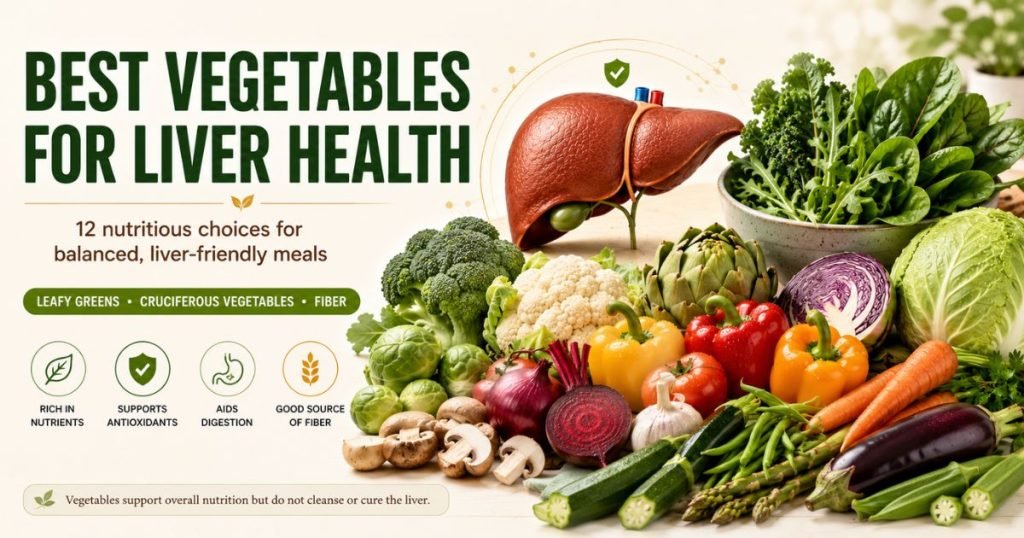
No vegetable cleanses or repairs the liver, and anything sold on that promise is selling you a story. What the research does support is quieter and more useful: the best vegetables for liver health work through quantity and consistency, and there is now a measured number attached. In a cohort of 1,297 adults, eating roughly 325 g of vegetables a day, about two servings, was associated with nearly half the odds of metabolic dysfunction associated steatotic liver disease.
Short answer: Aim for about 325 g of vegetables daily, with at least 35 g of that being green. Nitrate rich vegetables such as rocket, spinach and beetroot carry the strongest observational signal. None of them removes liver fat on its own. Losing 3 to 5 percent of body weight does that, and 7 to 10 percent is what shifts inflammation and fibrosis.
What the Evidence Actually Shows
Three findings are worth knowing before you read a list of vegetables, because they explain what the list can and cannot do.
Quantity has a threshold. The NUTRIHEP cohort of 1,297 southern Italian adults found that around 325 g of total vegetables a day was associated with reduced odds of MASLD, at an odds ratio of 0.521. Green vegetables were the most protective subgroup, and the benefit appeared at only about 35 g a day, which is roughly one large handful of raw spinach.
Nitrate rich vegetables stand out. A case control study of 225 newly diagnosed cases and 450 controls found that people in the highest third of nitrate containing vegetable intake had an adjusted odds ratio of 0.20 compared with the lowest third. Dietary nitrate converts to nitric oxide, which affects blood flow and insulin sensitivity, and that is a plausible mechanism rather than a proven one.
All of it is observational. These are associations, not proof. People who eat 325 g of vegetables daily also tend to weigh less, drink less, move more and eat less processed food. A 2024 meta analysis pooling 11 studies and nearly 494,000 people reached the same conclusion with the same limitation.
What is established comes from NIDDK: losing at least 3 to 5 percent of body weight reduces liver fat, and 7 to 10 percent may be needed to reduce inflammation and fibrosis. Physical activity helps even without weight loss. Crucially, rapid weight loss and malnutrition make liver disease worse, so this is not a case where faster is better.
Vegetables are how you make that deficit tolerable. They are not the mechanism.
The 12 Best Vegetables for Liver Health
Nitrate rich greens, where the signal is strongest
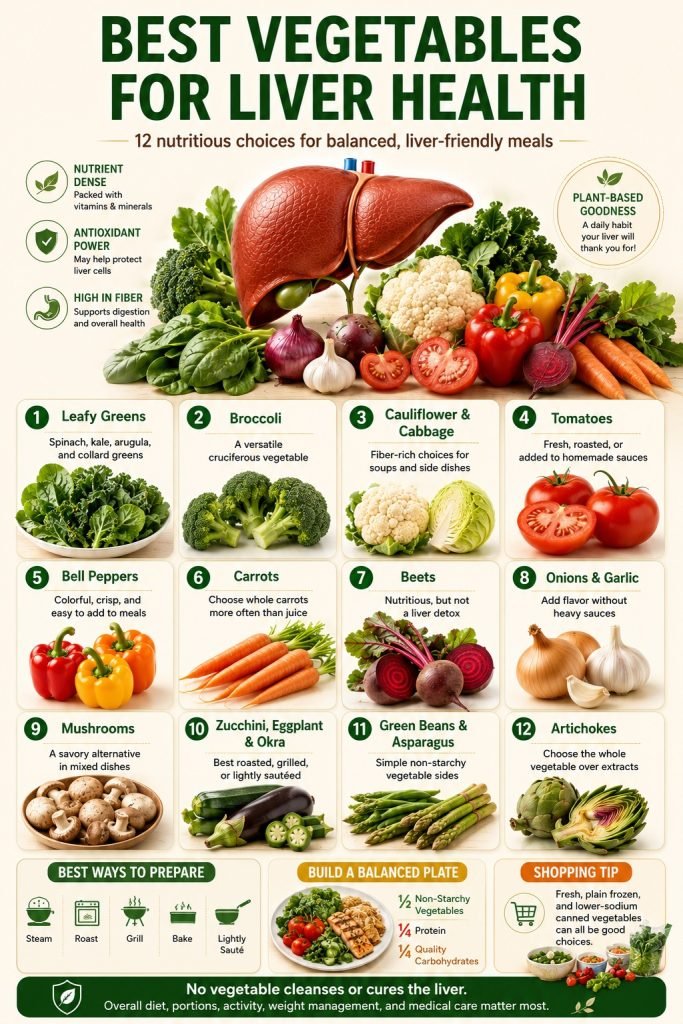
- 1. Rocket and watercress. The highest nitrate content of any common vegetable, several times that of most others. Rocket is 25 calories per 100 g. Both are peppery enough to carry a salad without dressing, which is part of the point. Watercress wilts into soup in seconds.
- 2. Spinach. Second only to rocket for nitrate, and the most practical green to eat daily. Raw it is 23 calories per 100 g. A cup cooked gives 5.3 g of protein and 4.3 g of fibre for 41 calories. Wilts into eggs, soup, curry and pasta without anyone noticing.
- 3. Kale, collard greens and Swiss chard. Sturdier, so they hold up in stews and roasting. Cooked kale is about 36 calories a cup with 2.6 g of fibre. These are the greens that survive a week in the fridge, which matters more than nutrient rankings.
- 4. Beetroot. High in nitrate and betalains, and consistently oversold as a liver cleanse. It is not one. As a whole vegetable it is genuinely good: a cup cooked is 75 calories with 3.4 g of fibre. Roast it, or grate it raw into salad. Beet juice concentrates the sugar and removes the fibre, and does nothing a whole beetroot does not.
Cruciferous vegetables, promising but unproven
- 5. Broccoli. A cup cooked is 55 calories with 5.1 g of fibre and a full day of vitamin C. Sulforaphane, its most studied compound, has produced encouraging results in animal models of fatty liver. Human trials have not established broccoli or sulforaphane as a treatment, and it is worth being clear that the gap between mouse liver and human liver is where most promising compounds die.
- 6. Cauliflower and cabbage. Cauliflower is 29 calories a cup cooked, cabbage 34. Both are cheap, keep for weeks, and work as a partial swap for rice or potato, which is where the real benefit sits.
- 7. Brussels sprouts and bok choy. Sprouts give 4.1 g of fibre and 4 g of protein a cup for 56 calories, among the better numbers on this list. Roast them rather than boiling. Bok choy takes three minutes in a pan.
Everyday vegetables that make the pattern work
- 8. Tomatoes. A medium tomato is 22 calories. Lycopene absorbs better from cooked tomatoes with a little oil than from raw, so tinned and passata count. Check labels on jarred sauces and ketchup, where the sodium and added sugar live.
- 9. Peppers. A medium red pepper is 37 calories and carries more vitamin C than an orange. Raw with hummus, roasted with fish, or thrown into anything.
- 10. Carrots. Frequently and wrongly put on avoid lists. A medium carrot is 25 calories with 1.7 g of fibre, and the notion that its natural sugar is comparable to soda does not survive contact with the numbers. Eat them whole rather than juiced. What ruins carrots is a sugar glaze, not the carrot.
- 11. Onions and garlic. These earn their place by making everything else edible without butter, salt or bottled sauce. A meal you will repeat beats a meal you tolerate once. Note that garlic supplements are a different matter and are not established for liver disease.
- 12. Mushrooms. Fifteen calories a cup sliced, with a savoury depth that lets them replace some of the meat in a dish. Mushrooms exposed to UV light also supply vitamin D. One serious caveat: never eat foraged wild mushrooms unless an expert has identified them, because amatoxin poisoning is a leading cause of acute liver failure from food.
Courgette, aubergine, okra, green beans and asparagus all belong in the rotation too. They carry no special liver property, they simply add volume and variety, which is the whole mechanism anyway.
Hitting 325 g Without Thinking About It
That number sounds like work. In practice it is three additions.
- A handful of spinach into eggs, soup or curry (about 30 g, and that alone clears the green vegetable threshold)
- Half the rice or pasta portion replaced with roasted vegetables (about 150 g)
- Salad or raw peppers and cucumber with lunch (about 100 g)
Substitution is what makes it count. Vegetables added on top of an unchanged plate add calories rather than removing them, which matters because weight change is the part of this with actual causal evidence behind it. The same principle runs through our guide to foods that support weight loss.
On form: fresh, plain frozen and no salt added tinned all count. Frozen is picked and frozen quickly and often beats fresh produce that has spent a week in transit. Skip anything packaged in cheese sauce, butter sauce, glaze or breading. Rinse tinned vegetables to cut sodium.
On preparation: steam, roast, grill, bake, sauté with measured oil, or add to soup. Deep frying, heavy breading, cream sauces and sugary glazes change the arithmetic completely. Aubergine in particular soaks up oil, so roast or grill it rather than pan frying.
On juice: whole vegetables beat juice every time. Juicing removes fibre, lets you drink 400 g of vegetables in ninety seconds without any of the fullness, and bottled versions can carry serious sodium or added fruit. Green juice, celery juice and beet juice are not liver treatments. For a fuller picture of what belongs on the plate, see our fatty liver diet guide.
Where the Detox Claims Go Wrong
The liver is the detoxification organ. It does not need help detoxifying itself, and no food flushes it. Three specific claims deserve a direct answer.
Artichoke extract. Whole artichokes are a perfectly good vegetable, filling and Mediterranean and fine steamed or from a jar. Artichoke extract is marketed for bile flow and liver detoxification on evidence that remains insufficient, and an extract is not nutritionally the same thing as the vegetable.
Beetroot and beet juice. Beetroot has a real nitrate story, which is why it appears at number four above. It does not flush toxins, dissolve liver fat or reverse scarring, and beet juice is the weaker version of the whole vegetable.
Supplements generally. This is the one that carries actual risk. NIDDK warns plainly that some herbal remedies can damage the liver, and concentrated botanical extracts are a recognised cause of drug induced liver injury. High dose green tea extract is a documented example, which is a very different proposition from drinking the beverage, as we cover in green tea and liver health. Taking a supplement to protect your liver is the one intervention on this page that can plausibly hurt it.
It is also worth knowing that MASH with moderate to advanced fibrosis now has an approved medicine, resmetirom, cleared in the United States, the European Union and the United Kingdom. That belongs in a conversation with a hepatologist, not a supplement aisle, and it exists precisely because diet alone was not enough for everyone.
Who Needs to Be More Careful
- Taking warfarin. Leafy greens are high in vitamin K. You do not need to avoid them, but keep intake steady rather than swinging between none and large amounts, and tell your clinician if you are changing your diet.
- Cirrhosis. Nutrition here is genuinely different. Malnutrition and muscle loss are common and dangerous, sodium may be restricted for fluid retention, and restrictive diets can do harm. Follow a hepatologist or dietitian rather than general advice, including this article.
- Kidney stones or oxalate restriction. Spinach, chard and beetroot are high in oxalate. Vary your greens rather than eating spinach exclusively.
- Diabetes. Non starchy vegetables have little effect on blood glucose and can fill half the plate. Potatoes, sweet potato, corn, peas, pumpkin and plantain are carbohydrate foods and should be counted as such.
Diet is one lever among several. Alcohol, sleep, activity, medicines and metabolic risk all matter, and we cover the full set in lifestyle habits that may support liver health.
Frequently Asked Questions
What is the best vegetable for fatty liver?
There is no single best one, but if you want the strongest signal, it is the nitrate rich greens. A case control study found people in the highest third of nitrate containing vegetable intake had an adjusted odds ratio of 0.20 for fatty liver compared with the lowest third. Rocket, spinach, watercress and beetroot lead that group. That said, the more useful target is total quantity: around 325 g of vegetables a day was associated with roughly half the odds of MASLD in a cohort of 1,297 adults.
How many vegetables should I eat for liver health?
About 325 g a day, which is roughly two decent servings, is the figure associated with reduced MASLD odds in the NUTRIHEP cohort. At least 35 g of that should be green vegetables, which is about one large handful of raw spinach. In practice that is a handful of spinach in your eggs, vegetables replacing half your rice portion, and a salad at lunch.
Can vegetables reverse fatty liver?
Not by themselves. What reverses liver fat is weight loss: NIDDK puts the threshold at 3 to 5 percent of body weight to reduce liver fat, and 7 to 10 percent to reduce inflammation and fibrosis. Vegetables help you reach that deficit while still eating a full plate, and physical activity helps even without weight loss. Rapid weight loss makes liver disease worse, so gradual is not just safer, it is more effective.
Do beets or beet juice detox the liver?
No. The liver is itself the detoxification organ and does not need flushing. Beetroot is genuinely worth eating, at 75 calories and 3.4 g of fibre per cooked cup, and it is high in dietary nitrate, which is why it appears on this list. But it does not remove toxins, dissolve liver fat or reverse scarring. Beet juice is the weaker version: the sugar is concentrated and the fibre is gone.
Is broccoli good for the liver?
It is a good vegetable, at 55 calories and 5.1 g of fibre per cooked cup with a full day of vitamin C. Sulforaphane, the compound it is famous for, has shown encouraging effects on liver fat in animal studies. Human trials have not established broccoli or sulforaphane as a treatment for fatty liver, so eat it because it is nutritious and filling, not because it repairs liver damage.
Are carrots and beets bad if I have fatty liver?
No. Both are frequently put on avoid lists over their natural sugar, and the numbers do not support it. A medium carrot is 25 calories with 1.7 g of fibre, and comparing that to soda is not a serious comparison. Eat them whole rather than juiced, and watch what goes on them: a sugar glaze is the problem, not the vegetable.
Is spinach good for fatty liver?
Yes, and it is among the highest nitrate vegetables, second only to rocket. Raw it is 23 calories per 100 g, and a cooked cup gives 5.3 g of protein and 4.3 g of fibre for 41 calories. Two cautions: it is high in vitamin K, so keep intake steady if you take warfarin, and high in oxalate, so vary your greens if you are prone to kidney stones.
Is vegetable juice as good as whole vegetables?
No. Juicing removes most of the fibre and lets you consume a large quantity in seconds without the fullness that made the vegetables useful in the first place. Bottled vegetable juices can also carry substantial sodium or added fruit. A small low sodium serving occasionally is fine. Green juice, celery juice and beet juice are not liver treatments and should not replace meals or medical follow up.
Are frozen vegetables as good as fresh?
Yes, and sometimes better. Frozen vegetables are usually picked and frozen quickly, which can preserve more nutrients than fresh produce that has spent a week in transit and storage. They are also cheaper and reduce waste. Choose plain packs rather than those with cheese sauce, butter sauce, glaze or breading. No salt added tinned vegetables count too, ideally rinsed.
Should I take a liver supplement or artichoke extract?
This is the one thing on this page that can plausibly harm you. NIDDK warns that some herbal remedies can damage the liver, and concentrated botanical extracts are a recognised cause of drug induced liver injury, with high dose green tea extract a documented example. Artichoke extract lacks sufficient evidence for treating liver disease and is not equivalent to eating the vegetable. If you have MASH with fibrosis, an approved medicine now exists and that conversation belongs with a hepatologist.
Final Thoughts on the Best Vegetables for Liver Health
The best vegetables for liver health are the ones you will actually eat, in enough quantity to matter. The evidence points at roughly 325 g a day with at least 35 g green, and it points hardest at the nitrate rich end of the spectrum: rocket, spinach, watercress, beetroot. That is a shopping list, not a cure.
Hold two things at once. Vegetables are worth eating and the association with lower MASLD risk is real and repeatedly found. And the causal lever is weight: 3 to 5 percent to shift liver fat, 7 to 10 percent to shift inflammation and fibrosis, lost gradually rather than fast. Vegetables are how you make that survivable. They are not the thing doing the work.
Then ignore the detox aisle entirely. Nothing there flushes your liver, and some of it can injure it. A handful of spinach in your eggs tomorrow morning will do more than any bottle labelled liver support.
Related reading: fatty liver diet | lifestyle habits for liver health | can coffee support liver health | green tea and liver health
Medical Disclaimer
This article is for general education and does not diagnose, prevent or treat liver disease. Dietary needs differ substantially for people with cirrhosis, diabetes, kidney disease, food allergies, pregnancy, medicine interactions, or prescribed sodium, potassium, vitamin K or carbohydrate limits. Consult a qualified healthcare professional or registered dietitian before making major dietary changes, and never start a restrictive diet with cirrhosis without supervision. See our medical disclaimer, editorial policy and fact checking policy.
Cross checked against NIDDK guidance on MASLD treatment and cirrhosis nutrition, the NUTRIHEP vegetable intake cohort, a case control study of dietary nitrate and fatty liver, a 2024 meta analysis of 11 studies covering nearly 494,000 people, and USDA FoodData Central. Nutrition figures are approximate and vary with variety, portion and preparation. Last updated July 2026.
About the Author and Reviewer
Mezbaul Islam, MSc Nutrition owns and writes Simple Health Naturally. He researches each article from public health guidance, clinical guidelines and peer reviewed studies, and traces every figure back to a named source.
Dr. Obeydur Rahman, MBBS, MD in Medicine edits the articles, checks the sources cited and is responsible for the site’s editorial standards. MD in Medicine is the specialty for adult conditions such as liver disease, type 2 diabetes and high blood pressure.
Read more about our authors and reviewers or see our editorial policy.
Edited by Dr. Obeydur Rahman, MBBS, MD in Medicine.