Your natural detox system is real, it runs every second of every day, and it is far more impressive than any juice cleanse. Your kidneys alone contain about a million filtering units each and process roughly 180 litres of plasma a day. Your liver runs a two stage chemical process that converts fat soluble compounds into water soluble ones your kidneys can excrete. None of this needs help from a fourteen day programme.
What that system does need is raw materials, and this is where most detox articles go wrong in both directions. They either promise foods that flush toxins, which is nonsense, or they simply say detoxes are a myth and leave you with nothing. Below is the middle path: how the system genuinely works, what each of these seven foods actually contributes, and the three things missing from almost every detox list that matter far more.
Medical Disclaimer: This article is educational and is not medical advice. A genuine toxic exposure, such as poisoning, overdose, carbon monoxide or heavy metal exposure, is a medical emergency and must never be treated with food, juice, fasting or supplements. Read our medical disclaimer, editorial policy and fact checking policy.
How Your Natural Detox System Actually Works
Two organs do most of the work, and understanding them tells you immediately why a cleanse is unnecessary.
The liver: a two stage chemical plant
Most substances your body needs to clear are fat soluble, which means they cannot simply be flushed out in urine. The liver solves this in two steps.
- Phase I uses a family of enzymes called cytochrome P450 to oxidise, reduce or hydrolyse the compound. This often makes it more chemically reactive, not less, which is why Phase I on its own is not the finish line
- Phase II then attaches a water soluble molecule to it, a process called conjugation. The main routes are glucuronidation, sulfation, glutathione conjugation, methylation and acetylation
- The result is water soluble and can leave through urine or bile
This matters practically for one reason. Phase II conjugation consumes actual raw materials: amino acids such as glycine and cysteine, sulfur, and glutathione. Those come from protein in your diet. A juice fast supplies almost none of them, which is the quiet irony of most cleanses.
The kidneys: the filter you cannot improve on
Each kidney holds around a million nephrons. Together they filter roughly 180 litres of plasma every day, then reabsorb more than 99 percent of it, leaving 1 to 2 litres of urine. As NIDDK explains, healthy kidneys filter about half a cup of blood every minute, continuously, without instruction.
You cannot speed this up by drinking more. Beyond the fluid needed to produce normal urine, extra water is simply excreted. What you can do is avoid damaging the system: control blood pressure and blood glucose, go easy on anti inflammatory painkillers, and limit alcohol.
The 7 Foods, and What Each One Genuinely Does
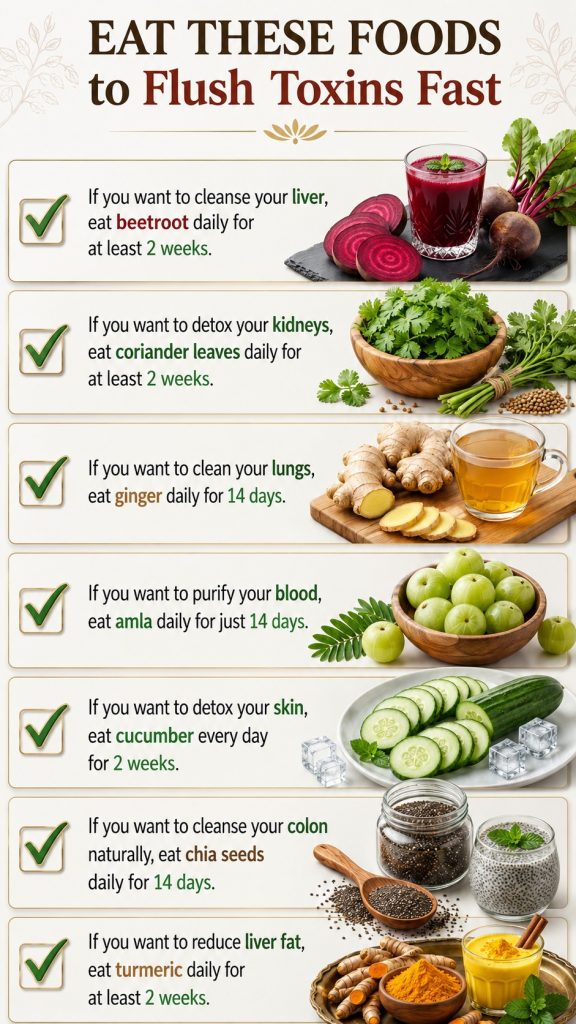
1. Beetroot
Real contribution: fibre, nitrate and pigment. Not a liver cleanse.
Beetroot’s best evidence is cardiovascular rather than hepatic. Its dietary nitrate converts to nitric oxide, and pooled trials show a meaningful blood pressure reduction. The betalain pigments that make it red have shown Phase II enzyme effects in laboratory and animal work, but that has not been demonstrated in people.
- Use it: roasted, grated raw into salad, or blended with the pulp kept in
- Caution: beetroot is high in oxalate. NCCIH specifically flags high oxalate juices as a risk for people prone to kidney stones
- Harmless surprise: pink urine after eating it is beeturia, not blood
2. Coriander Leaves
Real contribution: flavour without salt. Nothing more, and that is fine.
Coriander is widely claimed to chelate heavy metals. That idea traces back to animal experiments and has never been demonstrated in humans. Genuine heavy metal poisoning is treated with prescription chelating agents under medical supervision, not with a herb.
Its honest value is culinary and it is not trivial: fresh herbs let you cut salt substantially without the food tasting flat, which matters for blood pressure and therefore for your kidneys.
3. Ginger
Real contribution: nausea relief at supplement doses. No lung cleansing, because nothing cleanses lungs.
Ginger has reasonable evidence for nausea, particularly in pregnancy, at roughly 1,000 to 1,500 mg of dried ginger daily in capsules. A few slices in hot water deliver far less than that. Lungs are cleared by the mucociliary escalator and by cough, and the only interventions that genuinely help are not smoking, reducing air pollution exposure, and treating any underlying condition.
Check first if you take blood thinners or have reflux, which strong ginger can aggravate.
4. Amla
Real contribution: exceptional vitamin C, around 600 mg per 100 g.
That is roughly ten times an orange, and unusually heat stable because tannins protect it during processing. Blood is not purified by food, but vitamin C does have a legitimate role here: it regenerates other antioxidants and supports the systems that handle oxidative stress, which is part of what Phase I generates.
Check the label. Dried, candied, pickled and bottled amla products often carry substantial added sugar or salt, which undoes the point.
5. Cucumber
Real contribution: water, at about 95 percent by weight.
This is the one food on the list with a direct link to the excretion side of the system, because urine formation requires fluid. That is a modest claim, not a dramatic one: adequate hydration lets the kidneys do their job, while extra hydration beyond that does nothing additional.
It does not clear or repair skin. Skin responds to sun exposure, sleep, smoking, genetics and overall diet, as our guide to anti aging foods for skin explains. If you slice cucumber into water, eat the slices afterwards rather than discarding them.
6. Chia Seeds
Real contribution: fibre, and this one has a genuine mechanism.
Chia is about 34 g of fibre per 100 g, so a 30 g serving provides roughly 10 g. Fibre matters to elimination in a way most detox foods do not: once the liver conjugates a compound and sends it into bile, that compound enters the gut. Fibre binds bile acids and speeds transit, which reduces how much gets reabsorbed and sent back to the liver. That is a real, if unglamorous, contribution to clearance.
- Use it: soaked in yogurt, oats or liquid, never as a dry spoonful
- Safety: dry chia swells rapidly in liquid and has caused oesophageal obstruction. Always hydrate it first
- Build up slowly over two or three weeks with fluid alongside, or expect bloating
7. Turmeric
Real contribution: culinary. And the one item here with a documented risk in the opposite direction.
Turmeric is marketed as a liver detox, yet it is the ingredient on this page most clearly linked to liver injury. The NIH LiverTox database documents cases of turmeric associated liver injury, and in one case series seven of ten affected people carried the immune gene variant HLA-B*35:01.
Dose is what separates the spice from the problem. A quarter teaspoon in cooking delivers roughly 15 to 25 mg of curcumin. A supplement capsule delivers 500 to 2,000 mg, often with piperine from black pepper which can raise absorption up to twentyfold, and nearly all reported injuries involved those enhanced products.
Stop and seek advice if you develop jaundice, dark urine, unusual fatigue, nausea or loss of appetite while taking any supplement.
What Each Food Really Offers
| Food | Genuine contribution | Popular claim that fails | Caution |
|---|---|---|---|
| Chia seeds | 10 g fibre per 30 g, aids bile acid clearance | Colon cleansing | Never eat dry |
| Amla | About 600 mg vitamin C per 100 g | Blood purification | Added sugar in products |
| Cucumber | 95 percent water, supports urine formation | Skin detox | None |
| Beetroot | Nitrate, fibre, lowers blood pressure | Liver cleanse | Oxalate and kidney stones |
| Ginger | Nausea relief at capsule doses | Lung cleansing | Reflux, blood thinners |
| Coriander | Flavour without salt | Heavy metal chelation | None |
| Turmeric | Culinary spice only | Removes liver fat | Capsules linked to liver injury |
Three Things Missing From Every Natural Detox List
If you actually want to supply what the liver and kidneys use, these three matter more than anything above.
Cruciferous vegetables
Broccoli, cabbage, cauliflower, Brussels sprouts and rocket contain glucoraphanin, which converts to sulforaphane when chopped or chewed. Sulforaphane activates a cellular switch called Nrf2, which increases production of Phase II enzymes including glutathione S transferases and UDP glucuronosyltransferases. This is the closest thing to a genuine detox food on the science, and it is not on most detox lists.
Our guide to the best vegetables for liver health covers the trials in more detail.
Adequate protein
Phase II conjugation consumes amino acids. Glutathione, the workhorse of the system, is built from glycine, cysteine and glutamate. Eggs, fish, poultry, dairy, beans and lentils supply them. This is the single strongest argument against a juice cleanse: it removes the very thing the process runs on.
Ordinary water
Not lemon water, not infused water, just enough fluid to produce normal urine. Our guide to healing waters and what they really do covers why the flavoured versions add nothing beyond making water easier to drink.
What the Research Says About Detox Programmes
The evidence base is thin and the safety record is worse. According to NCCIH, a 2015 review found no compelling research supporting detox diets for weight management or for eliminating toxins, and a 2017 review found that juicing and detox diets cause initial weight loss through low calorie intake but tend to lead to weight regain once normal eating resumes. There have been no studies of long term effects at all.
The FDA and FTC have taken action against several companies selling detox products, for hidden ingredients posing health risks, for false claims about treating serious disease, and for marketing colon cleansing devices for unapproved uses. Specific documented harms include:
- Unpasteurised juices carrying bacteria, which can be serious in children, older adults and anyone immunocompromised
- High oxalate juices from leafy greens and beets raising kidney stone risk
- Laxative based programmes causing diarrhoea, dehydration and malabsorption
- Prolonged fluid only regimens causing dangerous electrolyte imbalances
- Destabilised blood glucose in people with diabetes
- Delayed medical care for a symptom that needed investigating
When It Is Not Something Food Can Fix
See a doctor rather than starting a cleanse if you have:
- Yellowing of the skin or eyes, dark urine or pale stools
- Persistent abdominal swelling or pain
- Blood in urine or stool, or a marked change in urination
- Swelling of the legs or face, or breathlessness
- Unexplained weight loss, ongoing vomiting or severe fatigue
- Any suspected poisoning or chemical exposure, which needs emergency care
Anyone with kidney disease, liver disease or heart failure may need specific limits on fluid, potassium, sodium or protein, and should follow their own plan rather than any general advice. For the wider picture, see our guides to foods that support liver health and lifestyle habits that support liver health.
Frequently Asked Questions
What is the body’s natural detox system?
Mainly the liver and kidneys. The liver runs a two stage process: Phase I uses cytochrome P450 enzymes to modify a compound, and Phase II attaches a water soluble molecule to it through glucuronidation, sulfation, glutathione conjugation, methylation or acetylation. The kidneys then filter the result, processing roughly 180 litres of plasma a day and producing 1 to 2 litres of urine.
Do detox diets and cleanses actually work?
No. NCCIH reports that a 2015 review found no compelling research supporting detox diets for weight management or eliminating toxins, and a 2017 review found juicing causes short term weight loss from low calories followed by regain. No studies exist on long term effects, and the FDA and FTC have acted against companies for hidden ingredients and false disease claims.
Which foods genuinely support detoxification?
Cruciferous vegetables have the best mechanism, since sulforaphane activates Nrf2 which increases Phase II enzyme production. Adequate protein matters because conjugation consumes amino acids such as glycine and cysteine. Fibre helps because it binds bile acids and reduces reabsorption. Plain water supports urine formation. Notably, none of these appear on most detox lists.
Does drinking more water flush out toxins faster?
No. Beyond the fluid needed to produce normal urine, extra water is simply excreted. Your kidneys already filter about half a cup of blood every minute continuously. Adequate hydration lets them work normally, but there is no additional benefit from drinking beyond that, and people with kidney or heart conditions may need to restrict fluid.
Can coriander remove heavy metals from the body?
There is no human evidence for this. The claim traces to animal experiments and has never been demonstrated in people. Genuine heavy metal poisoning is treated with prescription chelating agents under medical supervision. Coriander’s real value is letting you cut salt without food tasting flat.
Is turmeric good for detoxing the liver?
No, and it carries a risk in the opposite direction. The NIH LiverTox database documents cases of turmeric associated liver injury, with one case series finding seven of ten affected people carried the HLA-B*35:01 gene variant. A quarter teaspoon in cooking is about 15 to 25 mg of curcumin. Capsules deliver 500 to 2,000 mg, often with piperine, and that is where the reported harm occurred.
Why is a juice cleanse a bad idea specifically?
Because Phase II detoxification consumes amino acids, and glutathione is built from glycine, cysteine and glutamate. A juice fast supplies almost no protein, so it removes the raw material the process actually runs on. Unpasteurised juices also carry infection risk, and high oxalate juices from greens and beets raise kidney stone risk.
Are chia seeds good for cleansing the colon?
The colon needs no cleansing, but chia does have a real mechanism. At about 34 g of fibre per 100 g, a 30 g serving gives roughly 10 g. Fibre binds bile acids and speeds transit, which reduces how much conjugated material is reabsorbed. Always soak chia before eating, since dry seeds swell and have caused throat obstruction.
Is beetroot juice safe for everyone?
Not quite. Beetroot is high in oxalate and NCCIH specifically flags high oxalate juices as a concern for people prone to kidney stones. Beetroot juice also concentrates the sugar without the fibre, so blending with the pulp is better than juicing. Pink urine afterwards is beeturia and is harmless.
How can I support my liver and kidneys long term?
Eat enough protein and cruciferous vegetables, get adequate fibre and fluid, keep alcohol low, do not smoke, maintain a healthy weight, stay active, and control blood pressure and blood glucose. Use painkillers and herbal supplements cautiously, since both are common causes of liver and kidney injury, and attend the check ups you are offered.
Final Thoughts
The honest verdict on natural detox is that the system is genuine and impressive, and the products sold to support it are neither. Of these seven foods, chia earns its place through fibre, amla through vitamin C, cucumber through water and beetroot through nitrate. Coriander and ginger are good cooking ingredients with no detox mechanism. Turmeric is the one to treat with respect, as a spice rather than a supplement.
If you want to genuinely support the process, the answer is unglamorous: eat enough protein so Phase II has its raw materials, eat cruciferous vegetables, get your fibre, drink plain water, keep alcohol low and do not smoke. Your liver and kidneys have been doing this without instruction your entire life. The most useful thing you can do is avoid getting in their way.
Edited by Dr. Obeydur Rahman, MBBS, MD in Medicine.