
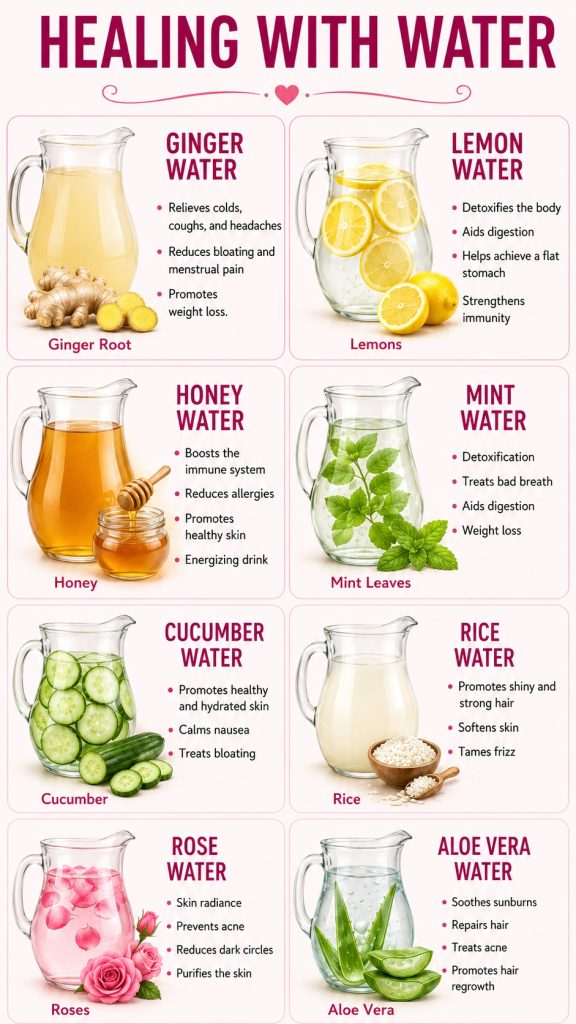
The phrase healing waters is marketing, not medicine. Ginger, lemon, honey, mint, cucumber, rice, rose and aloe infusions do not detoxify organs, burn fat, cure disease or repair hair. What they genuinely do is make water taste good enough that you drink more of it and less of something sweetened, which is a modest but real benefit.
This guide gives each one an honest verdict, and it is more useful than the usual list because three of these eight carry safety issues that are almost never mentioned. Rice water concentrates the arsenic you would normally pour down the sink. Whole leaf aloe is classified as a possible human carcinogen. Honey can cause infant botulism. Those matter far more than any benefit claimed for them.
Medical Disclaimer: This article is educational and is not medical advice. No infused water diagnoses, cleanses or treats any condition. Speak to a qualified professional before regularly using herbal preparations, particularly during pregnancy or breastfeeding, or with diabetes, kidney disease or regular medication. Read our medical disclaimer, editorial policy and fact checking policy.
What Healing Waters Can and Cannot Do
Your body already has two highly effective detox organs, the liver and the kidneys, and neither needs a beverage to work. No infusion removes toxins, dissolves fat or fixes skin from the inside.
What an infusion can do is narrow. It adds flavour without sugar, which helps some people drink more fluid. It displaces soft drinks, which is where the actual health gain sits. And in one or two cases the ingredient has modest evidence behind it for a specific symptom. That is the whole list. Everything beyond it is invention.
If you want the genuine version of the detox idea, see our guide to the foods that support your body’s natural detox system.
How Much Water You Actually Need
The National Academies found that adequately hydrated adults take in roughly 3.7 litres of total water a day for men and 2.7 litres for women. Two points get lost from that figure.
- That is total water, not glasses of water. About 80 percent comes from all drinks and 20 percent from food
- Everything counts. Tea, coffee, milk and infused water all contribute
- Thirst is a reasonable guide for most healthy adults, adjusted upward for heat, exercise and pregnancy
Since a fifth of your fluid arrives on a plate, our list of the most hydrating foods ranked by water content is a practical companion to any of these drinks.
1. Ginger Water
Ginger has the best evidence of the eight, and it is specific: nausea. Research supports ginger for pregnancy related nausea, with trials generally using about 1,000 to 1,500 mg of dried ginger a day. Results are less consistent for other kinds of nausea.
The catch is the same one that runs through this entire list. Those trials used concentrated capsules. Three slices steeped in a mug deliver a small fraction of that dose, so treat ginger water as a pleasant drink that may take the edge off mild queasiness rather than a treatment.
- How to make it: 3 or 4 thin slices in a cup of hot water, steeped 5 to 10 minutes
- Possible effects: heartburn, stomach discomfort, mouth irritation
- Check first if: you take blood thinners or are pregnant and considering supplement doses
- Verdict: the only one here with a genuine, narrow evidence base
2. Lemon Water
Lemon water has no liver, kidney or fat burning effect whatsoever. A tablespoon of lemon juice provides about 3 calories and roughly 6.5 mg of vitamin C, which is around 7 percent of a day’s requirement. Useful, unremarkable.
The part worth knowing is dental. Enamel starts dissolving below about pH 4.0, and lemon water sits near pH 3. That is closer to soft drink territory than to plain water, which is why the habit of sipping it all morning is the problem rather than the drink itself.
- Drink it in one sitting rather than nursing it for an hour
- Have it with a meal, when saliva flow is highest
- Rinse with plain water afterwards, and wait 30 minutes before brushing
- Verdict: a flavour trick with a real dental caveat and no metabolic benefit
3. Honey Water
Honey water is sugar water with a better reputation. A teaspoon of honey carries about 21 calories and 5.8 g of sugar, and a tablespoon about 64 calories and 17 g. For context, the American Heart Association suggests a daily added sugar ceiling of about 25 g for women and 36 g for men, so a generous spoonful is a meaningful share of it.
Warm honey water is genuinely soothing on a sore throat, and honey has decent evidence for easing cough in children over one year. It does not boost immunity, cure allergies or clear skin.
The one rule that matters: never give honey to a baby under 12 months, in food, water or on a dummy. Honey can contain spores that cause infant botulism, a serious illness. This applies to raw, pasteurised and organic honey alike.
- How to make it: half to one teaspoon in warm, not boiling, water
- Verdict: soothing and pleasant, but count it as added sugar
4. Mint Water
Mint water is the most straightforward item on the list. It adds aroma and a cooling sensation for zero calories and zero sugar, and it is genuinely nice in hot weather. It does not detoxify anything or aid weight loss.
Two honest notes. Mint relaxes the valve at the top of the stomach, so it can make reflux worse rather than better, which is the opposite of what it is usually recommended for. And persistent bad breath is a reason to see a dentist, not to drink more mint, since it usually signals gum disease, decay or dry mouth.
- How to make it: lightly bruise 4 to 6 washed leaves, refrigerate 30 minutes
- Verdict: the best pure flavour option here, with no downside unless you have reflux
Mint and cucumber both feature in our guide to body cooling foods for summer.
5. Cucumber Water
Cucumber is about 95 percent water and provides roughly 15 calories per 100 g, which makes it the most hydrating vegetable you can buy. Slices in a jug contribute almost nothing nutritionally, though, since you are drinking the water rather than eating the cucumber. Eat the slices afterwards if you want the fibre and potassium.
It does not produce glowing skin. Skin appearance responds to sleep, sun exposure, smoking, genetics and overall diet, and no single drink overrides those. Our guide to anti aging foods for skin covers what actually has evidence.
- How to make it: 5 or 6 washed slices per jug, refrigerated 30 to 60 minutes
- Verdict: pleasant and harmless, with hydration as the only real benefit
6. Rice Water
Here is the one that deserves a rethink. Rice takes up inorganic arsenic from soil and water more than most crops. The standard advice for reducing it is to cook rice in excess water and drain it, because that removes 40 to 60 percent of the inorganic arsenic.
Which means the arsenic ends up in the cooking water. Drinking rice water is, in effect, drinking the fraction you are advised to throw away. This is not a reason to panic over one glass, but it is a strong reason not to make a daily habit of it, and a very strong reason not to give it to young children. For context, one analysis found 80 percent of rice milk samples exceeded the 10 micrograms per litre inorganic arsenic standard applied to drinking water. The FDA page on arsenic in food sets out the wider picture.
- As a hair rinse: broadly fine, and it may temporarily smooth the hair shaft, but evidence for growth or repair is thin
- As a drink: not something to do daily, and best avoided for children
- If you do use it: refrigerate promptly and discard it if the smell or appearance changes
- Verdict: the one on this list where the popular advice runs against the safety advice
7. Rose Water
Rose water is a fragrance and a flavouring, and it is pleasant as both. There is not good evidence that it prevents acne, removes dark circles or purifies skin.
The practical point is a product one. Cosmetic rose water and culinary rose water are different things. Cosmetic versions may contain preservatives, fragrance compounds and alcohol that are not meant to be swallowed. Only drink something explicitly labelled food grade.
- Patch test any new product on a small area for several days before wider use
- Stop if you get burning, itching, redness, swelling or a rash
- Verdict: lovely in cooking and as a facial mist, with no proven skin clearing effect
8. Aloe Vera Water
This is the one with a real safety file, and the distinction between aloe products is not a technicality.
An aloe leaf contains inner gel, and beneath the rind a bitter yellow latex rich in aloin, a strong laxative. In a two year National Toxicology Program study, non decolourised whole leaf aloe extract caused tumours of the large intestine in rats, and the International Agency for Research on Cancer classifies whole leaf aloe extract as possibly carcinogenic to humans, in Group 2B. The FDA also ruled in 2002 that aloe is no longer recognised as safe and effective as an over the counter laxative. The NCCIH summary on aloe vera covers this in full.
Commercial drinking products are usually decolourised, meaning the aloin is filtered out, often reducing it by a factor of up to 100. That is the version to buy. Slicing a houseplant into a jug is not, because that is precisely the unpurified whole leaf preparation the concern attaches to.
- Buy a commercially prepared, decolourised or purified drink, and check the added sugar
- Do not make homemade whole leaf aloe drinks or use it as a laxative or weight loss aid
- Avoid oral aloe in pregnancy and breastfeeding, and check with your doctor if you take medicines or manage kidney, digestive or blood glucose conditions
- Verdict: the one where product choice genuinely matters for safety
Which Healing Waters Are Worth It
| Water | What it really does | Evidence | Main caution |
|---|---|---|---|
| Ginger | May ease mild nausea | Good, at capsule doses | Reflux, blood thinners |
| Mint | Flavour, cooling, no sugar | None needed | Can worsen reflux |
| Cucumber | Hydration and flavour | None for skin claims | None |
| Lemon | Flavour, small vitamin C | None for detox or fat | Enamel erosion near pH 3 |
| Rose | Fragrance and flavouring | None for skin claims | Use food grade only |
| Honey | Soothes throat and cough | Fair for cough over age 1 | Never under 12 months |
| Aloe | A commercial beverage | None for the usual claims | Whole leaf is IARC Group 2B |
| Rice | Traditional hair rinse | Thin, and none for drinking | Concentrates arsenic |
Food Safety When You Infuse Water
Fresh produce sitting in warm water for hours is a growth medium. This is the most likely way an infused water actually harms you, and it is entirely avoidable.
- Wash hands, produce and equipment before you start
- Refrigerate the jug rather than leaving it on the counter
- Remove the fruit and herbs after about 12 hours, and drink the water within 24
- Make only what you will finish, in a clean sealed container
- Discard anything cloudy, slimy or off smelling
- Use water you would drink plain, especially when travelling
Who Should Take Extra Care
- Babies under 12 months: no honey, in any form
- Pregnancy and breastfeeding: avoid oral aloe, and discuss ginger at supplement doses
- Young children: avoid regular rice water because of arsenic
- Diabetes: count honey and any sweetened aloe drink as sugar
- Kidney or heart disease, or a fluid restriction: follow the limit you were given rather than a general intake target
- Reflux: mint and strong ginger may both aggravate it
- Blood thinners: raise concentrated ginger with your doctor
Frequently Asked Questions
What are healing waters and do they work?
Healing waters is a marketing term for infused waters such as lemon, ginger, cucumber or mint water. They do not heal, detoxify or cure anything. Their genuine value is flavour without sugar, which helps some people drink more fluid and fewer soft drinks. Ginger is the only one here with a specific evidence base, and that is for nausea.
Can infused water detox your body?
No. The liver and kidneys perform detoxification continuously and need no help from a drink. No infused water removes toxins, dissolves body fat or cleanses an organ. Any product marketed as a detox water is making a claim it cannot support.
Is lemon water bad for your teeth?
It can be with frequent sipping. Enamel begins to dissolve below about pH 4.0 and lemon water sits near pH 3. The habit matters more than the drink, so have it in one sitting rather than over an hour, ideally with a meal, rinse with plain water afterwards and wait 30 minutes before brushing.
Is it safe to drink rice water?
Occasionally, yes, but not as a daily habit. Rice absorbs inorganic arsenic, and the standard advice is to cook rice in excess water and drain it because that removes 40 to 60 percent of the arsenic into the cooking water. Drinking rice water means drinking that fraction. It is best avoided for young children.
Is aloe vera water safe to drink?
Commercially prepared decolourised aloe drinks are generally considered acceptable for short term use. Homemade whole leaf preparations are a different matter: non decolourised whole leaf aloe extract caused intestinal tumours in a two year rodent study and is classified by IARC as possibly carcinogenic to humans, Group 2B. Avoid oral aloe in pregnancy and breastfeeding.
Why can babies not have honey water?
Honey can contain Clostridium botulinum spores, which an infant gut cannot yet handle, and these can cause infant botulism. Never give honey to a child under 12 months in food, water or on a dummy. This applies to raw, organic and pasteurised honey equally.
How much water should I drink each day?
The National Academies found adequately hydrated adults take in about 3.7 litres of total water daily for men and 2.7 litres for women. That is total water from all sources, with roughly 80 percent from drinks and 20 percent from food. Thirst is a reasonable guide for most healthy adults, adjusted upward for heat, exercise and pregnancy.
Does ginger water help with nausea?
Possibly, for mild nausea. Ginger has reasonable evidence for pregnancy related nausea, though trials generally used 1,000 to 1,500 mg of dried ginger daily in capsule form. A few slices steeped in water deliver far less, so treat it as a comforting drink rather than a treatment, and discuss supplement doses in pregnancy with your midwife or doctor.
How long does infused water keep?
Keep it refrigerated, remove the fruit and herbs after about 12 hours, and drink the water within 24 hours. Fresh produce sitting in water at room temperature allows bacteria to multiply, which is the most realistic way an infused water could actually make you unwell. Discard anything cloudy, slimy or off smelling.
Is infused water better than plain water?
Not nutritionally. Plain water hydrates just as well with no acid, sugar or added ingredients. Infused water is better only in the sense that it may get you to drink more or to skip a sweetened drink. If you enjoy plain water, there is nothing to gain by switching.
Related reading: for more drink options see our 4 refreshing morning drinks, the wider guide to 9 morning drinks and what they actually do, and 10 infused water recipes.
Final Thoughts
Judged honestly, these eight healing waters sort into three groups. Mint and cucumber are simply nice ways to drink more water, with nothing to worry about. Ginger and honey have narrow, genuine uses, for mild nausea and for a sore throat. Lemon, rose, rice and aloe all come with a caveat that matters more than any benefit attached to them.
None of them heals anything, and plain water remains the simplest option. Choose an infusion because you like the taste and it helps you skip a fizzy drink. That is a good enough reason on its own, and it happens to be the only one the evidence supports. For other drink choices, see our guides to healthy drinks that may support weight loss and natural drinks and liver health.
Edited by Dr. Obeydur Rahman, MBBS, MD in Medicine.

Pingback: 9 Morning Drinks and What They Actually Do