Food will not cure you, but it can help you at the margins, and the best foods for common health concerns live in that gap. The difference between the useful pairings and the useless ones comes down to numbers. Two kiwis an hour before bed cut sleep onset time by 35 percent in one trial. One avocado a day for six months in 1,008 people did nothing at all to visceral fat. Same category of claim, opposite outcomes.
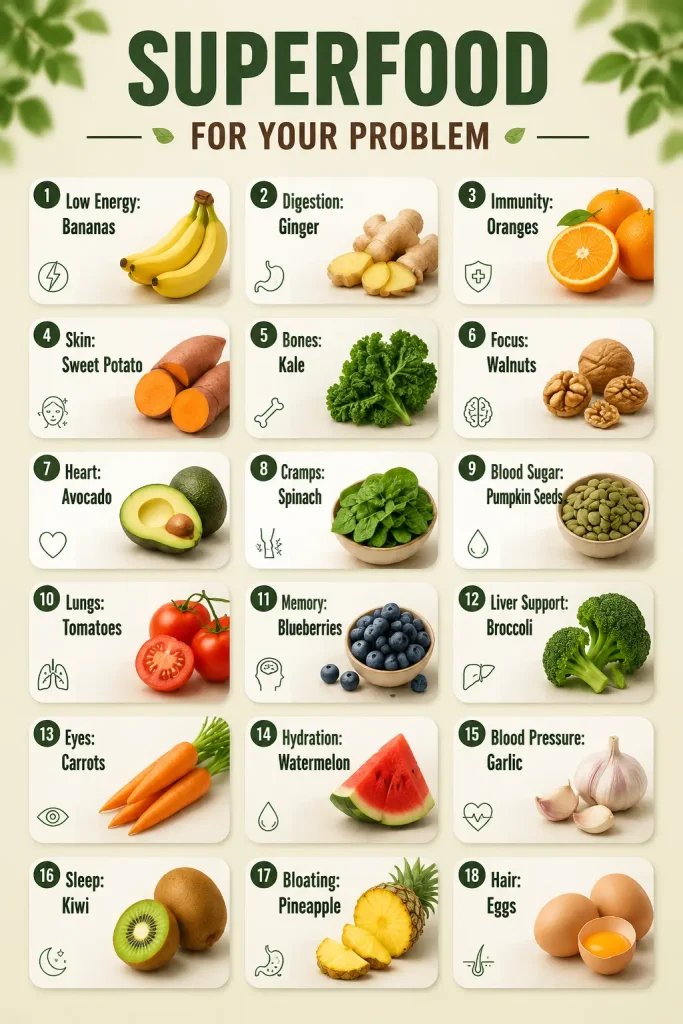
This guide pairs 18 everyday complaints with a food worth eating for each, gives the amount you actually get per serving, and grades the evidence honestly. Six of these pairings are strong. Five are weak, and this page says which.
Medical Disclaimer: This is educational and is not medical advice. No food here replaces medication or treats a diagnosed condition. Speak to a doctor or dietitian about persistent symptoms, supplements or dietary changes. Read our medical disclaimer, editorial policy and fact checking policy.
How to Read This List of Best Foods for Common Health Concerns
Five rules make the difference between using this list well and wasting your time with it.
- Supplements are not food. This is the single biggest error in nutrition writing. The garlic trials below used concentrated extracts, not cloves. Trial results on extracts do not transfer to your dinner
- Small effects stay small. A food that moves blood pressure a few points helps. It does not treat hypertension
- Patterns beat single foods. The avocado trial below is the clearest demonstration. Adding one good food to an unchanged diet changed almost nothing
- Most effects take weeks. Ginger for nausea works within an hour. Nearly everything else here needs eight weeks before you judge it
- Superfood means nothing. No regulator defines it and no food qualifies. It is a marketing word
Best Food for Low Energy: Bananas
One medium banana of 118 g gives 105 calories, 27 g of carbohydrate, 422 mg of potassium and 0.4 mg of vitamin B6, which is roughly a quarter of a day’s B6. Your brain and muscles both run on glucose, and B6 is a cofactor in turning food into usable energy.
Evidence: strong for the mechanism, useless for chronic fatigue.
Try this: One about 30 minutes before a workout or a long afternoon.
Tiredness lasting more than a few weeks needs blood tests, not fruit. Anaemia, thyroid disease and sleep apnoea all present this way, and our guide to signs of nutrient deficiencies covers what to look for.

Best Food for Digestion and Nausea: Ginger
Ginger is the best evidenced item on this entire page. Randomised trials support it for nausea in pregnancy, motion sickness and chemotherapy, and it speeds gastric emptying, which eases the heavy feeling after a large meal.
The dose matters and most recipes miss it. Trials use 1,000 to 1,500 mg of dried ginger a day. One teaspoon of freshly grated ginger is about 2 g fresh, and fresh ginger is roughly 79 percent water, so that is around 420 mg of dried equivalent. You need considerably more than a token slice.
Evidence: strong. Multiple randomised trials and meta analyses.
Try this: Steep a generous amount of fresh slices in hot water for 10 minutes. Ask your doctor before large amounts if you take anticoagulants.
Best Food for Immune Support: Oranges
One medium orange of 131 g provides 70 mg of vitamin C, which covers the 75 mg daily target for women almost entirely, plus 3.1 g of fibre. Your body cannot make vitamin C or store much of it.
Now the honest part. The NIH Office of Dietary Supplements notes that vitamin C does not prevent colds in the general population. The Cochrane review of 31 comparisons covering 9,745 cold episodes found that regular vitamin C shortened colds by 8 percent in adults and 14 percent in children. On a seven day cold that is about half a day. Taking it after symptoms start showed no consistent benefit at all.
Evidence: strong that you need vitamin C, weak that extra stops you getting ill.
Try this: Whole oranges rather than juice. Juice loses the fibre and concentrates the sugar.
Best Food for Skin Health: Sweet Potato
One medium baked sweet potato of 150 g supplies about 1,440 mcg RAE of vitamin A as beta carotene, which is roughly 160 percent of a day’s requirement, along with 5 g of fibre for 135 calories. Vitamin A drives skin cell turnover and repair.
Cucumber gets the credit in most lists, but that comes from putting slices on your eyes rather than from eating them.
Evidence: moderate. Vitamin A clearly matters for skin. Diet effects on visible ageing stay modest, and daily sunscreen has far better trial evidence than any food.
Try this: Roast wedges with olive oil, since fat substantially improves beta carotene absorption. Our guide to foods that support skin as you age goes deeper.
Best Food for Bone Strength: Kale
Here is the number that settles the kale versus spinach argument. Spinach holds about 99 mg of calcium per 100 g and kale about 150 mg, so spinach looks competitive on paper. But spinach oxalates block absorption almost completely.
- Kale calcium absorbs at roughly 49 percent, so 100 g delivers about 74 mg
- Spinach calcium absorbs at roughly 5 percent, so 100 g delivers about 5 mg
That is close to a fifteenfold difference from foods that look similar on a label. Kale also gives about 82 mcg of vitamin K per cup of raw chopped leaves, near a full day’s adequate intake, and vitamin K helps direct calcium into bone.
Evidence: moderate. Nutrients clearly support bone. Diet alone will not treat osteoporosis.
Try this: Massage raw kale with olive oil and lemon, or add it to soup. If you take warfarin, keep vitamin K intake consistent rather than avoiding it.
Best Food for Focus and Concentration: Walnuts
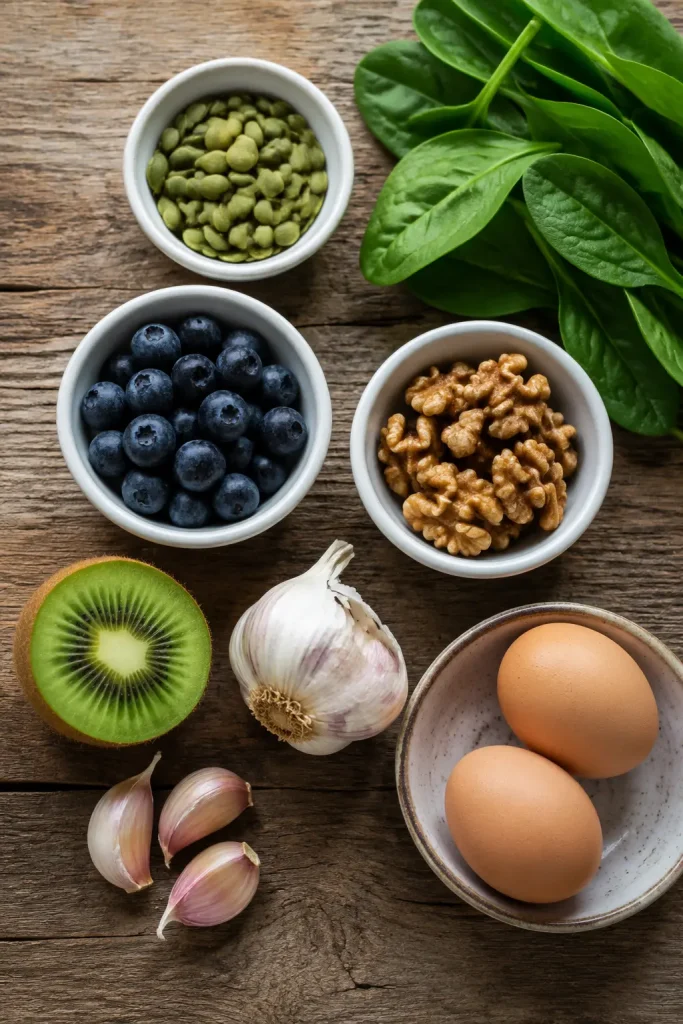
A 28 g handful gives 183 calories and 2.5 g of ALA, the plant omega 3, which is the highest of any common nut. A few small short studies link walnut intake with better scores on cognitive tests.
Evidence: weak to moderate. Promising rather than proven, and the effect sizes are small.
Try this: A small handful daily. Store them in the fridge, since their oils go rancid quickly at room temperature.
Best Food for Heart Health: Avocado
One large avocado of 200 g holds 970 mg of potassium, 13.4 g of fibre and about 20 g of monounsaturated fat for 320 calories. On paper that is an excellent profile.
The largest trial ever run on it is a useful reality check. The Habitual Diet and Avocado Trial gave 1,008 adults with elevated waist circumference one large avocado a day for six months and measured visceral fat by MRI. The primary result was null. Visceral fat did not budge, and neither did liver fat, inflammation, blood pressure, glucose or waist size.
Two things did happen. Total cholesterol fell by 2.9 mg/dL and LDL by 2.5 mg/dL against the control group, both modest. And despite adding roughly 280 calories a day, participants gained no weight, because the avocado displaced other food.
Evidence: moderate for a small LDL effect, and clearly negative for belly fat. The trial authors concluded that changing your overall pattern, rather than adding one food, is what moves cardiometabolic risk. That conclusion applies to every food on this page.
Try this: Use half an avocado in place of butter or mayonnaise, so it replaces saturated fat rather than adding to your day. Our guide to foods for heart, liver, brain and gut health covers the wider pattern.
Best Food for Muscle Cramps: Spinach
One cup of cooked spinach at 180 g delivers 157 mg of magnesium, around 40 percent of a day’s requirement, and about 840 mg of potassium, for just 41 calories.
Straight talk on this pairing. Trials of magnesium for leg cramps come back mixed and mostly disappointing, particularly in older adults. Dehydration and overuse cause far more cramps than diet does.
Evidence: weak. Fix fluid intake first.
Try this: A handful into eggs or a smoothie. It is worth eating for the magnesium and potassium regardless of the cramp question.
Best Food for Steady Blood Sugar: Pumpkin Seeds
A 28 g serving gives 166 mg of magnesium, 8.5 g of protein and 157 calories with very little carbohydrate. That magnesium figure is around 40 percent of a day in a single spoonful, one of the densest sources in the food supply.
Population studies link higher magnesium intake with lower type 2 diabetes risk, but that is observational data, so treat it as a pattern rather than proof.
Evidence: moderate for blunting the glucose rise when eaten alongside carbohydrate. Not a diabetes treatment.
Try this: A spoonful on yogurt or salad. Never change medication based on food. Our guide to foods for blood sugar management has the full list.
Best Food for Lung Health: Tomatoes
This pairing has a specific study behind it. Researchers followed more than 650 adults across Germany, Norway and the UK for 10 years, measuring lung function twice. Higher tomato intake tracked with slower decline in both FEV1 and FVC, and the effect was strongest in former smokers, who showed roughly 80 mL less decline over the decade on a diet high in tomatoes and fruit.
One medium tomato carries around 3,200 mcg of lycopene. This was observational, so tomatoes were not proven to cause the effect.
Evidence: moderate but observational.
Try this: Cooked beats raw here. Heat plus a little oil both improve lycopene absorption.
Best Food for Memory: Blueberries
One cup at 148 g gives 84 calories, 3.6 g of fibre and the anthocyanins behind the colour. Small trials in older adults reported modest gains on memory tasks after regular intake.
Evidence: weak to moderate. The studies are small and short, but the direction is consistent and the food is harmless.
Try this: Frozen blueberries hold nearly identical nutrition and cost far less. See also our guide to foods that support healthy ageing.
Best Food for Liver Support: Broccoli
One cup of cooked broccoli at 156 g provides 101 mg of vitamin C, more than a full day, plus 5.1 g of fibre for 55 calories. Its sulforaphane activates the enzyme systems your liver uses to process waste.
The word detox belongs nowhere near this. Your liver and kidneys already do that work continuously and no food speeds them up.
Evidence: moderate in lab and animal work, early in humans.
Try this: Steam lightly. Long boiling destroys sulforaphane. Our guides to foods that support liver health and your body’s natural detox system explain the biology properly.
Best Food for Eye Health: Carrots
One medium carrot of 61 g gives about 509 mcg RAE of vitamin A, over half a day’s requirement, for 25 calories. Vitamin A is genuinely required for low light vision.
The famous carrot story came from British wartime propaganda. Carrots prevent the deficiency that causes night blindness. They will not sharpen normal vision. For age related eye protection, leafy greens actually beat carrots, because the lutein and zeaxanthin in kale and spinach accumulate in the retina.
Evidence: strong for deficiency prevention, weak for improving normal sight.
Try this: Eat carrots with a little fat so the beta carotene absorbs.
Best Food for Hydration: Watermelon
Watermelon is 91 percent water, so a cup at 152 g is roughly 139 mL of fluid for 46 calories, plus potassium and lycopene. Food supplies about a fifth of daily fluid intake, so this genuinely counts.
Evidence: strong. Water content is measurable fact rather than inference.
Try this: Cube and freeze it. Our full list of the most hydrating foods ranked by water content covers 15 more.
Best Food for Blood Pressure: Garlic
Garlic attracts more attention than anything else on this list, and the evidence needs a careful read.
Some meta analyses of garlic supplements report systolic drops of around 8 mmHg in people with hypertension. A Cochrane review of the same area concluded the evidence was insufficient to draw firm conclusions. NCCIH summarises that split.
The detail almost every article omits: those trials used concentrated aged garlic extract at supplement doses. Two cloves in your pasta sauce is a different thing entirely, and no trial has tested it.
Evidence: mixed for supplements, unknown for cooking garlic.
Try this: Cook with it freely. Crush cloves and let them sit 10 minutes before heating. Garlic supplements raise bleeding risk with blood thinners, so ask a pharmacist first. For better evidenced options see our review of herbs that may support healthy blood pressure.
Best Food for Better Sleep: Kiwi
Two kiwis at 138 g give 84 calories, 4.1 g of fibre and 128 mg of vitamin C, well over a full day.
The sleep claim traces to one Taiwanese study in which 24 adults ate two kiwis an hour before bed for four weeks. Sleep onset time fell 35 percent, total sleep time rose 13 percent and sleep efficiency rose 5 percent.
Read those numbers with the study design in mind. Twenty four people, 22 of them women, and no control group, so everyone knew they were eating kiwi. That design cannot separate the fruit from expectation. Nobody has replicated it convincingly since.
Evidence: weak but interesting, and the intervention is cheap and harmless.
Try this: Two kiwis about an hour before bed. Sleep problems lasting more than a month deserve a doctor rather than a fruit, and a consistent bed and wake time outperforms any food. See our daily wellness habits guide.
Best Food for Bloating: Pineapple
One cup at 165 g gives 83 calories, 79 mg of vitamin C and bromelain, an enzyme that breaks down protein. Some people find it eases the heavy feeling after a protein rich meal.
Fresh only. Canning heats the fruit and destroys bromelain.
Evidence: weak to moderate.
Try this: A few fresh cubes after dinner. Persistent bloating with pain, weight loss or a change in bowel habit needs medical attention rather than fruit.
Best Food for Hair Health: Eggs
Two large eggs give 12.6 g of complete protein and about 20 mcg of biotin for 143 calories. Hair is almost entirely protein, and low protein intake genuinely does affect it.
The biotin supplement warning is the important part of this section. Biotin pills only help people who are actually deficient, which is rare. High dose biotin also interferes with immunoassay lab tests. The FDA warns that it can produce falsely low troponin results, the marker used to diagnose heart attacks, and it has received a report of a patient death linked to an incorrect troponin reading caused by biotin. Thyroid panels are affected too.
Evidence: strong that protein matters, weak that extra biotin helps anyone with normal levels. Eat eggs and skip the pills. If you do take biotin, tell whoever draws your blood.
Try this: Two eggs at breakfast. Our high protein breakfast ideas build on this.
All 18 Pairings, Graded
| Concern | Food | Key number per serving | Evidence |
|---|---|---|---|
| Nausea | Ginger | Trials use 1,000 to 1,500 mg dried | Strong |
| Hydration | Watermelon | 91 percent water | Strong |
| Low energy | Banana | 422 mg potassium, 27 g carb | Strong mechanism |
| Immune support | Orange | 70 mg vitamin C, colds 8 percent shorter | Strong need, weak effect |
| Night vision | Carrot | 509 mcg RAE vitamin A | Strong for deficiency |
| Hair | Eggs | 12.6 g protein per 2 eggs | Strong for protein |
| Bone strength | Kale | Calcium absorbs at 49 percent | Moderate |
| Skin | Sweet potato | 1,440 mcg RAE vitamin A | Moderate |
| Blood sugar | Pumpkin seeds | 166 mg magnesium per 28 g | Moderate |
| Lung function | Tomato | 80 mL less decline over 10 years | Moderate, observational |
| Liver support | Broccoli | 101 mg vitamin C per cup | Moderate, early |
| Cholesterol | Avocado | LDL down 2.5 mg/dL, no fat loss | Moderate, small |
| Memory | Blueberries | 3.6 g fibre per cup | Weak to moderate |
| Focus | Walnuts | 2.5 g ALA per 28 g | Weak to moderate |
| Bloating | Pineapple | Bromelain, fresh only | Weak to moderate |
| Sleep | Kiwi | Onset 35 percent faster in 24 people | Weak |
| Blood pressure | Garlic | 8 mmHg, but from supplements | Mixed |
| Cramps | Spinach | 157 mg magnesium per cup cooked | Weak |
If you only act on the top six rows you will have captured most of the real value on this page.
When to See a Doctor Instead
Some symptoms need testing rather than a grocery list.
- Tiredness lasting more than a few weeks
- Chest pain, pressure or shortness of breath
- Unplanned weight loss
- Blood in stool or urine
- Bloating with pain or vomiting that keeps returning
- Sudden vision changes
- Memory loss that affects daily life
- Sleep problems lasting more than a month
Food supports health. Testing finds problems. The two are not interchangeable.
Frequently Asked Questions
Which food on this list has the strongest research?
Ginger for nausea. Randomised trials support it for nausea in pregnancy, motion sickness and chemotherapy, which puts it well ahead of everything else here. The catch is dose: trials use 1,000 to 1,500 mg of dried ginger a day, and one teaspoon of freshly grated ginger is only about 420 mg of dried equivalent, so a token slice will not do it.
Does eating an avocado a day reduce belly fat?
No, and this has been tested properly. The Habitual Diet and Avocado Trial gave 1,008 adults with elevated waist circumference one large avocado daily for six months and measured visceral fat by MRI. The result was null, as were liver fat, inflammation, blood pressure and waist size. Total cholesterol fell 2.9 mg/dL and LDL 2.5 mg/dL, both modest. Notably, participants gained no weight despite the extra 280 calories.
Does vitamin C prevent colds?
Not in the general population. The Cochrane review covering 31 comparisons and 9,745 cold episodes found regular vitamin C did not reduce how often people caught colds, but shortened them by 8 percent in adults and 14 percent in children. On a seven day cold that is roughly half a day. Taking vitamin C after symptoms begin showed no consistent benefit.
Is kale really better than spinach for calcium?
Yes, by a wide margin, and the reason is absorption rather than content. Spinach holds about 99 mg of calcium per 100 g and kale about 150 mg, which looks close. But spinach oxalates block absorption, so only around 5 percent gets through against roughly 49 percent from kale. That works out to about 5 mg absorbed from spinach versus about 74 mg from kale per 100 g.
Does garlic lower blood pressure?
The evidence is genuinely split. Some meta analyses of garlic supplements report systolic reductions of around 8 mmHg in people with hypertension, while a Cochrane review concluded the evidence was insufficient for firm conclusions. The detail most articles omit is that those trials used concentrated aged garlic extract, not cooking garlic. No trial has tested cloves in food.
Do kiwis actually help you sleep?
The claim rests on one small study. Twenty four adults, 22 of them women, ate two kiwis an hour before bed for four weeks, and sleep onset time fell 35 percent while total sleep time rose 13 percent. There was no control group, so the fruit cannot be separated from expectation, and nobody has replicated it convincingly. It is harmless to try, but a consistent bedtime does more.
Should I take biotin supplements for hair?
Not unless you are deficient, which is rare, and there is a specific safety reason to be careful. High dose biotin interferes with immunoassay lab tests. The FDA warns it can cause falsely low troponin results, the marker used to diagnose heart attacks, and has received a report of a patient death linked to this. Thyroid tests are affected too. Eat eggs instead, and tell your clinician if you take biotin.
Can food replace my medication?
No. Every effect on this page is small compared with a prescribed drug. A food that shifts blood pressure a few points is helpful alongside treatment, not instead of it. Never stop or reduce a medication because you added a food, and talk to your doctor before changing anything.
What is a superfood?
Nothing official. No regulator defines the term and no food qualifies by any standard, so it functions purely as marketing. Whole fruits, vegetables, nuts, fish and legumes all deserve a place in your diet without the label, and the research consistently shows that overall eating patterns predict health outcomes far better than any single item.
How long until I notice a difference?
Ginger for nausea works within an hour. Almost everything else on this list takes weeks to months, because nutrient status and cardiometabolic markers move slowly. Give any dietary change at least eight weeks before judging it, and pick two or three pairings that match your actual concerns rather than attempting all 18.
Related reading: for a broader list built the same way, see our 20 nutrient rich foods that support overall health and the vitamin food sources chart covering all 13 vitamins.
Put numbers on your own diet. Several habits on this page have a target you can calculate: our free health calculators cover fibre, protein, water, sodium, added sugar and more.
Final Thoughts on the Best Foods for Common Health Concerns
The best foods for common health concerns work by supporting normal function rather than fixing what is broken, and the numbers on this page show how modest that support usually is. Ginger for nausea and kale for absorbable calcium are worth acting on. Avocado gives you 2.5 mg/dL of LDL and no belly fat reduction. Garlic’s 8 mmHg came from supplements you are not taking. Kiwi’s sleep result came from 24 people with no control group.
The avocado trial holds the lesson for all 18 pairings. Adding one good food to an otherwise unchanged diet moved almost nothing across 1,008 people and six months. What changes outcomes is the overall pattern. So pick two or three that match what actually bothers you, eat them often enough to matter, and book a doctor visit for anything that lasts or worsens. That beats chasing whatever food the internet calls miraculous this month.
About the Author and Reviewer
Mezbaul Islam, MSc Nutrition owns and writes Simple Health Naturally. He researches each article from public health guidance, clinical guidelines and peer reviewed studies, and traces every figure back to a named source.
Dr. Obeydur Rahman, MBBS, MD in Medicine edits the articles, checks the sources cited and is responsible for the site’s editorial standards. MD in Medicine is the specialty for adult conditions such as liver disease, type 2 diabetes and high blood pressure.
Read more about our authors and reviewers or see our editorial policy.
Edited by Dr. Obeydur Rahman, MBBS, MD in Medicine.